EPA’s 2026-2027 fuel rule tightens biofuels market, boosts RIN demand
EPA’s new RFS rule adds 2.89 billion RINs of demand and strips out low-cost compliance options, squeezing refiners while lifting low-CI biofuel value.
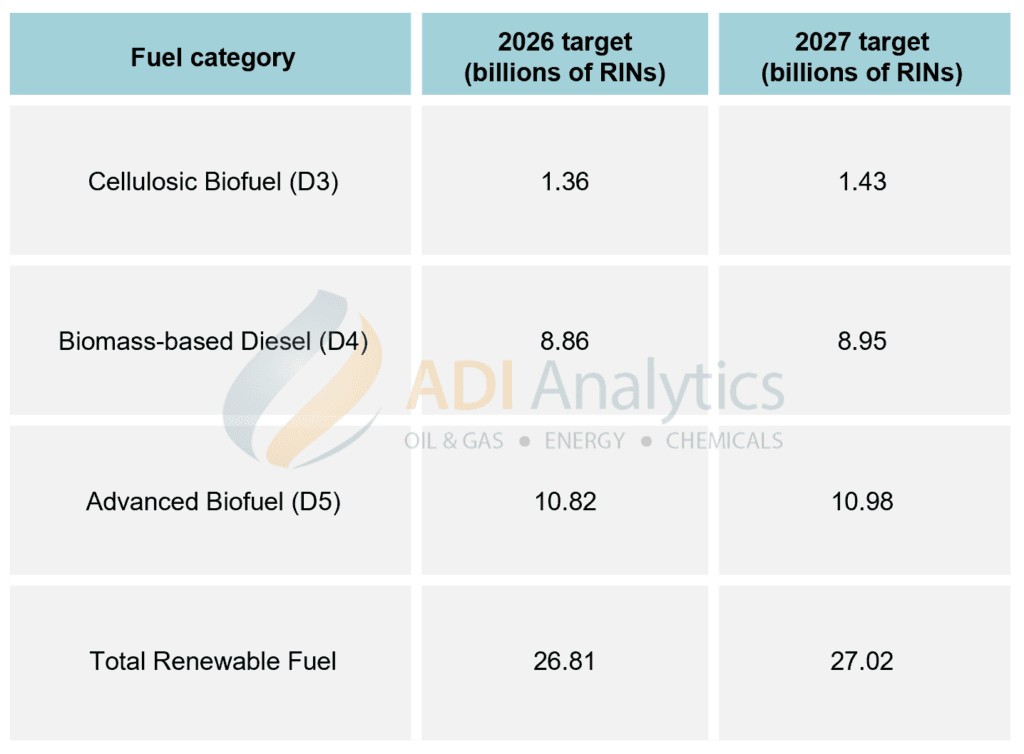
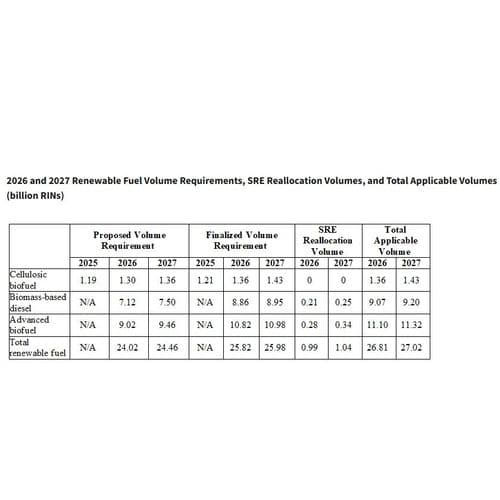
The U.S. Environmental Protection Agency on March 27 finalized 2026-2027 Renewable Fuel Standard volumes at 26.81 billion RINs for 2026 and 27.02 billion RINs for 2027, a setting ADI Analytics said has created one of the tightest compliance markets the U.S. biofuels sector has faced. EPA’s final Set 2 rule also restored 70% of the small-refinery-exemption gallons granted for 2023-2025 into future standards, adding an estimated 2.89 billion RINs of demand back into the system and leaving refiners with far less room to maneuver.
The practical effect is a squeeze on obligated parties. EPA removed renewable electricity as a compliance option and pushed cheaper foreign-import penalty relief out to 2028, which ADI said strips away flexibility that had softened RIN demand in prior years. That leaves refiners leaning harder on domestic liquid biofuels, especially ethanol, biodiesel and renewable diesel, just as the agency says the rule will require biodiesel and renewable diesel production and use to rise by more than 60% versus 2025 volumes.

The winners are likely to be low-carbon producers and the feedstock chain behind them. ADI said fuels with lower carbon intensity can capture more value across RINs, California’s LCFS market and the 45Z clean fuel production credit, making CI management a direct margin strategy rather than a side project. Ethanol plants that add carbon capture and storage, mechanical vapor recompression and membrane dehydration could cut facility CI by 25 to 30 points, ADI said, with a 100 MMgy plant potentially unlocking more than $70 million in incremental annual revenue.
The rule’s broader market signal is that compliance strategy now hinges on operational efficiency and carbon score, not just gallons. For traders, that means tighter spreads and more competition for domestic molecules. For feedstock suppliers, it points to stronger pull from corn, soybean oil and other inputs tied to lower-CI production pathways. EPA said the rule should reduce U.S. dependence on foreign oil by roughly 300,000 barrels per day over 2026-2027, generate more than $10 billion for rural economies and support more than 100,000 jobs.
Industry reaction split along familiar lines. Growth Energy said the final rule opened the market for more than 15 billion gallons of conventional biofuel in 2026 and 2027 and brought clarity after the 2025 proposal process, which began with a June 17 proposal and a July 8 public hearing. AFPM said the rule was the largest and most expensive RFS iteration in history; Chet Thompson called it “baffling” and said it would worsen consumer fuel-price pressure. AFPM has since said it filed a lawsuit in the D.C. Circuit. The National Corn Growers Association said the EPA numbers gave corn farmers certainty and reinforced the push for year-round E15, a fight that now sits alongside the new RIN squeeze and the 45Z race to lower CI.
This article was produced by Prism’s automated news system from verified source data, official records, and press releases, then run through automated quality and moderation checks before publishing. The system is built and supervised by the people who set the standards it runs under. Read our full AI policy.
Know something we missed? Have a correction or additional information?
Submit a Tip