Summer travel season tests whether sustainable aviation fuel can scale
Air travel’s peak season is turning SAF from policy target to operational test, with 3 billion gallons a year due by 2030 and supply still the choke point.

The summer travel rush is forcing sustainable aviation fuel out of the policy realm and into day-to-day operations. Airlines, fuel suppliers and airport systems now have to prove that SAF can move beyond small, symbolic volumes and into routine commercial use at prices and logistics that do not break the network.
That is exactly what the federal SAF Grand Challenge was built to test. The U.S. Department of Energy, the U.S. Department of Agriculture and the U.S. Department of Transportation launched the initiative in September 2021 through a memorandum of understanding, then published a roadmap in September 2022 and an implementation framework in 2024. The program’s core targets are blunt: cut aviation fuel life-cycle emissions by at least 50%, produce 3 billion gallons of SAF a year by 2030, and meet 100% of domestic aviation fuel demand with SAF by 2050.
What the Grand Challenge is trying to change
The point of the Grand Challenge is not simply to find low-carbon molecules. It is to coordinate research, development, demonstration and deployment across USDA, DOE, DOT and later FAA implementation, while bringing in industry, academia and other government stakeholders that can help scale production. The September 2022 roadmap was developed with DOE, DOT, FAA and USDA input, drawing on workshops and feedback from stakeholders across government, academia, nongovernmental organizations and industry.
That matters because SAF has always had a dual problem: supply is too small and the cost curve is too steep. The government’s framework treats both as binding constraints, not side issues. In the 2024 Implementation Framework, the agencies said current federal capabilities exist, but so do gaps that will require more effort, more data and more public-private partnerships if the roadmap goals are going to be met.
Why summer travel changes the equation
Summer demand turns those gaps into visible bottlenecks. When airlines schedule more flights and fuel burn rises across a concentrated period, SAF is no longer judged only on project announcements or pilot deliveries. It is tested on whether volumes can show up consistently, whether procurement teams can secure offtake without straining budgets, and whether airport-side handling can support blending and distribution at something closer to mainstream scale.
The result is a real market stress test. If SAF supply remains thin, airlines will be forced to treat it as a premium compliance or branding instrument. If it can cover a larger share of summer uplift at workable prices, the sector begins to look less like a demonstration program and more like an emerging fuel market with repeat customers, repeat logistics and repeat contracting.
What the federal timeline says about scale
The federal timeline shows how long the runway still is. The 2021 memorandum of understanding established the interagency commitment, the 2022 roadmap translated that commitment into a set of production and emissions targets, and the 2024 implementation framework clarified what capabilities already exist and where the holes remain. On January 13, 2025, federal agencies said they had released new funding opportunities and initiatives, provided technical assistance, expanded interagency collaboration and improved data, modeling and analysis.
That progress report signals movement, but not completion. In practice, it says Washington has been building the scaffolding around SAF supply chains rather than declaring victory on commercialization. The 2050 goal to meet all domestic aviation fuel demand with SAF is especially ambitious, and the 2030 target of 3 billion gallons a year still implies a scale-up far beyond today’s market.
The bottlenecks that matter most
The summer test exposes four pressure points first.
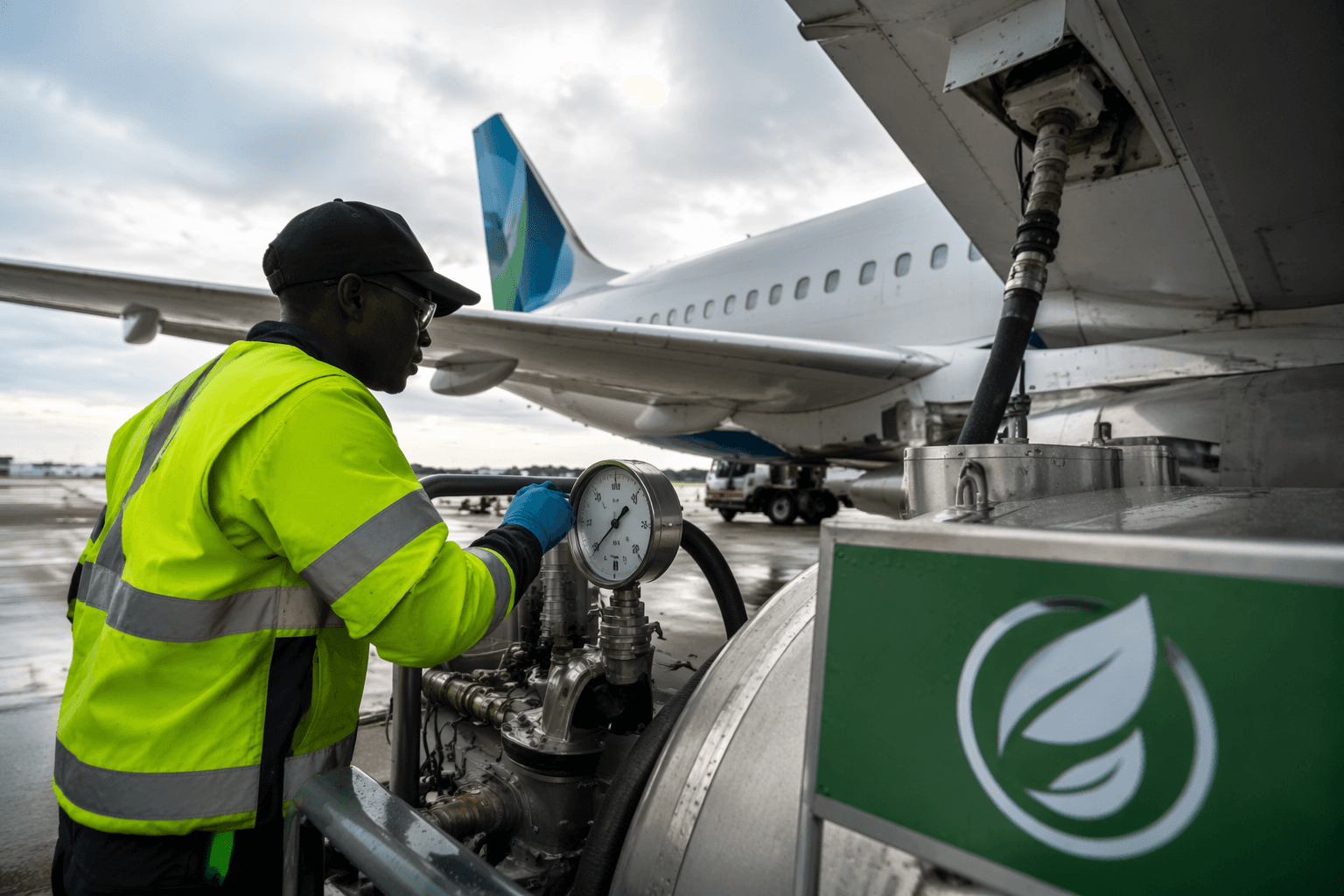
- Supply: There still are not enough gallons to meet broad airline demand at scale. The federal framework’s emphasis on public-private partnerships reflects that reality.
- Pricing: SAF has to compete with conventional jet fuel and fit into airline procurement budgets. If summer demand tightens the market, price spreads become even more important.
- Logistics: Fuel must get to airports reliably and on time, which means terminal operations, blending, storage and transport all have to function without friction.
- Data and modeling: The agencies’ January 2025 progress report specifically pointed to improved data, modeling and analysis as part of the effort, which underscores how much the sector still relies on better visibility into supply, emissions and deployment.
Those are not theoretical issues. They determine whether SAF can be bought as a regular input or only as a special-case transaction.
How the market should read the signals
For airlines, the key signal is whether summer procurement becomes a repeatable process rather than a one-off headline. For producers and developers, the question is whether offtake can be matched with real project financing and timely startup plans. For policymakers, the test is whether the mix of grants, technical support and interagency coordination can move the market from early volumes to industrial scale.
The agencies have already framed the mission this way. The Grand Challenge is not just about cleaner fuel, it is about building a national SAF system that can sustain production, distribution and use over decades. The roadmap’s 50% emissions reduction target sets the climate threshold, while the 3 billion gallon and 2050 domestic demand targets define the commercial scale. Summer travel season is where those ambitions meet operational reality.
What to watch next
The most useful markers over the rest of the season are not speeches or slogans. They are gallons delivered, contracts signed, airport throughput and whether buyers can secure SAF without distorting their fuel programs. If supply remains scarce, summer will confirm that SAF is still stuck in pilot mode. If procurement, logistics and production hold together under peak demand, the market will have taken a meaningful step toward normalizing SAF as a commercial fuel rather than an exception.
The Grand Challenge has already put the target on paper. Summer travel is the first broad test of whether the industry can build the system around it.
This article was produced by Prism’s automated news system from verified source data, official records, and press releases, then run through automated quality and moderation checks before publishing. The system is built and supervised by the people who set the standards it runs under. Read our full AI policy.
Know something we missed? Have a correction or additional information?
Submit a Tip