Türkiye positions itself as a regional hub for marine biofuels
Türkiye is leaning on certified supply, drop-in blends and domestic waste oils to turn marine biofuels into a regional bunker business. The regulatory clock is already forcing adoption.
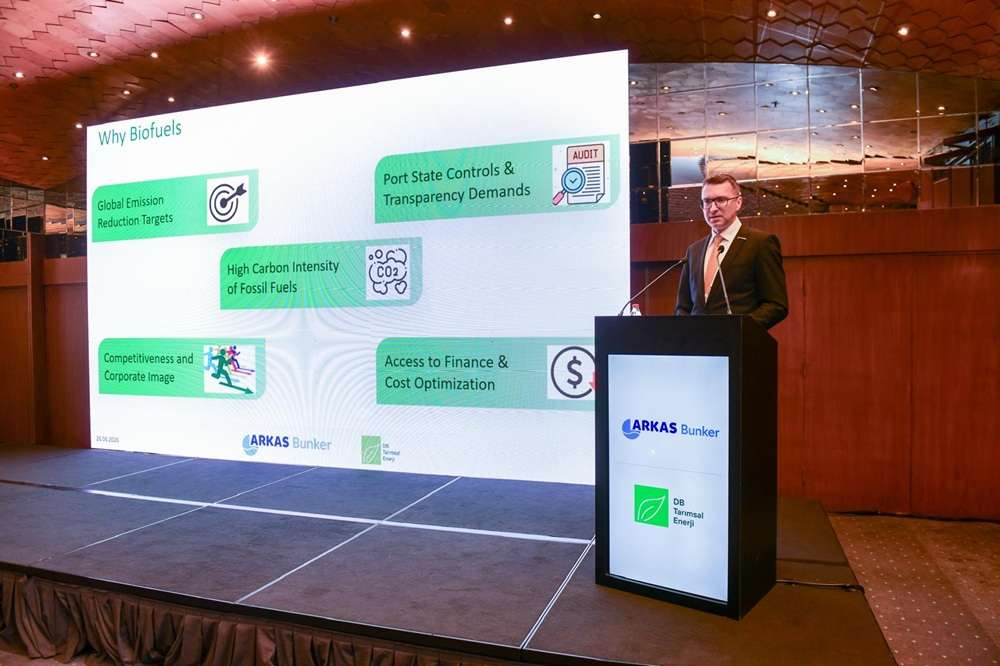
Arkas Bunker and DB Tarımsal Enerji on June 30 used an Istanbul seminar to pitch Türkiye as a marine biofuels hub built on certified supply and drop-in blends. The case rests on shipping’s time-horizon problem: operators need emissions cuts now, not after ammonia, hydrogen or electrification systems are ready.
Biofuels fit the shipping clock
Under its 2023 strategy, the International Maritime Organization calls for 5% to 10% of international shipping energy use to come from new zero or near-zero GHG fuels by 2030 and for net-zero GHG emissions by or around 2050. The same framework sets indicative checkpoints of a 20% cut in total shipping GHG emissions by 2030, striving for 30%, and 70% by 2040, striving for 80%, versus 2008 levels.
In the IMO’s 2025 Future Fuels and Technology publication, about 64% of shipping’s total CO2 reduction in 2050 is expected to come from alternative low- and zero-carbon fuels, and commercialization is linked to IMO measures, FuelEU Maritime, the EU ETS and shippers’ Scope 3 emission-reduction demands. That puts pressure on owners to find fuels that can move through existing bunkering systems without waiting for fleetwide retrofits.
The rulebook now reaches the engine room
MARPOL Annex VI Regulation 18.3.2 already addresses biofuels, placing marine biofuel use inside the current regulatory framework. ISO 8217 was updated again in 2024 to expand allowable biofuel blends across marine fuel grades, a change that matters for buyers trying to match blend stability, engine compatibility and bunker documentation.
Revised IMO interim guidance on biofuels under the DCS and CII framework is scheduled to take effect on 1 January 2027. Existing SEEMP Part II plans that use the old biofuel conversion method should be revised so the new Confirmation of Compliance can be issued by 31 December 2026.
Türkiye is building around domestic supply
Arkas Bunker says it is Türkiye’s first ISCC-EU certified marine fuel supplier, and it has anchored its marine biofuel line around Bio24F and Bio30F. Bio24F is a blend of 24% ISCC-EU certified UCOME and 76% fuel oil, while Bio30F is a 30% bio-component blend. Arkas Bunker says its Bio24F delivery marked Türkiye’s first commercial marine biofuel delivery.
Arkas Line says it is the first container shipping company in Türkiye to use ISCC-certified Bio24F Marine Fuel supplied by Arkas Bunker. The company has identified Bio24F, Bio30F and B100 UCOME as milestones for emission reduction and compliance.
DB Tarımsal Enerji says its maritime fuel production model converts domestic waste vegetable oils into marine fuel and was built over two years of R&D. In February 2026, Arkas Bunker and DB Tarımsal Enerji presented that integrated waste-to-fuel model at the IMO Maritime Biofuels Technical Seminar in London, where they said the sustainable maritime fuel had a carbon emission reduction potential of 33.7% compared with fossil fuels.
Why the model is more than a one-off delivery
Biofuels can be blended into current marine fuel streams and, in Arkas Bunker’s case, used without technical modification to ship engines. That is the immediate advantage over propulsion shifts that require new tanks, fuel systems or vessel redesign.
The commercial test is still supply, certification and price discipline. DNV’s 2025 white paper on biofuels in shipping focuses on global supply and the technical and operational issues involved in drop-in use. Wallem Group’s May 2025 best-practice guidance covers how ships, systems and crews should prepare to load, store and use biofuels in routine operations. Scalability still depends on documented volumes, logistics and handling systems behind the fuel, the same constraint the Istanbul seminar emphasized.
This article was produced by Prism’s automated news system from verified source data, official records, and press releases, then run through automated quality and moderation checks before publishing. The system is built and supervised by the people who set the standards it runs under. Read our full AI policy.
Did this article answer your question?