Capterra spotlights Voltaire as claims correspondence automation gains traction
Capterra’s July 4 update places Voltaire in the claims workflow layer, where 50-plus state rules are turning correspondence into a distinct software buy.
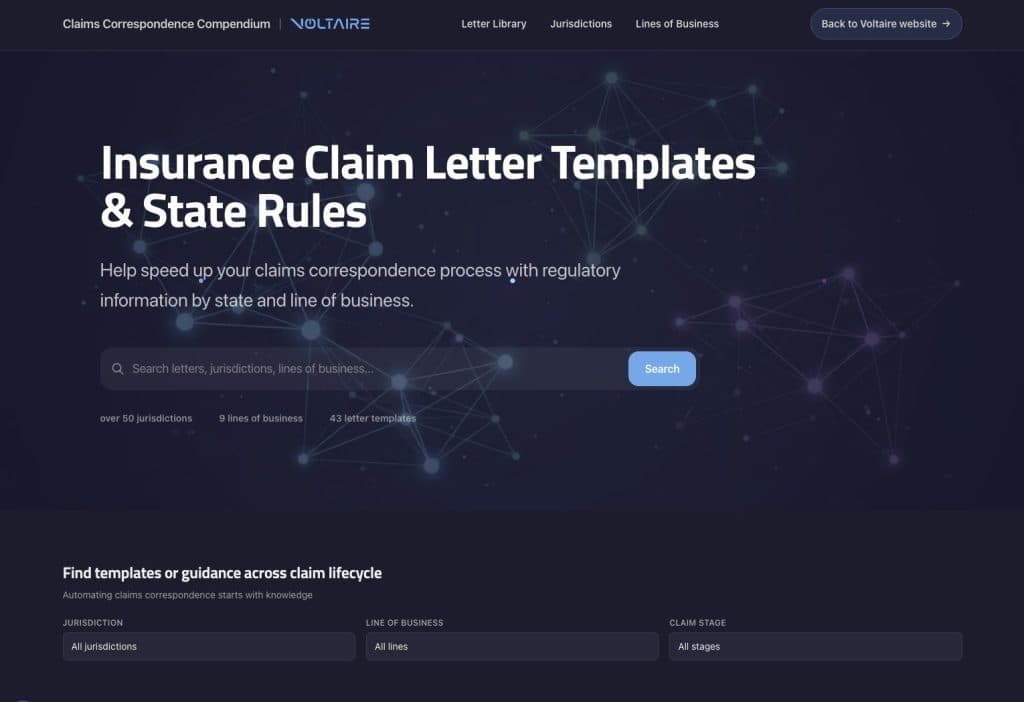
Capterra’s July 4 update on Voltaire puts the product in a part of the claims stack that carriers have long treated as an internal drafting task: the letters themselves. The listing describes Voltaire as a tool that can be used standalone or integrated into existing workflows, and says it can generate accurate, compliant claims correspondence in as little as 30 seconds. That combination of speed, workflow fit and controls is what is pushing claims correspondence automation toward a separate purchasing category inside P&C.
Voltaire’s own positioning makes the category line even clearer. The company says its automation includes policy-language citation and formatting, compliance guardrails, comprehensive QA and human approval built into the workflow. It is aimed at claims, compliance and legal teams that need to produce settlement letters at scale, which places it between the core claims system and the manual work of drafting and review. For carriers, that is a different problem from generic document generation: the buyer is not just looking for templates, but for control over wording, versioning and signoff.

The company’s Claims Correspondence Compendium, launched in Las Vegas on April 28, sharpens that message. Voltaire describes the compendium as a free reference library for claim correspondence, with templates, required components and state-by-state rules that govern when and how each letter must go out. It says the library includes more than 50 state pages covering acknowledgment deadlines, denial-content requirements, mandated forms, appeal-rights notices and unfair-claims standards. The letter library itself spans acknowledgment, denial, reservation of rights, payment, appeal and subrogation templates.
That state-by-state complexity is the reason the niche is gaining traction. The National Association of Insurance Commissioners says its model law process is meant to provide uniformity while balancing the needs of multistate insurers with state regulatory frameworks, and it adopted the Unfair Claims Settlement Practices Act model in June 1990 as a freestanding act focused on claims handling. A 50-state survey by Wilson Elser adds another layer, noting that insurers may need to tell insureds in some jurisdictions that they can contact a department of insurance or other state agency after a denial. In that environment, a missed notice or wrong clause can turn a routine letter into a dispute.
Competition is starting to reflect that shift. Kyber says Aspire General Insurance automated 44% of all outbound claims correspondence within 90 days, while Kyber’s pitch is to move compliance-driven correspondence out of adjuster workflows and into system-level processes. Voltaire says Harbor Claims tested the product on hard letters first, Heritage Insurance adopted it during CAT season, and one carrier saw more than 85% of adjuster staff actively using the tool. The pattern is clear: carriers are buying correspondence automation for compliance, workload relief and litigation control, not as a nice-to-have feature bolted onto claims intake.
This article was produced by Prism’s automated news system from verified source data, official records, and press releases, then run through automated quality and moderation checks before publishing. The system is built and supervised by the people who set the standards it runs under. Read our full AI policy.
Did this article answer your question?