CargoNet warns Memorial Day remains a peak cargo theft risk window
CargoNet counted 221 Memorial Day-period thefts in five years, then flagged May 21 to May 27 as a prime 2026 theft window after 66 incidents in 2025.
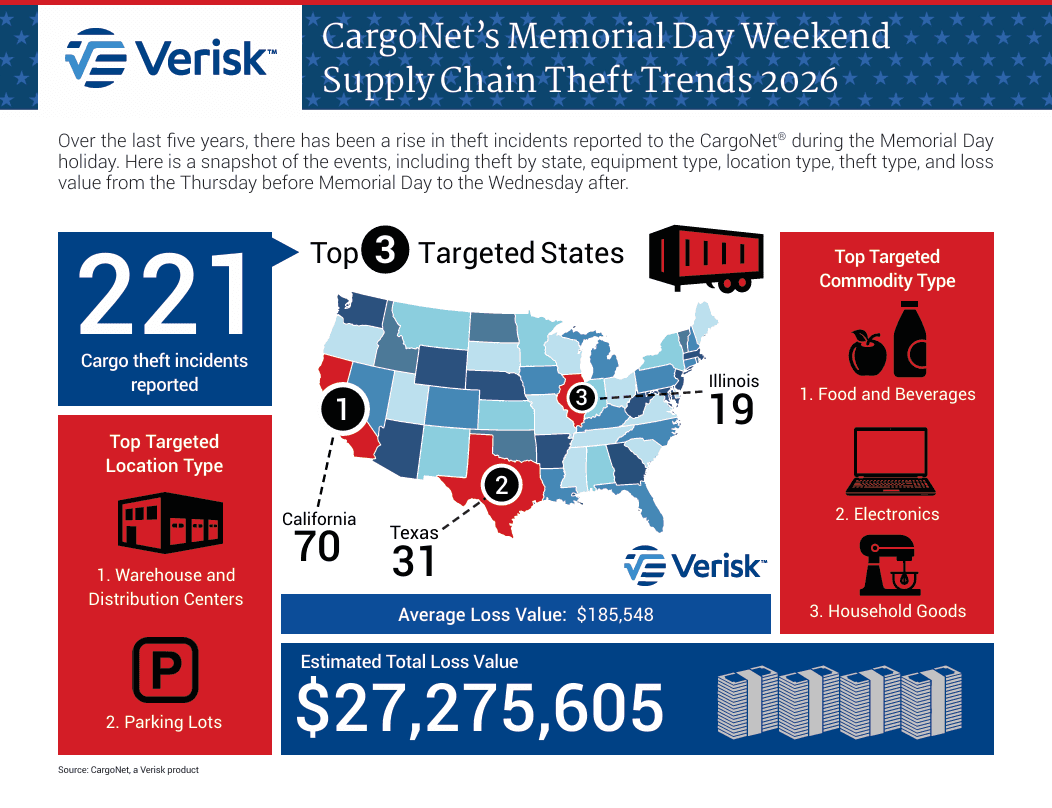
Memorial Day has become a predictable theft window for freight criminals, and Verisk CargoNet put numbers behind the warning. The company said the risk period runs from the Thursday before the holiday through the Wednesday after it, which placed the 2026 window at May 21 through May 27.
Across the five Memorial Day periods from 2021 through 2025, CargoNet recorded 221 cargo theft events. The tempo climbed sharply in 2025, when the count reached 66 events, up from 49 in both 2023 and 2024. California, Texas, Illinois, Georgia and Florida emerged as the most active states in that five-year analysis, underscoring how exposed major freight corridors and distribution hubs remain when staffing thins and freight sits unattended.
CargoNet said organized theft groups are moving toward more selective, higher-value targets, and that shift is showing up in the loss data. The company had already documented 28 stolen shipments valued at more than $1 million in the first several months of 2026. It also said thieves continue to exploit long weekends, reduced staffing, closed facilities and unattended freight, while increasingly leaning on fraud-based schemes and shipment redirection tactics after freight has already been tendered to legitimate carriers.

That broader pattern matters because cargo theft is no longer just a trailer-security problem. The Federal Bureau of Investigation defines cargo theft as theft of goods, chattel, money or baggage that is part of a commercial freight shipment moving in commerce. The National Insurance Crime Bureau describes it more broadly still, including broker fraud, shipment interception, hijacking and cyber-enabled theft. The NICB lists California, Texas, Illinois, Florida and Washington as the most impacted states overall, and says holiday weekends are among the most frequent timing windows for these crimes.
For insurers, brokers and logistics operators, the signal is clear: this is a CAT-model-style exposure spike that demands software, not just vigilance. A holiday weekend can concentrate risk in a way that should trigger temporary underwriting scrutiny, accumulation monitoring, route and facility alerts, and claims triage before losses stack up. Cargo theft intelligence has to move into real-time risk scoring, especially when theft groups are impersonating carriers and rerouting freight after pickup.

Verisk said the economics of the problem worsened even when incident volume fluctuated. Its January 2026 analysis put estimated cargo-theft losses at nearly $725 million in 2025, up 60% from 2024, with average theft value rising to $273,990. That is why the market is treating holiday theft not as a seasonal nuisance, but as a data problem that connected platforms need to recognize early, price quickly and respond to before high-value freight disappears.
This article was produced by Prism’s automated news system from verified source data, official records, and press releases, then run through automated quality and moderation checks before publishing. The system is built and supervised by the people who set the standards it runs under. Read our full AI policy.
Did this article answer your question?