Carriers race to improve partner portals, speed API onboarding
The real portal race is no longer API count. Carriers now win by getting partners onboarded, authenticated, and binding faster with less manual work.
The portal is now the product
The carriers pulling ahead are not the ones that simply expose APIs. They are the ones that make those APIs easy enough for a broker, MGA, wholesaler, or embedded partner to use without a week of back-and-forth. Fern’s May 23 guide captures that shift clearly: the strategic question is no longer whether a carrier has an API, but how quickly partners can integrate and move work forward.
That change matters because partner portals sit right at the intersection of revenue, compliance, and operations. In a P&C market built on legacy policy admin systems, delegated authority relationships, and uneven agency tech maturity, the portal becomes the front door to distribution. If credentials take too long, docs drift out of date, or approvals need manual chasing, the carrier does not just waste time, it slows broker onboarding, program launches, and embedded deals.
Why 2026 is pushing carriers harder
The macro backdrop is making this a priority, not a nice-to-have. Deloitte says insurers enter 2026 as the hard market ends, while customer expectations, broker shifts, and modernization pressure keep rising. Capgemini adds that stronger engagement, innovation, and customer value are reshaping the industry, and Accenture describes 2026 as a year defined by geopolitical and macroeconomic volatility, with carrier response becoming the differentiator.
The NAIC’s 2025 annual property and casualty analysis points to the operating squeeze behind all of this. It warns that slower premium growth could tighten margins, while social inflation continues to pressure reserve adequacy and severe convective storm losses remain a concern in 2026. The NAIC’s mid-year analysis, based on filings as of June 30, 2025, shows the industry still working through a complicated transition. In that kind of environment, every day shaved off onboarding and every manual step removed from partner integration matters.
What a carrier portal has to do in the real world
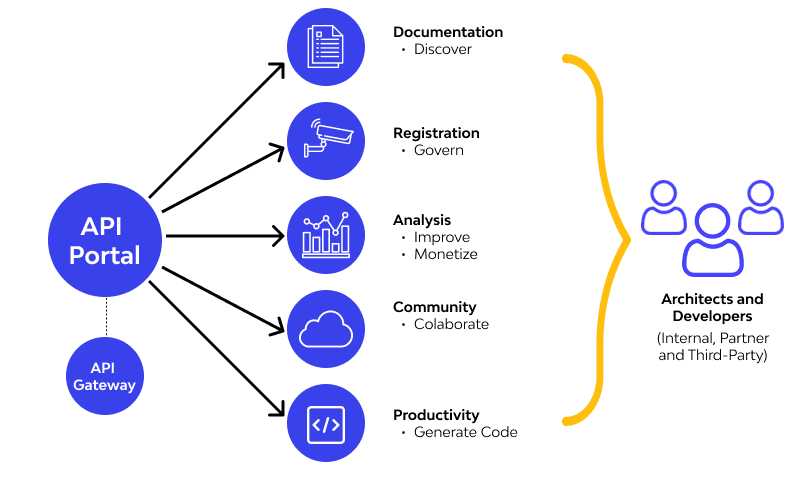
A serious partner portal has to behave like an operating layer, not a static web page with a login. It needs to give external developers and distribution partners self-service access to the things they actually need: authentication, onboarding, version clarity, document exchange, permissioning, and usable analytics.
For a carrier operator, that means the portal has to solve for five realities at once:
- Legacy policy admin systems that were never designed for external developer traffic.
- Delegated authority partners who need clean rules on what they can quote, submit, endorse, or bind.
- Agencies and brokerages with very different technical maturity, from fully staffed integration teams to small shops that need click-through tools.
- Compliance and governance requirements that cannot be loosened just to make onboarding easier.
- A business need to measure whether the portal actually shortens time-to-bind, not just logins.
That is why the best portals are productized. They reduce friction for partners while giving carrier teams control over authentication, approvals, data exposure, and auditability.
A build-vs-buy checklist carriers can actually use
If the decision is whether to build a partner portal in-house or buy one from a platform vendor, the test should be practical. The portal should earn its keep in production, not in a slide deck.
Authentication and access
A carrier-grade portal should support secure, entitlement-based access that is simple for partners but tightly governed for the carrier. Postman’s partner-workspace model is useful here because it shows how secure workspaces can speed onboarding while keeping access controlled and documentation current for external users. If the authentication model still relies on email chains and manual credential issuance, onboarding friction will keep piling up.
Partner onboarding
One-click or near-one-click onboarding patterns are now a benchmark, not a luxury. Postman’s developer onboarding guidance highlights shared collections, documentation, and the Run in Postman flow as a way to get partners moving faster. A carrier portal should aim for the same result: the partner should be able to discover the API, test it, and understand the required payloads with as little hand-holding as possible.
API versioning
Version control has to be obvious inside the portal. Partners need to know which APIs are current, what changed, and what is deprecated before they build against the wrong contract. In a P&C setting, version confusion can break quoting or binding flows, so the portal should present version histories, migration guidance, and deprecation timelines in plain language.
Document exchange
Documentation is not just reference material, it is operational infrastructure. Postman’s Cover Genius case study says manual testing of insurance product iterations was cumbersome and that partner-specific payload nuances were not always captured in documentation. That is the warning sign: if docs do not match real-world behavior, partners will keep escalating edge cases instead of self-serving.
Permissions and delegated authority
A portal for delegated authority partners has to make the rules visible. Who can quote, who can submit, who can bind, and what data each role can see should be clear from the start. If permissioning is too broad, governance suffers; if it is too opaque, partners stall. The portal needs role-based access that reflects the actual distribution model, not a generic user directory.
Analytics and operational visibility
The best portals do more than expose APIs. They show what is happening: which partners are active, where integration attempts fail, what documents are most used, and where approval bottlenecks appear. That lets carrier teams spot whether a partner is stuck in testing, failing on payload structure, or falling behind on a required integration step.
Time-to-bind impact
This is the metric that matters most. A portal strategy should be judged on how much it cuts the path from first login to first live transaction, and from first submission to bind. If the portal does not reduce manual intervention, shorten troubleshooting cycles, and speed partner activation, it is not producing the distribution lift the carrier needs.
What the market is already signaling
The vendors and platforms in the market are already moving toward this model. Guidewire’s InsuranceNow API documentation shows developers building agent and broker portals through a native interface that uses Swagger OpenAPI specifications. That is telling: insurance software vendors are no longer treating the portal as an add-on. They are packaging the developer experience as part of the platform itself.
That is also the deeper lesson in Fern’s framing. Carriers are competing on how quickly and easily partners can integrate, not on whether an API catalog exists. The winning portal will be the one that removes uncertainty, supports delegated authority cleanly, and turns integration from a delay into a distribution advantage.
This article was produced by Prism’s automated news system from verified source data, official records, and press releases, then run through automated quality and moderation checks before publishing. The system is built and supervised by the people who set the standards it runs under. Read our full AI policy.
Know something we missed? Have a correction or additional information?
Submit a Tip