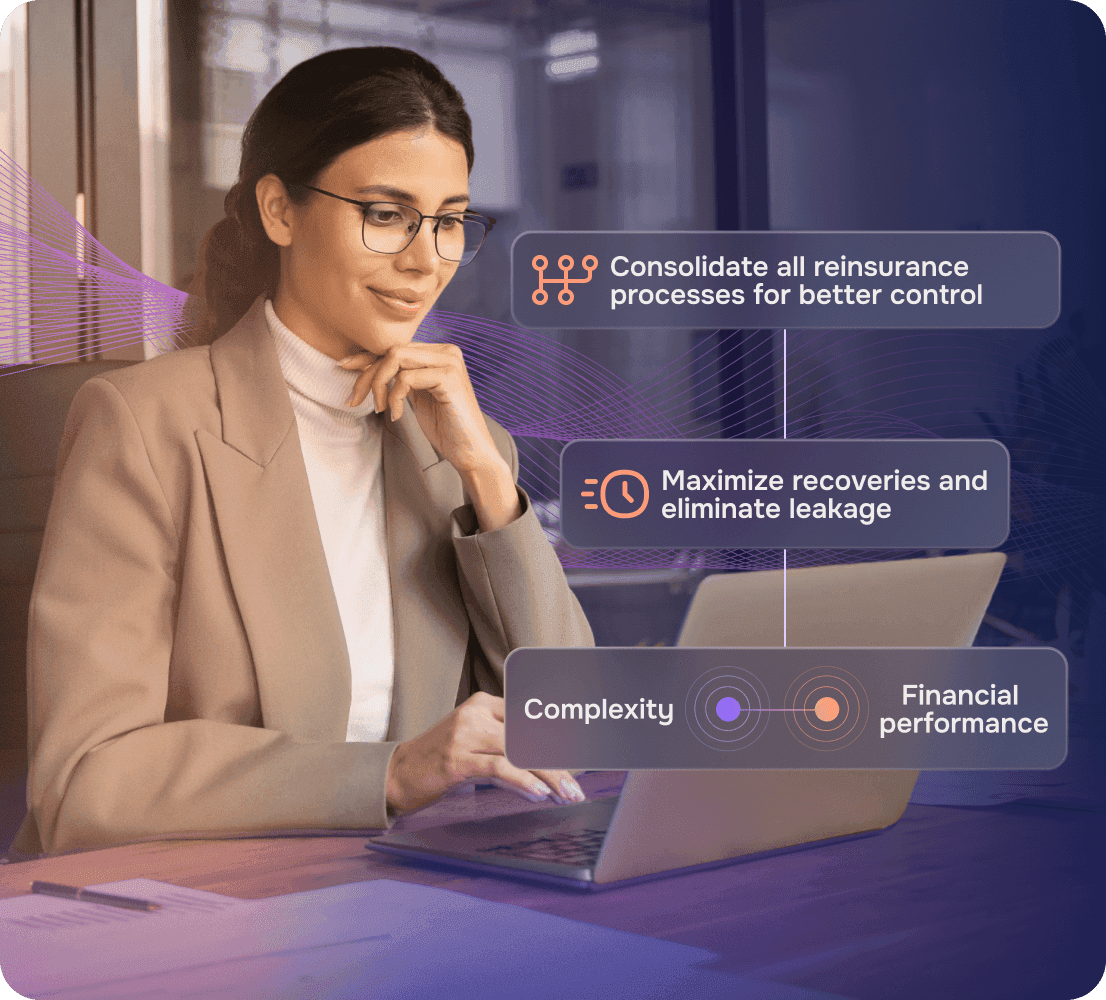
Policy administration systems power the full P&C policy lifecycle
A modern PAS is the workflow engine behind quoting, underwriting, endorsements, renewals, billing triggers, and claims handoffs, not just a policy database.
Submission intake, rating, underwriting, bind and issue, endorsements, renewals, reporting, compliance, billing, and claims all run through policy administration software when a carrier is using a true modern PAS. It decides how fast a carrier can move from submission to bind, how cleanly it can service changes after issue, and how much work still depends on manual handoffs. The difference between a system that merely stores policy records and one that orchestrates the full policy lifecycle shows up in quote speed, product-change cost, automation rates, and the quality of downstream billing and claims data.
What a modern PAS actually does
A credible PAS sits at the center of P&C operations. It has to handle submission intake, rating, underwriting, bind and issue, endorsements, renewals, reporting, and compliance, then pass clean data into billing and claims. Origami Risk breaks the work into submission speed, rating, underwriting, bind and issue, policy servicing, renewal, reporting and compliance, moratoriums, agency management, loss control, and product administration.
The practical tools behind it are underwriter workbench dashboards, ISO and NCCI bureau rules, rates and forms, native API integrations, and straight-through processing.
Why architecture matters more than the label
The buying mistake is to treat every PAS as a database with screens on top. A database-centric design keeps the record of what happened, but it leaves the carrier to coordinate work across underwriting, servicing, billing, and claims with separate tools and human intervention. A workflow-engine PAS does something different: it routes tasks, enforces business rules, automates approvals, and preserves one operating model across quote, bind, change, and renewal.
That distinction drives speed to market. When rates, forms, or eligibility rules change, a database-first product usually forces more custom code and more testing across disconnected processes. A workflow-engine approach reduces that drag because the same rules engine and task logic can govern how submissions are triaged, how endorsements are approved, and how renewals are issued.
Guidewire PolicyCenter as the enterprise benchmark
PolicyCenter manages the full policy lifecycle from quote to renewal. The platform centers on configurable product design, omnichannel servicing, and centralized data, which Guidewire says improves accuracy and speed to market. That combination is why PolicyCenter is often used as the reference point for enterprise PAS buying decisions: it is not a policy file cabinet, but one core system inside a broader insurance stack.
The broader Guidewire suite makes that point concrete. PolicyCenter sits alongside ClaimCenter and BillingCenter in its core-products lineup, which makes the architecture argument concrete. A PAS is only one part of the operating chain, and Guidewire’s model assumes that policy, claim, and billing data must stay connected across the life of the account. Guidewire says more than 540 insurers in 40 countries run on its platform, with 1,600-plus implementations worldwide.
Duck Creek’s unified-core pitch, with operating numbers attached
Duck Creek takes a similar core-platform view, but it leans harder into a single unified system that spans policy, billing, claims, rating, and related functions. That matters for buyers who want one operational core rather than multiple stitched-together modules. The platform’s value proposition is less about isolated configuration and more about end-to-end process consistency across the insurance lifecycle.
Duck Creek publishes performance claims that help translate architecture into operations. It says its policy tooling can produce tailored quotes in 5 seconds, update rates and factors with a 70% reduction in time, and reduce product costs and delivery time by up to 75%.
Duck Creek says its claims platform has processed more than 30 million claims and has scaled to 60,000 claims per day during a CAT event.
Origami Risk’s workflow-heavy view of the policy lifecycle
Origami Risk breaks policy administration into operational stages instead of broad buzzwords. The sequence runs from submission speed through reporting and compliance. It includes moratoriums, agency management, loss control, and product administration.
Underwriter workbench dashboards support decision-making in the workflow itself, while ISO and NCCI bureau rules, rates and forms, and native API integrations make the system adaptable to real product content. Straight-through processing lets the system move work without staff reentry.
How to choose among them
The right PAS depends on how much product complexity and change a carrier is carrying. Guidewire PolicyCenter fits buyers that want an enterprise core with strong lifecycle coverage, centralized data, and clear adjacency to claim and billing systems. Duck Creek fits buyers that want a unified core and are looking for published speed and cost metrics that speak directly to product delivery. Origami Risk fits organizations that want the workflow details exposed, especially when bureau content, underwriter workbenches, and straight-through processing are central to the operating model.
This article was produced by Prism’s automated news system from verified source data, official records, and press releases, then run through automated quality and moderation checks before publishing. The system is built and supervised by the people who set the standards it runs under. Read our full AI policy.
Did this article answer your question?