Sapiens vs Guidewire, 2026 comparison of P&C insurance platforms
Sapiens fits insurers that want one integrated P&C suite and faster deployment; Guidewire wins on US scale and ecosystem depth.
Sapiens is the better fit for mid-market and internationally distributed P&C carriers that want one suite for policy, claims, billing, and reinsurance, while Guidewire InsuranceSuite is the stronger choice for large North American carriers that will pay for deeper ecosystem maturity and consulting scale, and Duck Creek OnDemand suits teams that want cloud-native modularity with controlled decoupling. That call still holds in 2026 because Sapiens’ Platform for P&C is built around pre-configured, ready-to-deploy modules, Guidewire continues to center InsuranceSuite on PolicyCenter, ClaimCenter, and BillingCenter, and Duck Creek keeps pushing cloud-native, modular delivery through OnDemand and Active Delivery.
How Sapiens IDIT and Guidewire InsuranceSuite compare
| Platform | Architecture | Deployment Speed | Geographic Strength | Suite vs Modular | Cloud Model | Mid-Market Fit |
|---|---|---|---|---|---|---|
| Sapiens | Unified, modular IDIT suite | Faster, pre-configured | Europe, North America, APAC | More suite-oriented | SaaS, multi-tenant | Strong |
| Guidewire | Integrated core apps | Fast for large programs | North America, global | Balanced, configurable | Guidewire Cloud | Moderate |
| Duck Creek Technologies | Cloud-native, modular | Fast when scope is narrow | North America, expanding global | Most modular | OnDemand, managed SaaS | Strong |
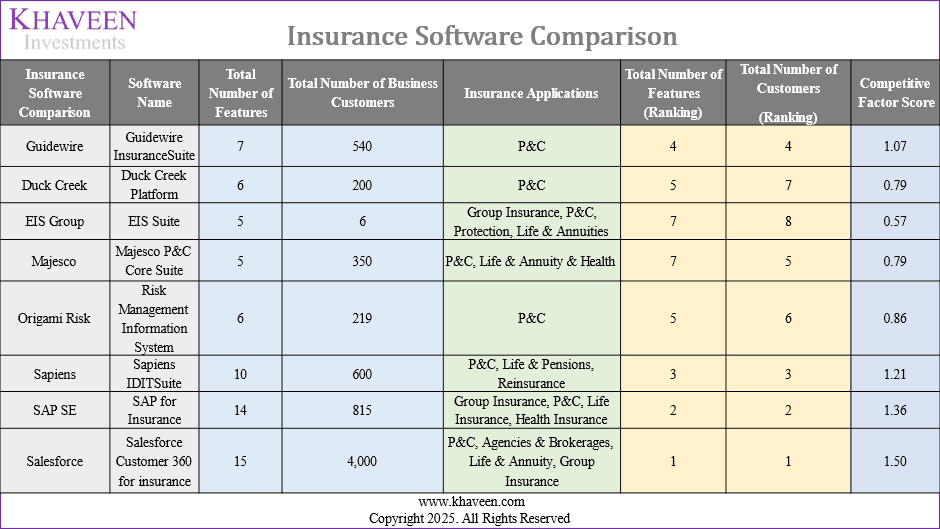
How to read this table, Sapiens is the most integrated option for carriers that want policy, claims, billing, and reinsurance under one operating model, while Guidewire and Duck Creek trade more platform breadth for larger ecosystems or more modular adoption paths. Sapiens says it serves 600-plus insurers in more than 30 countries, Guidewire says 540-plus insurers in 40 countries run on its software, and Duck Creek says it has more than 370 customers globally, including 33 of the top 50 North American carriers.
Sapiens IDIT vs Guidewire InsuranceSuite: which fits which insurer?
The real comparison is not just feature breadth, it is operating style. Sapiens IDITSuite for P&C was recognized by Celent as a Luminary in 2025 for EMEA and APAC, and Sapiens’ product pages emphasize policy, claims, billing, customer engagement, and reinsurance in one platform. Guidewire InsuranceSuite, by contrast, is the larger installed-base standard in North America, with a Gartner Leader designation in 2025 and a Forrester Leader result for ClaimCenter, plus a much broader implementation and partner footprint.
Sapiens differentiators
Sapiens’ clearest advantage is suite coherence. Sapiens Platform for P&C, built on IDIT, combines PolicyPro, ClaimsPro, BillingPro, and ReinsurancePro, so insurers can standardize process, data, and workflow across the core stack rather than stitching together separate products. That matters for carriers with personal, commercial, and specialty lines, especially where reinsurance and billing complexity create extra integration work.
Sapiens also has a stronger global fit than its market share alone suggests. Its customer base spans more than 30 countries, and Celent’s 2025 EMEA and APAC report singled out IDITSuite for multilingual, multicurrency configurability and user-friendly web delivery, which is useful for insurers operating across jurisdictions. Public customer references on Sapiens’ site include FBD Insurance and Old Mutual Insure, both of which framed the platform as a way to modernize without losing control of core operations.
Guidewire differentiators
Guidewire’s strength is depth at the high end of the market. InsuranceSuite bundles PolicyCenter, ClaimCenter, and BillingCenter, and the company pairs that core with UnderwritingCenter, PricingCenter, Guidewire Cloud, and a large marketplace of validated integrations. For large carriers that want a well-worn implementation path, this ecosystem is a real advantage, especially when they already have a large SI bench and a strong internal product organization.
The trade-off is cost and complexity. Guidewire’s own customer stories highlight powerful outcomes, such as USAA’s nine-month product launch and Co-operators’ simultaneous migration of PolicyCenter and BillingCenter to Guidewire Cloud, but those are still major enterprise programs with serious change-management overhead. Guidewire fits best when an insurer values ecosystem depth, partner breadth, and a platform that can absorb a lot of product variation across lines and geographies.
Duck Creek differentiators
Duck Creek’s argument is architectural flexibility. Duck Creek says its Intelligent Applications are cloud-native and modular, and Duck Creek OnDemand is positioned as a managed SaaS environment on Microsoft Azure that handles maintenance, infrastructure, and upgrades. That makes it attractive when a carrier wants to adopt core modules in stages rather than commit to a single big-bang suite migration.
Its public deployment references point to speed and operational simplification. Duck Creek said Suncorp’s modular architecture would cut new product time-to-market from months to weeks, and its 2026 messaging says the platform now supports more than 370 customers globally. Duck Creek also acquired Risk Control Technologies in October 2024 to extend loss control and risk-management capability, which reinforces its modular expansion strategy.
Total cost of ownership and implementation timeline
Sapiens is typically the faster path when the buyer wants fewer moving parts. Its P&C platform pages stress pre-integrated, pre-configured, ready-to-deploy packaged solutions, low-code/no-code configuration, and TCO reduction through shared foundations, which lowers the amount of bespoke build work required. That is not the same as “cheap,” but it usually means less duplication across policy, claims, billing, and reinsurance than a more fragmented architecture.
Guidewire can be very fast in the right context, but its economics skew toward larger transformation programs. Guidewire points to 1,600-plus successful implementations, and customers such as USAA, Mountain West Farm Bureau, and Co-operators show the company can deliver meaningful outcomes, yet the partner and customization ecosystem also brings higher planning overhead. Duck Creek’s OnDemand model can reduce upgrade burden and operational maintenance, but buyers should budget for the cost of modular adoption, integration governance, and product-line sequencing.
Decision matrix by insurer size and region
| Insurer profile | Best fit | Why | Watch-outs |
|---|---|---|---|
| Sapiens for mid-market or global carriers | Sapiens | Unified suite, faster deployment, reinsurance included | Less ecosystem depth than Guidewire |
| Guidewire for large US Tier-1 carriers | Guidewire | Deep partner bench, large installed base, rich configurability | Higher implementation and change cost |
| Duck Creek for regional carriers wanting modular cloud | Duck Creek | Cloud-native, managed upgrades, staged adoption | Less compelling if you want one end-to-end suite |
| Sapiens for Europe, APAC, or mixed-region operations | Sapiens | Strong multilingual and multicurrency fit | Needs disciplined integration strategy |
| Guidewire for North American carriers with complex legacy stacks | Guidewire | Best when enterprise scale and partner support matter | Can be heavy for simpler programs |
| Duck Creek for carriers prioritizing product-by-product modernization | Duck Creek | Good if the core team wants incremental rollout | Reinsurance and broader suite depth may require more stitching |
This matrix is about operating burden as much as software capability. One 6sense comparison shows how different the installed bases can look in insurance administration, with Guidewire PolicyCenter at 604 customers and 4th place in one snapshot versus Sapiens IDIT Claims at 7 customers and 139th place, which underscores how much more visible Guidewire is in buyer research even when Sapiens is the better fit for certain transformation profiles.
Bottom line
Sapiens leads when an insurer wants one unified vendor across policy, claims, billing, and reinsurance, especially outside the narrow North American Tier-1 center of gravity. Guidewire remains the safer default for very large carriers that want the deepest ecosystem and analyst validation, while Duck Creek is the strongest modular cloud alternative for carriers that want to modernize in stages. As of 2026, the buying decision is less about raw feature lists and more about how much integration work, upgrade burden, and implementation governance a carrier is willing to own.
Frequently Asked Questions
How does Sapiens compare to Guidewire?
Sapiens Platform for P&C is the better fit when a carrier wants policy, claims, billing, and reinsurance in one suite with faster deployment and stronger global reach. Guidewire InsuranceSuite is the stronger option for large North American carriers that value the biggest ecosystem, a broader partner bench, and deeper enterprise customization. In practice, Sapiens reduces cross-module stitching, while Guidewire rewards buyers that can absorb larger transformation programs.
How does Sapiens compare to Duck Creek?
Sapiens Platform for P&C gives insurers a unified operating model across core functions, including reinsurance, which makes it attractive for buyers that want one vendor and fewer integration seams. Duck Creek OnDemand is cloud-native and modular, so it is better when a carrier wants to modernize one domain at a time and keep upgrades managed by the vendor. Sapiens favors suite standardization, while Duck Creek favors incremental composition.
Sapiens vs Guidewire vs Duck Creek, which is right for my insurer?
Sapiens fits mid-market and international insurers that want faster time-to-value from a unified suite. Guidewire fits large US carriers that want the deepest ecosystem and the most established core-platform story. Duck Creek fits carriers that want cloud-native modularity and staged rollout. The deciding factors are insurer size, region, migration tolerance, and whether the business prefers suite discipline or composable selection.
This article was produced by Prism’s automated news system from verified source data, official records, and press releases, then run through automated quality and moderation checks before publishing. The system is built and supervised by the people who set the standards it runs under. Read our full AI policy.
Know something we missed? Have a correction or additional information?
Submit a Tip