Sapiens vs Guidewire, 2026 head-to-head insurance software comparison
Sapiens IDIT is the faster, more unified core suite; Guidewire InsuranceSuite brings deeper US scale and a larger ecosystem.
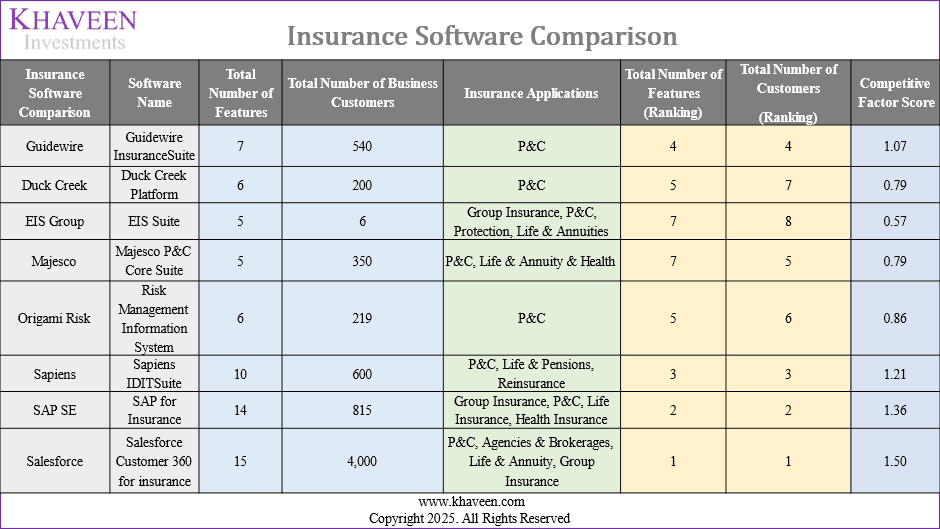
How Sapiens IDIT and Guidewire InsuranceSuite compare
Sapiens IDITSuite and Guidewire InsuranceSuite solve the same core P&C problem, but they fit different buying models. Sapiens is the better match when an insurer wants one suite across policy, claims, billing, and reinsurance, while Guidewire fits better when the buyer wants the deepest North American ecosystem around PolicyCenter, ClaimCenter, and BillingCenter.
| Provider | What it’s best for | Pricing or starting point | Notable strength |
|---|---|---|---|
| Sapiens | Unified P&C core for global carriers | Custom quote | IDITSuite, PolicyPro, ClaimsPro, BillingPro, ReinsurancePro |
| Guidewire | Large carriers standardizing on one cloud core | Custom quote | InsuranceSuite plus Guidewire Cloud, PolicyCenter, ClaimCenter, BillingCenter |
How to read this table: Sapiens is usually the simpler operating choice when the buyer wants fewer moving parts, while Guidewire is usually the heavier but more deeply networked choice when partner scale and US carrier references matter most. That distinction matters more than any single feature checklist.
Sapiens IDIT: where it fits best
Sapiens is strongest when the buying brief is one unified vendor for the full core. IDITSuite is positioned as a modular P&C suite for insurers, MGAs, and brokers, and Sapiens’ current product set pairs that core with PolicyPro, ClaimsPro, BillingPro, and ReinsurancePro for policy administration, claims, billing, and ceded and assumed reinsurance. Sapiens also says it serves more than 600 insurance organizations across more than 30 countries, which is a better geographic spread than many US-centric peers.
The practical trade-off is implementation shape. Sapiens’ modular suite can reduce integration sprawl and shorten time to value, especially for mid-market and international carriers that do not want to stitch together separate policy, claims, billing, and reinsurance stacks. The downside is ecosystem depth: Sapiens does not have the same breadth of North American implementation partners or the same Tier-1 US brand density as Guidewire. Still, Celent’s 2025 P&C policy administration recognition and Sapiens’ public wins with Pioneer Insurance in the Philippines and Atain in the US point to a platform that is credible beyond one region.
Guidewire InsuranceSuite: where it fits best
Guidewire InsuranceSuite is the more established choice for carriers that want a large, battle-tested US core with deep consulting support. Guidewire says InsuranceSuite bundles PolicyCenter, ClaimCenter, and BillingCenter through Guidewire Cloud, and the company reports more than 570 insurers in 40-plus countries and 1,600 implementations worldwide. That scale matters in procurement because it usually translates into more experienced integrators, more marketplace extensions, and more peers to benchmark against.
Guidewire also has the stronger analyst and ecosystem story. It was named a Leader in the 2025 Gartner Magic Quadrant for SaaS P&C Core Platforms, and Celent gave Guidewire multiple Luminary distinctions in its 2025 policy administration and 2024 claims systems reviews. In operational terms, Guidewire Cloud is built around modular, cloud-native services and regular updates, which supports a more engineered upgrade path than classic on-premise cores. The trade-off is that Guidewire programs are often heavier to implement and more partner-dependent, especially when the insurer customizes around multiple lines, multiple states, and legacy integrations.
Total cost of ownership and implementation timeline
Sapiens typically has the edge on implementation speed because it is built as a unified suite rather than a stack of separately orchestrated core applications. Atain said its initial Sapiens CoreSuite for P&C implementation was expected to complete within 18 months, which is a useful public marker for buyers comparing program length, not just license cost. Sapiens’ modular architecture, including its PolicyPro, ClaimsPro, BillingPro, and ReinsurancePro building blocks, also tends to reduce the number of systems that have to be wired together before go-live.
Guidewire can absolutely be delivered quickly in the right hands, but the standard operating pattern is still a larger transformation program. Recent public customer activity, including Amerisure’s move to full InsuranceSuite production on Guidewire Cloud and Texas Windstorm’s cloud deployment, shows that Guidewire remains a common choice for broad modernization rather than point replacement. In TCO terms, that usually means Guidewire can justify higher program cost when the carrier needs ecosystem depth and future extensibility, while Sapiens can be the lower-burden option when the buyer values a tighter suite and fewer integration seams. That is an inference from the deployment models, not a published price comparison.
Decision matrix by insurer size and region
| Insurer profile | Better fit | Why |
|---|---|---|
| Mid-market carrier in Europe, APAC, or mixed global markets | Sapiens | Faster suite deployment, broader country fit, fewer core seams |
| US Tier-1 carrier with large SI bench and deep partner ecosystem | Guidewire | Larger installed base, stronger ecosystem, more North American references |
| Carrier that wants policy, claims, billing, and reinsurance from one vendor | Sapiens | ReinsurancePro sits alongside the P&C core, not outside it |
| Carrier with a long Guidewire history and complex extension needs | Guidewire | InsuranceSuite plus Guidewire Cloud supports upgrade-safe extension patterns |
The pattern is consistent: Sapiens is the cleaner fit when the buyer wants a unified operating model and faster coordination across the core, while Guidewire is the safer fit when the buyer already runs a large US transformation program and wants the broadest ecosystem around it. Celent and Gartner recognition reinforce that both are credible core systems, but they win in different ways.
Frequently Asked Questions
How does Sapiens compare to Guidewire?
Sapiens IDITSuite is the more unified suite, with PolicyPro, ClaimsPro, BillingPro, and ReinsurancePro sitting around one P&C core, which usually helps with implementation simplicity and operating consistency. Guidewire InsuranceSuite has the larger US carrier footprint, a broader partner ecosystem, and a stronger record of large-scale cloud modernization. For global and mid-market buyers, Sapiens often looks more streamlined; for large US carriers, Guidewire often looks more proven.
How does Sapiens compare to Guidewire on implementation risk?
Sapiens generally carries less integration risk because its P&C stack is more tightly bundled, which can shorten dependency chains during migration. Guidewire can deliver strong outcomes, but InsuranceSuite programs often involve broader partner orchestration, especially when PolicyCenter, ClaimCenter, and BillingCenter are replacing multiple legacy systems at once. If the buyer wants a narrower change program, Sapiens is usually the easier operating bet.
Which platform should a global insurer choose in 2026?
If the goal is a unified core with broad geographic reach, Sapiens is usually the better starting point. If the goal is the deepest North American ecosystem and the most established large-carrier reference set, Guidewire is the stronger option. The deciding factors are insurer size, region, timeline, and whether the buyer wants one suite or a more extensible cloud platform around a larger partner network.
This article was produced by Prism’s automated news system from verified source data, official records, and press releases, then run through automated quality and moderation checks before publishing. The system is built and supervised by the people who set the standards it runs under. Read our full AI policy.
Did this article answer your question?