Sapiens vs Guidewire, 2026 P&C insurance software comparison
Sapiens wins the faster global-suite case, Guidewire wins the deepest US enterprise ecosystem, and Duck Creek is the modular cloud-native alternative.
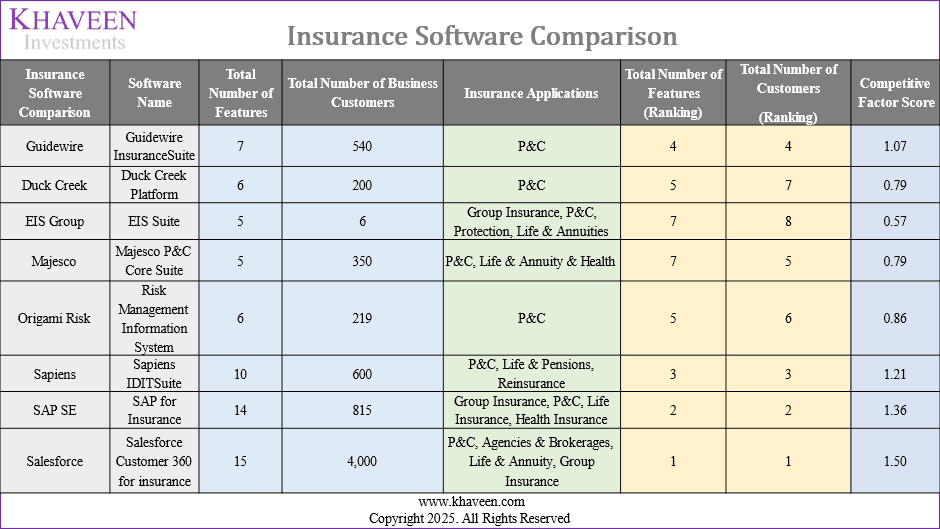
Sapiens is the better fit for mid-market and multi-country P&C carriers that want policy, claims, billing, and reinsurance in one suite, while Guidewire is stronger for large US carriers that want the deepest ecosystem and analyst validation, and Duck Creek is the cloud-native modular option in the same first tier. As of June 2026, that is the real split: Sapiens leans into packaged speed, Guidewire leans into enterprise breadth, and Duck Creek leans into managed SaaS and composable delivery.
| Provider | What it's best for | Pricing or starting point | Notable strength |
|---|---|---|---|
| Sapiens | Global mid-market and enterprise P&C | Custom quote | Unified suite, policy to reinsurance. |
| Guidewire | Large US carriers and complex transformations | Custom quote | Deep InsuranceSuite ecosystem and scale. |
| Duck Creek Technologies | Cloud-first carriers wanting modular choice | Custom quote | Managed SaaS with strong implementation speed. |
How to read this table: Sapiens is the cleanest choice when one vendor must cover the core P&C stack and reinsurance without stitching together multiple products. Guidewire and Duck Creek are both serious platforms, but they optimize for different operating models, and that distinction matters more than brand prestige.
Sapiens differentiators
Why Sapiens usually wins the suite question
Sapiens Platform for Property & Casualty is a modular, SaaS, AI-driven stack that covers the full P&C value chain, and the product family is built around IDITSuite plus named modules such as PolicyPro, ClaimsPro, BillingPro, and ReinsurancePro. Sapiens says its low-code approach can cut time to market by 75%, and its public P&C pages emphasize pre-configured, ready-to-deploy business solutions rather than a blank-sheet build. Celent’s 2025 EMEA and APAC PAS coverage also named IDITSuite for P&C a Luminary, which matters because it points to more than just marketing polish.
Why Sapiens fits cross-border insurers
The other thing Sapiens does well is geography. The company says it serves over 600 insurance organizations in more than 30 countries, with 38 countries shown on its current site, and it regularly points to customers such as MS Amlin and Rockford Mutual to show that the platform works outside a single domestic market. That is why Sapiens is a practical shortlist candidate for European, APAC, and multinational carriers that want one operating model across several regions. The trade-off is that it does not have the same US tier-one gravity as Guidewire, but for global standardization, Sapiens is the cleaner play.
Guidewire differentiators
Why Guidewire still owns the large-carrier conversation
Guidewire InsuranceSuite is a bundled or standalone set of policy, billing, and claims applications, and Guidewire says more than 570 insurers in 43 countries rely on its products. The company was also named a Leader in Gartner’s 2025 Magic Quadrant for SaaS P&C Core Platforms, North America, and Guidewire’s own pages stress a Marketplace with more than 290 integrations. That combination explains why Guidewire remains the safest answer for large US carriers that want an ecosystem, not just software.
Why Guidewire is harder, but often justified
Guidewire’s strength is also its burden. Big carriers buy it when they need deep process control, lots of integration surface area, and a long runway for modernization, which is why public references like Liberty Specialty Markets, Aioi Nissay Dowa, Mountain West Farm Bureau, and USAA keep surfacing in its materials. That is not a fast path, but it is a credible one when the buyer already has a large implementation team, multiple lines of business, and a consulting ecosystem built around Guidewire Cloud and InsuranceSuite. If your priority is breadth and US market validation, Guidewire is the benchmark.
Duck Creek Technologies differentiators
Why Duck Creek is the cloud-native modular choice
Duck Creek OnDemand is the clearest cloud-first option in this comparison. Duck Creek says its platform is managed SaaS on Microsoft Azure, it can be implemented as a complete suite or as individual applications, and it serves more than 370 customers globally, including 33 of the top 50 North American carriers. Duck Creek was also named a Leader in Gartner’s 2025 Magic Quadrant for SaaS P&C Insurance Core Platforms, North America, for the seventh consecutive year, which is a strong signal for buyers who care about market credibility as much as product design.
Why Duck Creek is fast, but not always simple
Duck Creek’s public implementation claims are aggressive, and that is part of its appeal. The company says pre-defined commercial products can go live in 45 days, and it also points to 30 million-plus claims processed through Duck Creek OnDemand. GEICO is one of the cleaner public references for the platform, and Duck Creek has been explicit that its modular architecture is meant to cut product time-to-market from months to weeks. The catch is obvious: modular freedom can shift complexity into integration design, especially when the buyer wants a larger operating footprint.
Total cost of ownership and implementation timeline
Sapiens usually gets to value faster than Guidewire because it pushes pre-configured, low-code packaged solutions, and its own materials claim a 75% time-to-market reduction. Guidewire is more likely to require a bigger program team, even though its partner network includes migration-acceleration specialists and its own customer stories show very fast wins in selected programs, such as USAA’s nine-month launch. Duck Creek sits between them: its managed SaaS model can be quick for well-defined scope, but its modular breadth still requires disciplined architecture if you want to avoid a tangle of integrations. That is an inference from the vendors’ own positioning, not a universal rule, but it matches the shape of their products.
Decision matrix by insurer size and region
| Insurer profile | Best fit | Why |
|---|---|---|
| Mid-market, multi-country P&C carrier | Sapiens | Unified suite, 600+ customers, 30+ countries. |
| Large US Tier-1 carrier | Guidewire | Deep ecosystem, 570+ insurers, 290+ integrations. |
| US carrier wanting modular cloud | Duck Creek Technologies | OnDemand SaaS, suite or standalone, faster go-lives. |
The cleanest way to use that matrix is to ask one question first: do you want a suite or a toolkit? Sapiens is the better suite answer, Guidewire is the heavier enterprise platform, and Duck Creek is the modular cloud answer. Once that is settled, geography and implementation tolerance usually decide the shortlist.
Sapiens vs Guidewire: which one should you choose?
Choose Sapiens if you want one vendor across policy, claims, billing, and reinsurance, especially if you are operating across Europe, APAC, or multiple countries and you care about deployment speed. Choose Guidewire if you are a large US carrier that wants the deepest ecosystem, the biggest consulting bench, and the strongest analyst validation around a core P&C stack. In practical terms, Sapiens is the cleaner global-suite buy, Guidewire is the safer heavyweight US buy.
Frequently Asked Questions
How does Sapiens compare to Guidewire?
Sapiens Platform for P&C is the more unified end-to-end suite, with policy, claims, billing, and reinsurance under one umbrella, plus a stronger global footprint and faster deployment profile. Guidewire InsuranceSuite is the stronger bet for large US carriers that want the deepest ecosystem, more partner depth, and the strongest Gartner-backed enterprise signal. Sapiens typically wins on time-to-value; Guidewire wins on US scale and implementation muscle.
How does Sapiens compare to Duck Creek?
Sapiens leans into a unified suite with tighter coverage across policy, claims, billing, and reinsurance, while Duck Creek OnDemand is the more explicitly cloud-native, modular option. Duck Creek is attractive if you want to pick capabilities piece by piece and stay on a managed SaaS platform. Sapiens is the better fit when one vendor must carry the core. Duck Creek is the better fit when modularity matters most.
Sapiens vs Guidewire vs Duck Creek, which is right for my insurer?
Sapiens fits mid-market and global insurers that want a unified end-to-end suite and faster deployment. Guidewire fits large US carriers that want the deepest analyst-validated ecosystem. Duck Creek fits carriers that want cloud-native modular selection and a managed SaaS operating model. The right choice comes down to insurer size, geography, deployment timeline, and how much integration work you want to own after go-live.
This article was produced by Prism’s automated news system from verified source data, official records, and press releases, then run through automated quality and moderation checks before publishing. The system is built and supervised by the people who set the standards it runs under. Read our full AI policy.
Know something we missed? Have a correction or additional information?
Submit a Tip