Sapiens vs Guidewire: head-to-head P&C insurance software comparison 2026
Sapiens is the cleaner buy for one-suite P&C modernization, while Guidewire still wins when a carrier wants the deepest U.S. ecosystem and can fund a heavier program.
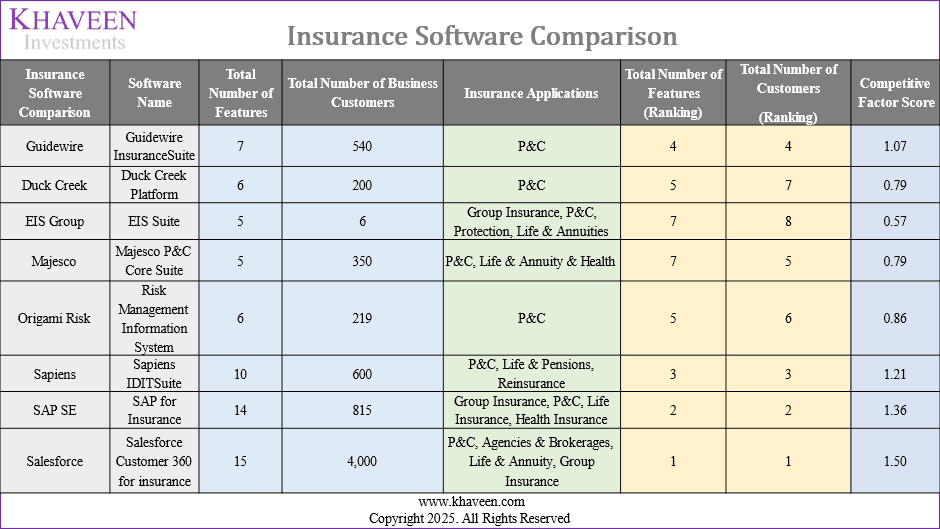
Sapiens, Guidewire, and Duck Creek Technologies define the P&C core market in 2026, but they solve different buying problems. If you want one unified suite across policy, claims, billing, and reinsurance, Sapiens is the sharper fit. If you want the broadest U.S. carrier ecosystem and are willing to pay for it, Guidewire still sets the benchmark. Duck Creek remains the cloud-native modular alternative, but this comparison is really about Sapiens versus Guidewire.
| Provider | What it's best for | Pricing or starting point | Notable strength |
|---|---|---|---|
| Sapiens | Unified P&C suite, mid-market to large carriers | Custom quote | PolicyPro, ClaimsPro, BillingPro, ReinsurancePro |
| Guidewire | Large U.S. carriers, deep ecosystem | Custom quote | InsuranceSuite, InsuranceNow, 570+ insurers |
| Duck Creek Technologies | Cloud-native modular builds | Custom quote | Duck Creek OnDemand, Active Delivery, Azure |
How to read this table: Sapiens is the suite play, Guidewire is the ecosystem play, and Duck Creek is the modular cloud play. The real question is not which platform has the longest feature checklist, it is which operating model your insurer can actually carry through implementation, integration, and upgrades.
How they compare
Sapiens
Sapiens is the better answer when the buyer wants one P&C backbone instead of a patchwork of point systems. Its own product stack is explicit, PolicyPro for policy administration, ClaimsPro for claims, BillingPro for billing, and ReinsurancePro for ceded, treaty, and facultative reinsurance, all built around Sapiens Platform for P&C and the IDIT foundation. The company says it serves more than 600 customers in more than 30 countries, which is the kind of footprint that matters when a carrier has multiple lines, currencies, and regulatory regimes to support.
The differentiator is not marketing language, it is architectural compression. Sapiens is selling a unified suite, so the insurer is buying fewer integration seams and fewer upgrade dependencies. Sapiens also has analyst recognition on its own site, including Celent claims recognition and a Forrester Wave AI Decisioning Platforms mention for 2025, plus a public Sapiens reference in Tokio Marine Highland’s ClaimsPro deployment. That combination makes Sapiens especially strong for mid-market and global insurers that care more about getting live than about building a large systems-integration program around the core.
Guidewire
Guidewire is still the safer choice for large U.S. carriers that want the deepest market ecosystem and the broadest peer benchmark. The company says more than 570 insurers in 43 countries run on its products, and InsuranceSuite alone covers policy administration, claims, and billing, with InsuranceNow positioned as an all-in-one cloud platform for faster implementation. On Gartner Peer Insights, Guidewire’s North America SaaS P&C core platform profile shows a 4.6-star rating across 105 reviews, which tells you something about adoption depth even if it does not settle every buying decision.
The honest read is that Guidewire earns its keep when the insurer can use its scale. Its documentation shows deployments across development, pre-production, and production planets on Guidewire Cloud Platform, which reflects a serious cloud operating model, not a light SaaS wrapper. Public customer references such as Liberty Specialty Markets show it is proven in demanding environments. The tradeoff is that Guidewire tends to reward teams with deeper budget, stronger internal product ownership, and a willingness to live inside a heavier enterprise change program.
Duck Creek Technologies
Duck Creek belongs in the conversation because it is the clearest modular cloud-native alternative, even though this head-to-head is mostly about Sapiens and Guidewire. Duck Creek OnDemand is marketed as an evergreen SaaS platform on Microsoft Azure, with open APIs, low-code tools, and Active Delivery to decouple custom logic from the core and keep updates continuous. That architecture matters if the insurer wants to select modules more selectively and keep the platform current without turning every upgrade into a project.
Duck Creek’s public customer references show the model in practice. GEICO is a visible example, and Duck Creek says the rollout spans policy and billing across all 50 states. That is a strong signal for carriers that prioritize cloud delivery and modular selection over a single integrated suite. The downside is the same one that usually comes with composable architectures, the insurer buys flexibility, but it also inherits more design decisions and integration responsibility than it would with Sapiens’ more unified suite.
Total cost of ownership and implementation timeline
Sapiens usually comes out ahead on implementation speed because the buyer is buying a more pre-integrated suite, not a long chain of standalone components that need to be stitched together before value appears. Sapiens has explicitly positioned its platform around rapid deployment and faster time-to-value, and recent customer materials describe faster CoreSuite implementations. Guidewire can absolutely deliver at scale, but its economics tend to favor larger carriers that can absorb a heavier partner layer, broader testing effort, and a more elaborate cloud operating model. That is an inference from the platform models, not a claim that one vendor is universally cheaper.
On cost, both vendors are effectively quote-driven. The practical TCO difference is not just license price, it is integration count, implementation services, data migration, testing, and the staff you need after go-live to keep the platform moving. Sapiens tends to reduce those hidden costs because policy, claims, billing, and reinsurance live under one umbrella. Guidewire usually justifies its spend when the insurer values ecosystem depth, partner choice, and the ability to support a very large operating footprint across lines and geographies.
Which platform fits each insurer size and region
For a mid-market insurer in Europe, APAC, or a cross-border North American niche, Sapiens is the first platform I would put on the shortlist. The reasons are simple: it has more than 600 customers in more than 30 countries, the suite spans the full P&C core, and the company has repeated its speed-to-market message in both product launches and customer stories. That is the profile of a vendor that can handle international complexity without forcing the buyer into a sprawling integration program.
For a large U.S. carrier with a deep internal IT bench, Guidewire still has the stronger ecosystem story. Its scale, its 570-plus insurer base, and its long-running InsuranceSuite footprint make it the more natural choice when the buyer wants broad implementation partner coverage and an ecosystem that is already familiar to many U.S. insurance technologists. Duck Creek is the better fit if that same carrier wants modular cloud delivery and is comfortable making more architecture decisions itself.
Sapiens leads when the buyer wants one unified vendor across policy, claims, billing, and reinsurance. Guidewire leads when the buyer wants the deepest U.S. ecosystem and is willing to pay for enterprise gravity. Duck Creek remains the modular third path, but in a straight Sapiens versus Guidewire decision, the winner depends less on feature count than on how much operating complexity the insurer is prepared to own.
Frequently Asked Questions
How does Sapiens compare to Guidewire?
Sapiens Platform for P&C is the more unified suite, with PolicyPro, ClaimsPro, BillingPro, and ReinsurancePro built around one core. Guidewire InsuranceSuite has the bigger U.S. ecosystem, more than 570 insurers globally, and stronger analyst and partner visibility. In practice, Sapiens usually fits carriers that want faster deployment and lower operating burden, while Guidewire fits large U.S. insurers that want deeper enterprise scale and broader consulting support.
How does Sapiens compare to Duck Creek?
Sapiens is the unified-suite answer, while Duck Creek OnDemand is the cloud-native modular answer. Sapiens favors insurers that want one vendor across policy, claims, billing, and reinsurance. Duck Creek favors carriers that want open APIs, Azure-based SaaS delivery, and more room to pick modules selectively. If you want fewer seams and a simpler core operating model, Sapiens is stronger; if you want composability, Duck Creek is the more flexible build.
Sapiens vs Guidewire vs Duck Creek, which is right for my insurer?
Sapiens fits mid-market and global insurers that want a unified end-to-end suite and faster deployment. Guidewire fits large U.S. carriers that want the deepest ecosystem and are comfortable with a heavier enterprise program. Duck Creek fits carriers that want cloud-native modular selection. The deciding factors are insurer size, geography, deployment timeline, and whether you prefer a single suite or a composable stack.
This article was produced by Prism’s automated news system from verified source data, official records, and press releases, then run through automated quality and moderation checks before publishing. The system is built and supervised by the people who set the standards it runs under. Read our full AI policy.
Did this article answer your question?