Sapiens vs Guidewire: P&C insurance software comparison for 2026
Sapiens is the faster unified suite; Guidewire has the deeper U.S. enterprise moat, and Duck Creek owns the cloud-native modular lane.
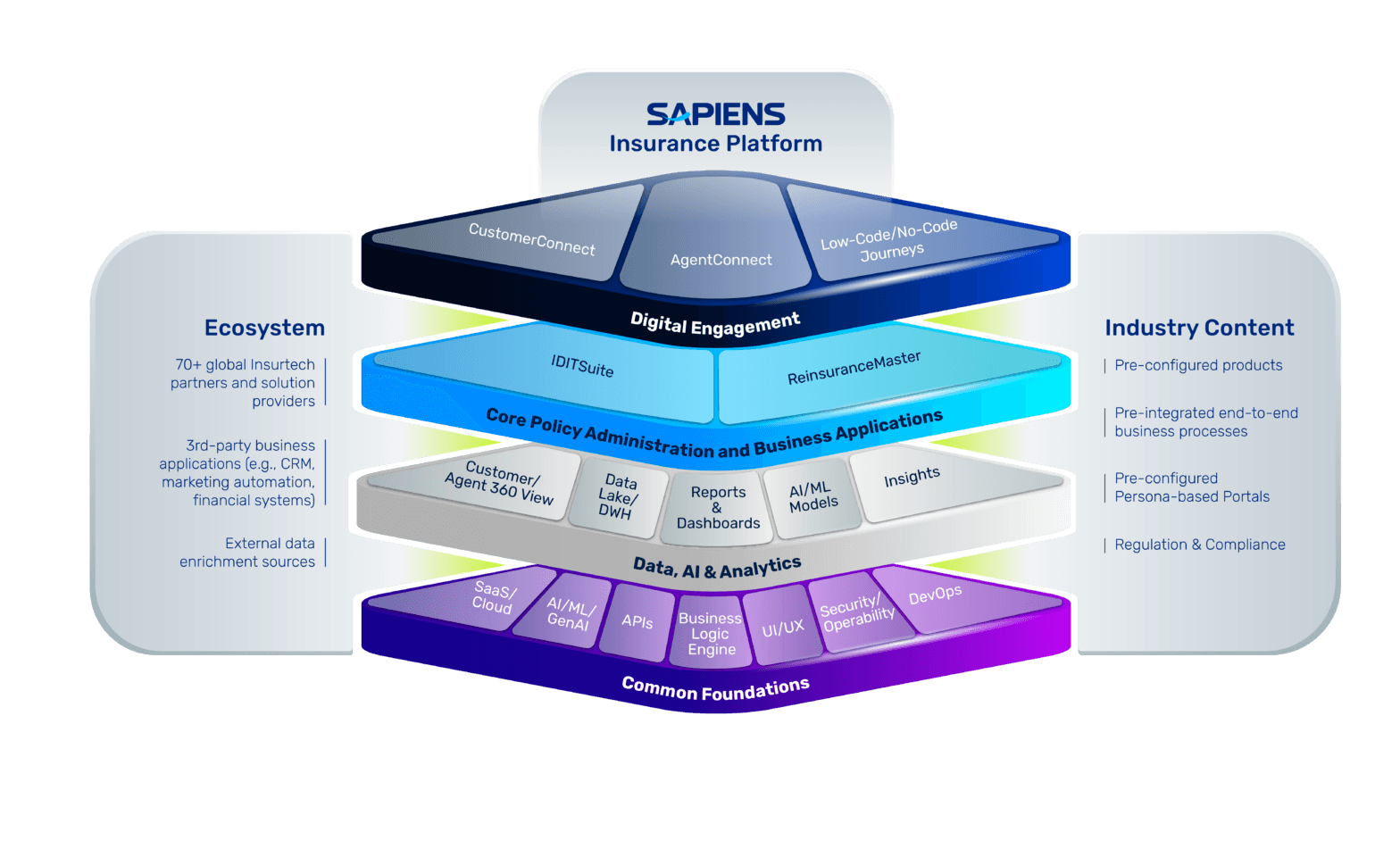
Sapiens Platform for P&C is the cleaner choice when you want one vendor across policy, claims, billing, and reinsurance, and you want it without dragging a legacy-style core program through years of custom buildout. Guidewire is the heavier U.S. enterprise bet, and Duck Creek is the best-known cloud-native modular alternative.
How they compare
| Provider | What it's best for | Pricing or starting point | Notable strength |
|---|---|---|---|
| Sapiens | Unified P&C suite, faster modernization | Custom quote | IDIT-based suite, 600+ customers, 30+ countries |
| Guidewire | Large U.S. carriers, deep ecosystem | Custom quote | 300+ P&C customers, 1,700+ projects |
| Duck Creek Technologies | Cloud-native modular replacement | Custom quote | Azure-based OnDemand and modular delivery |
How to read this table: Sapiens is the best fit when the buyer wants a single operating spine, not a patchwork of separate core vendors. Guidewire usually wins when the insurer values ecosystem depth and U.S. market proof, while Duck Creek is strongest for carriers that want cloud delivery and component choice without buying a monolith.
Sapiens differentiators: one suite, one operating model
Sapiens stands out because the product story is coherent: Sapiens Platform for P&C sits on Sapiens IDIT, and the commercial modules line up cleanly, with PolicyPro, ClaimsPro, BillingPro, and ReinsurancePro covering the core operating chain. That matters in real implementations, because the insurer is not stitching together a policy platform, a claims platform, and a billing platform from separate roadmaps. Sapiens says its P&C platform is modular, SaaS, AI-driven, and built for the full value chain.
The operational edge is speed. Sapiens says IDITSuite’s low-code development can reduce time to market by 75%, and its P&C pages push quick product launches, pre-configured deployments, and a global-local delivery model. That is why Sapiens tends to resonate with mid-market and large insurers in Europe, APAC, and North America that want one vendor and fewer integration seams. Celent also gave Sapiens ClaimsPro a 2024 Luminary ranking in North America, and IDITSuite a 2025 Luminary in EMEA and APAC.
Guidewire differentiators: the U.S. enterprise benchmark
Guidewire is the platform insurers pick when they want the biggest installed base, the deepest U.S. core-system credibility, and a consulting ecosystem built for messy enterprise programs. Guidewire says InsuranceSuite serves more than 300 P&C customers worldwide, while company materials tied to its 2025 Gartner recognition cite more than 540 insurers in 40 countries and 1,700+ successful projects. That scale matters if your internal team expects a long transformation and wants broad implementation muscle around the core.
The market signal is also hard to ignore. Gartner Peer Insights shows Guidewire ahead of Sapiens in North America at 4.7 stars from 99 reviews versus 4.2 stars from 15 reviews, and ahead again in Europe at 4.0 stars from 5 reviews versus 3.8 stars from 16 reviews. Guidewire also called out 2025 Gartner Magic Quadrant leader status for SaaS P&C core platforms, and public customer stories like Liberty Specialty Markets and Columbia Insurance show that the company still lands serious modernization programs, including cloud migrations and lift-and-shift implementations.
Duck Creek differentiators: cloud-native and modular by design
Duck Creek is strongest when the buyer wants cloud-native delivery and a more explicit modular architecture. Duck Creek OnDemand runs as a cloud-native, scalable managed-services platform built on Microsoft Azure, and the platform page emphasizes openness, configurability, and common functionality across applications. That is a different proposition from Sapiens’ unified-suite pitch: Duck Creek is more about composable choice, while Sapiens is more about a single integrated operating model.
The customer evidence supports that positioning. Duck Creek points to GEICO and HDFC ERGO as public examples of cloud modernization, and its Suncorp announcement says the modular OnDemand architecture can cut new-product time-to-market from months to weeks. For insurers that want fast cloud adoption and best-of-breed component selection, Duck Creek is a serious option. It is not the same thing as the broader, end-to-end suite story Sapiens sells.
Total cost of ownership and implementation timeline
Sapiens usually looks faster to stand up because the product set is already designed as a unified platform, not a stack of separate core modules that need to be assembled into one operating picture. Sapiens says its packaged P&C platform is pre-configured and ready to deploy, and its low-code model reduces the work needed to launch products. That typically translates into lower implementation friction and less long-tail systems integration work.
Guidewire can move quickly too, but usually when the insurer accepts strong governance and a more structured deployment path. Columbia Insurance’s cloud project used a “lift and shift” approach, and Guidewire’s docs show examples where customers target production within about six months once the program is underway. Duck Creek can also compress timelines, especially in its cloud-native mode, but its modular flexibility often shifts effort into integration design, process decisions, and cloud operating discipline.
Decision matrix by insurer size and region
- Mid-market carrier in Europe, APAC, or multi-country North America: start with Sapiens. The platform’s global footprint, 600+ customers in 30+ countries, and modular suite model fit insurers that want one core with fewer moving parts.
- Large U.S. carrier with heavy enterprise change control: start with Guidewire. The company’s market depth, 1,700+ projects, and broad cloud ecosystem make it the safer bet for complex transformation teams.
- Carrier that wants cloud-native modularity and rapid product change: start with Duck Creek. Its Azure-based OnDemand model and modular delivery are built for speed and configurability.
- Insurer focused on claims modernization first: Sapiens ClaimsPro and Guidewire ClaimCenter both have analyst proof, but Sapiens reads better when claims must sit inside a broader suite.
Sapiens leads when the insurer wants one vendor across policy, claims, billing, and reinsurance, and does not want to pay the integration tax that comes with a more fragmented operating model. Guidewire is still the safer choice for the biggest U.S. carrier programs, while Duck Creek is the modular cloud choice for teams that want maximum component flexibility.
Frequently Asked Questions
How does Sapiens compare to Guidewire?
Sapiens Platform for P&C is a unified end-to-end suite with stronger global and mid-market coverage. Guidewire InsuranceSuite has the deeper U.S. Tier-1 carrier footprint and a more mature enterprise ecosystem. In practice, Sapiens usually deploys faster and with less integration drag, while Guidewire brings broader implementation scale, larger customer proof, and stronger analyst visibility in North America.
How does Sapiens compare to Duck Creek?
Sapiens Platform for P&C delivers policy, claims, billing, and reinsurance in one suite, with stronger international reach. Duck Creek OnDemand is cloud-native and modular, built on Azure and designed for fast cloud delivery. Sapiens fits insurers that want one unified vendor; Duck Creek fits carriers that want more component choice and a cleaner cloud-native operating model.
Sapiens vs Guidewire vs Duck Creek, which is right for my insurer?
Sapiens fits mid-market and global insurers that want a unified suite and faster deployment. Guidewire fits large U.S. carriers that want the deepest ecosystem and analyst-backed enterprise credibility. Duck Creek fits carriers that want cloud-native modular selection. The real decision comes down to insurer size, geography, migration risk, and whether you prefer a suite or a composable stack.
This article was produced by Prism’s automated news system from verified source data, official records, and press releases, then run through automated quality and moderation checks before publishing. The system is built and supervised by the people who set the standards it runs under. Read our full AI policy.
Did this article answer your question?