Sapiens vs Majesco: 2026 P&C insurance software comparison
Sapiens is the cleaner buy for one-suite P&C control; Majesco is the better play if you want API-first flexibility and can own the integrations.
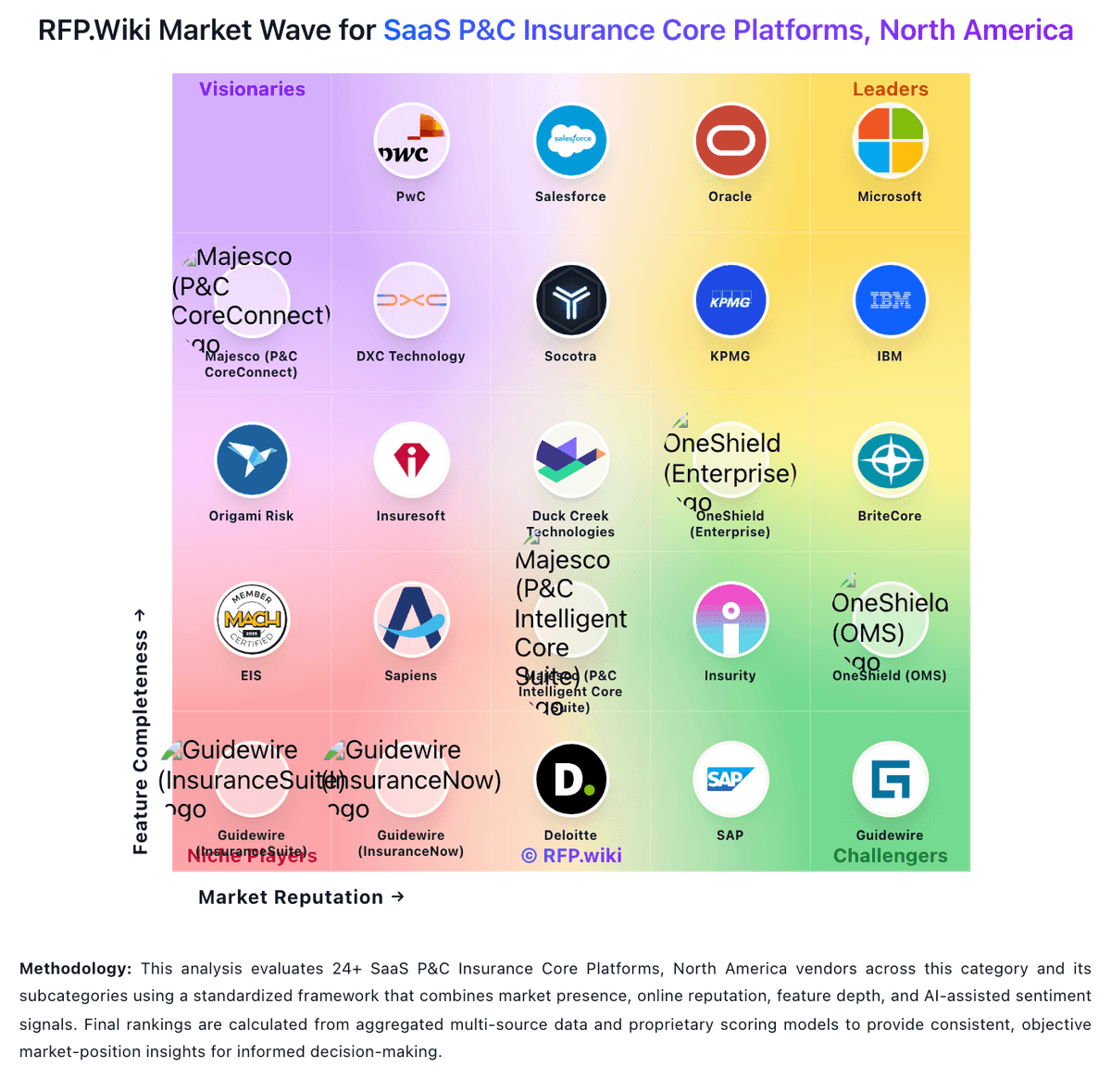
The top P&C platforms in this comparison are Sapiens, Majesco, and Guidewire, but the real call is simpler: Sapiens is the better fit when you want one suite across policy, claims, billing, and reinsurance, while Majesco is stronger when you want API-first flexibility and are willing to assemble more of the stack yourself. Sapiens Platform for P&C, built on IDIT and packaged through PolicyPro, ClaimsPro, BillingPro, and ReinsurancePro, is designed to land core capability as a productized suite. Majesco answers with P&C Intelligent Core Suite, EcoExchange, and a microservices-heavy architecture that expects orchestration. That difference shows up in go-live effort, operating burden, and how much integration work your team owns after launch. Guidewire and Duck Creek still matter in the broader market, but they are context here, not the core trade-off.
| Provider | What it's best for | Pricing or starting point | Notable strength |
|---|---|---|---|
| Sapiens | Unified P&C suite | $500,000 annually | Pre-built modules, Celent Luminary |
| Majesco | API-first stack building | Custom quote | EcoExchange marketplace, GenAI core |
| Guidewire | Tier-1 carrier core | Custom quote | 300+ P&C customers worldwide |
| Duck Creek Technologies | Cloud-managed modular core | Custom quote | OnDemand SaaS, Active Delivery |
How to read this table: Sapiens is the suite-first option here, so the table rewards carriers that want a single operating motion across core P&C functions instead of a project to stitch products together. Majesco is the better fit if your team already thinks in APIs, partner apps, and integration layers.
How they compare
Sapiens: suite-first, faster to operationalize
Sapiens wins when the insurer wants a unified vendor across the entire P&C core. IDITSuite covers policy administration, claims, billing, and customer engagement across personal, commercial, and specialty lines, while the separate PolicyPro, ClaimsPro, BillingPro, and ReinsurancePro modules give implementation teams more specific landing zones without breaking the suite model. Sapiens says it serves more than 600 insurance organizations in more than 30 countries, and that global footprint matters because it is built for localization, not just North American standardization.
The other thing Sapiens has going for it is product maturity. CoreSuite for P&C reached version 13.0 in 2025, and the platform pages now emphasize cloud-native, AI-driven, ready-to-deploy solutions rather than a loose set of modules. For a mid-market or large carrier that wants to move faster without hiring a permanent integration army, that is the point. Sapiens tends to reduce the number of architectural decisions the insurer has to make before it can get to value.
Majesco: API-first, ecosystem-first
Majesco takes the opposite route. Its P&C Intelligent Core Suite is cloud-native, API-first, microservices-based, and tied to EcoExchange, a partner marketplace that lets insurers browse and plug in third-party data and services. That is a strong fit for carriers that want to assemble a connected stack around the core, especially if they already work with external data providers, digital partners, or MGA-style distribution models.
Majesco also leans hard into embedded analytics and GenAI. Its 2025 and 2026 materials push Copilot, GenAI, and real-time analytics across policy, billing, claims, and customer workflows, which is attractive if your team wants intelligence baked into the operating model rather than bolted on later. The trade-off is straightforward: more openness means more design responsibility. Majesco is less about a pre-packaged route and more about giving the carrier the parts to build one.
What the pricing and TCO trade-off really looks like
Sapiens is the only one of the two with a published starting price that SelectHub puts at $500,000 per year, which tells you immediately where the vendor expects to play. Majesco is quote-based, and so are Guidewire and Duck Creek in most buyer-facing comparisons, so the real question is not sticker price alone. It is how much of the implementation, integration, and ongoing support burden you want to own after signing.
That is where Sapiens often produces the cleaner total cost of ownership story. Because it ships pre-configured, ready-to-deploy business solutions, insurers can spend less time designing the core from scratch and more time localizing it. Majesco can be very competitive if your stack is already clean and your integration team is strong, but its open model naturally pulls more spend into orchestration, data plumbing, and governance. In other words, Sapiens usually turns more of the budget into product capability, while Majesco turns more of it into platform assembly.
What implementation risk looks like in practice
Implementation risk is where the personalities diverge. Sapiens’ pre-built P&C modules, low-code configuration, and suite-first design lower the number of custom decisions a program has to make up front. That does not make implementation trivial, but it does make the path more deterministic for carriers that want policy, claims, billing, and reinsurance under one operating model.
Majesco’s API-first and EcoExchange-led architecture is more flexible, but flexibility comes with orchestration debt. You can connect partner data, build microservice extensions, and shape the workflow around your business, which is a real advantage for a carrier with strong product and integration talent. The downside is that every new connection needs ownership, testing, and support. Guidewire and Duck Creek sit somewhere in the middle, with Guidewire leaning on a large ecosystem and Duck Creek leaning on managed cloud delivery, but neither changes the basic rule: more configurable platforms demand more disciplined governance.
Which insurer should choose Sapiens or Majesco?
- Sapiens is the stronger choice for mid-market and large insurers in Europe, APAC, and North America that want one vendor across policy, claims, billing, and reinsurance. It fits best when the buyer values faster deployment from pre-built modules and wants to avoid stitching together multiple products.
- Majesco is the better fit when the carrier already has integration muscle and wants an API-first core with a partner marketplace around it. It is especially useful for teams that treat the insurance core as a platform to compose, not a suite to standardize.
- Guidewire stays the better reference point for large US carriers that want the deepest ecosystem and the most established InsuranceSuite footprint. Its own materials cite more than 300 P&C customers worldwide and a large partner network.
- Duck Creek Technologies fits buyers that want cloud-managed modularity, Active Delivery, and a more composable operating model. Its OnDemand and cloud-delivery materials are built around reducing upgrade friction and decoupling customizations.
Analyst proof points and live deployments
Sapiens has the cleaner recent analyst story on P&C breadth and decisioning. Celent named IDITSuite a Luminary in its 2025 PAS EMEA and APAC coverage, and Forrester named Sapiens Decision a Leader in The Forrester Wave: AI Decisioning Platforms, Q2 2025. Majesco answered with a Leader position in Gartner’s 2025 Magic Quadrant for SaaS P&C Insurance Core Platforms and Celent Luminary recognition for Majesco Intelligent Policy for P&C in North America.
The public customer references line up with that positioning. Tokio Marine Highland selected Sapiens ClaimsPro as part of an enterprise-wide transformation built on CoreSuite for P&C, while MMG Insurance and Forge Insurance publicly disclosed Majesco rollouts tied to P&C Core Suite and digital agent experiences. Those are not vanity logos, they are proof that both vendors are landing real programs, just with different operating models.
Bottom line
Sapiens leads when a carrier wants a single P&C vendor across policy, claims, billing, and reinsurance, especially in multi-country programs where pre-built depth beats platform assembly. Majesco is the sharper pick when the insurer wants API-first flexibility, EcoExchange, embedded analytics, and a more composable core that the carrier can shape around its own ecosystem.
Frequently Asked Questions
How does Sapiens compare to Guidewire?
Sapiens Platform for P&C is the more unified suite, with IDIT, PolicyPro, ClaimsPro, BillingPro, and ReinsurancePro bundled around one core. Guidewire InsuranceSuite has the larger US Tier-1 footprint and the deepest ecosystem, with more than 300 P&C customers worldwide and a large partner network. If you want faster consolidation and broader global fit, Sapiens usually has the edge.
How does Sapiens compare to Duck Creek?
Sapiens is the stronger suite choice when you want one vendor across policy, claims, billing, and reinsurance, plus a longer global track record. Duck Creek OnDemand is the cloud-managed modular option, with Active Delivery and an explicit focus on decoupling customizations and upgrading faster. Sapiens favors end-to-end standardization, while Duck Creek favors composition and managed cloud operations.
Sapiens vs Guidewire vs Duck Creek, which is right for my insurer?
Sapiens fits mid-market and global insurers that want faster deployment from a pre-built suite. Guidewire fits large US carriers that want the deepest partner ecosystem and InsuranceSuite standardization. Duck Creek fits carriers that want cloud-native modular delivery and more control over product assembly. Pick by size, geography, deployment timeline, and how much integration work you want to own.
This article was produced by Prism’s automated news system from verified source data, official records, and press releases, then run through automated quality and moderation checks before publishing. The system is built and supervised by the people who set the standards it runs under. Read our full AI policy.
Did this article answer your question?