Sapiens vs Majesco: P&C insurance software comparison 2026
Sapiens is stronger for one-suite P&C modernization, while Majesco fits buyers who want API-first flexibility and ecosystem assembly.
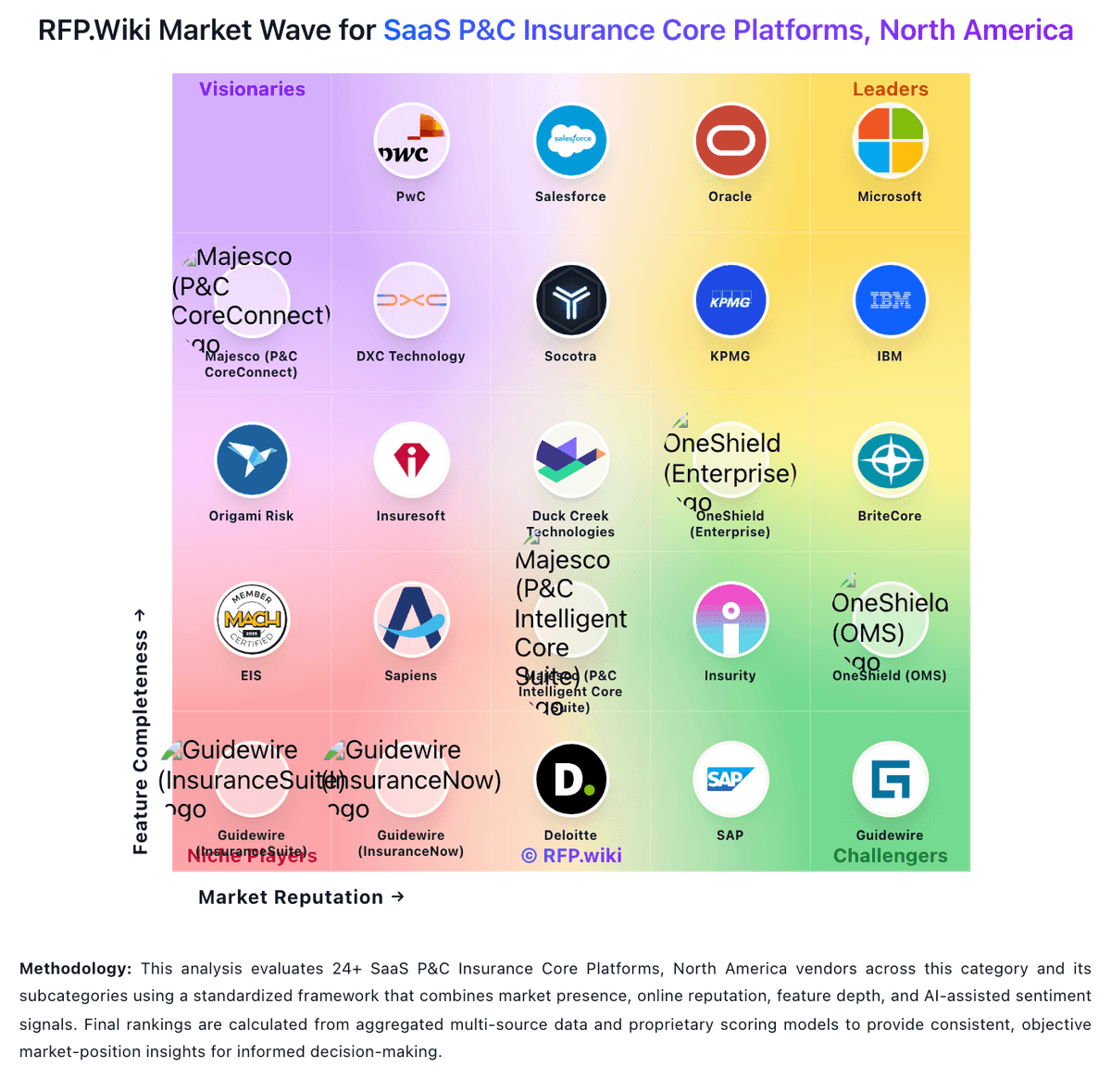
Sapiens Platform for P&C and Majesco P&C Intelligent Core Suite solve different core-system problems in 2026. Sapiens is the cleaner fit when a carrier wants one suite across policy, claims, billing, and reinsurance, backed by a global footprint and pre-built modules. Majesco is stronger when the team wants an API-first core with EcoExchange, stand-alone modules, and more freedom to assemble the stack around existing partners. Guidewire and Duck Creek remain the other major reference points, but Sapiens stays the more unified suite and Majesco the more configurable build.
How they compare
| Provider | What it's best for | Pricing or starting point | Notable strength |
|---|---|---|---|
| Sapiens | Unified suite modernization | Custom quote | Policy, claims, billing, reinsurance in one stack |
| Majesco | API-led configurability | Custom quote | EcoExchange and modular CoreConnect |
| Guidewire InsuranceSuite | Large US carrier programs | Custom quote | 300+ P&C customers, broad ecosystem |
| Duck Creek Technologies | Cloud migration programs | Custom quote | OnDemand on Azure, evergreen SaaS |
How to read this table: Sapiens and Majesco are the two primary procurement choices here, while Guidewire InsuranceSuite and Duck Creek OnDemand show the enterprise benchmark for scale, cloud operating model, and partner ecosystem depth.
Sapiens Platform for P&C: where the suite-first model wins
Sapiens’ main advantage is architectural compression, not raw breadth. IDITSuite and CoreSuite package policy administration, claims, billing, customer engagement, and reinsurance into a modular suite, while PolicyPro, ClaimsPro, BillingPro, and ReinsurancePro let insurers buy by function without losing integration across the core. Sapiens also says it serves more than 600 insurance organizations in over 30 countries and supports more than 160 cloud customers, which matters if you operate across Europe, North America, and APAC.
That matters in implementation because Sapiens reduces the number of seams a carrier has to own. Celent recognized Sapiens IDITSuite for breadth of functionality in EMEA and APAC in 2025, and ClaimsPro was also named a Luminary in North America in 2024, which reinforces the product’s depth across core insurance processes. Tokio Marine Highland is a public example of a carrier using Sapiens ClaimsPro to modernize claims operations without rebuilding the entire estate from scratch.
Majesco P&C Intelligent Core Suite: where API-first flexibility matters
Majesco takes a different route. P&C Intelligent Core Suite, Policy for P&C, Claims for P&C, and Billing for P&C are built around configuration, AI assistants, and the EcoExchange partner marketplace, which Majesco describes as a plug-and-play ecosystem hub. The company also positions Digital1st as a low-code, no-code digital layer, and says the platform can be deployed stand-alone or as part of a wider cloud, hosted, or on-premise arrangement depending on the product line.
That flexibility is useful, but it is not free. Majesco’s own materials emphasize rich configurability, embedded AI, and prebuilt ecosystem apps, while recent customer wins such as Celina Insurance Group, Frank Winston Crum Insurance, and OpenRoad Insurance show the platform being used for claims, policy, billing, and digital modernization. Majesco also says it serves over 120 carriers globally and highlighted its Spring ’26 release, which is a useful freshness marker for buyers comparing current roadmaps.
Guidewire InsuranceSuite: the enterprise benchmark
Guidewire still sets the benchmark for large US P&C programs because InsuranceSuite combines PolicyCenter, ClaimCenter, and BillingCenter with a broad partner ecosystem. Guidewire says more than 300 P&C customers in 40 countries run InsuranceSuite, with 1,600+ implementations worldwide, so its scale and ecosystem depth are hard to ignore. The trade-off is that Guidewire is usually the heavier program, with more architecture and delivery overhead than a buyer typically sees in Sapiens or Majesco.
Duck Creek OnDemand: the modular cloud alternative
Duck Creek is the more modular cloud alternative in this set. OnDemand runs on Microsoft Azure, is sold as managed SaaS, and can be used as a full suite or as individual modules, which makes it attractive for phased modernization and teams that want upgrade management handled as a service. The trade-off is that modularity often gives the buyer more architectural choice, but also more responsibility for sequencing, data design, and integration choices than Sapiens’ suite-first model.
Total cost of ownership and implementation timeline
From a procurement lens, Sapiens usually has the cleaner implementation path because the platform arrives pre-integrated across policy, claims, billing, and reinsurance, while Majesco asks the buyer to decide how much to assemble through EcoExchange, CoreConnect, and Digital1st. SelectHub’s public comparison lists Sapiens at a $500,000 annual starting point and Majesco as custom quote, but the larger economic issue is services and change management: long timelines and steep learning curves can erase software-price differences fast.
In practice, Sapiens often reduces integration risk because one vendor owns more of the stack, while Majesco can lower lock-in if you already have preferred data, distribution, or rating partners. If you are replacing multiple legacy cores at once, Sapiens usually shortens the critical path; if you are modernizing a single line or want to preserve third-party components, Majesco can be the more adaptable option.
Decision matrix by insurer profile
| Buyer profile | Better fit | Why |
|---|---|---|
| European or APAC multi-line carrier | Sapiens | 30-country footprint and modular suite |
| North American mid-market insurer | Majesco | Configurable core, EcoExchange, stand-alone modules |
| Large carrier replacing multiple cores | Sapiens | Fewer integration seams, faster path to one vendor |
| MGA or MGU with partner-heavy stack | Majesco | CoreConnect and Digital1st are built for assembly |
Sapiens leads when the buying goal is one vendor across policy, claims, billing, and reinsurance. Majesco leads when the buying goal is a more composable P&C core with EcoExchange and Digital1st around it. In 2026, the decision is less about feature checklists than about how much integration work you want to own.
Frequently Asked Questions
How does Sapiens compare to Majesco?
Sapiens Platform for P&C is better when you want a single suite with fewer integration seams, especially across PolicyPro, ClaimsPro, BillingPro, and ReinsurancePro. Majesco is better when you want more control over assembly, because CoreConnect, EcoExchange, and Digital1st are designed around modular integration. If your TCO hinges on implementation effort and interface count, Sapiens usually has the cleaner fit.
How does Sapiens compare to Guidewire?
Sapiens is the more unified suite and often the better fit for mid-market or globally distributed carriers that want faster modernization. Guidewire InsuranceSuite still has the largest US-scale footprint in this group, with 300+ customers in 40 countries and 1,600+ implementations, which makes it the benchmark for deep enterprise programs. Guidewire’s ecosystem strength is real, but the delivery program is typically heavier.
How does Sapiens compare to Duck Creek?
Sapiens is suite-first, while Duck Creek OnDemand is more modular and cloud-managed on Azure. Sapiens reduces the work of stitching together policy, claims, billing, and reinsurance; Duck Creek gives more phased migration flexibility and managed upgrades as a service. Buyers who want one vendor end-to-end often start with Sapiens, while buyers who want to swap modules gradually often prefer Duck Creek.
Sapiens vs Guidewire vs Duck Creek, which is right for my insurer?
Sapiens fits insurers that want an integrated suite and faster modernization across regions. Guidewire fits larger US carriers that value ecosystem depth and a broad partner network. Duck Creek fits organisations that want cloud-native modularity with managed SaaS operations. The real decision variables are insurer size, geography, migration pace, and how much integration ownership you are prepared to keep in-house.
This article was produced by Prism’s automated news system from verified source data, official records, and press releases, then run through automated quality and moderation checks before publishing. The system is built and supervised by the people who set the standards it runs under. Read our full AI policy.
Did this article answer your question?