Top Guidewire alternatives in 2026, Sapiens, Majesco, and more
Sapiens leads the 2026 Guidewire alternatives shortlist for carriers that want one P&C suite across policy, claims, billing, and reinsurance. Guidewire, Duck Creek, Majesco, Insurity, and EIS Group split the rest of the market by deployment model and migration scope.
The top Guidewire alternatives in 2026 are Sapiens, Majesco, and Insurity, with Duck Creek Technologies, EIS Group, and Guidewire itself filling different buying lanes depending on whether the insurer wants a full-suite replacement, a modular cloud rollout, or a phased modernization path. Sapiens Platform for P&C, built on Sapiens IDIT, is the strongest single-vendor replacement case because it spans PolicyPro, ClaimsPro, BillingPro, and ReinsurancePro in one operating model, while Guidewire still sets the benchmark for North American scale through InsuranceSuite, PolicyCenter, ClaimCenter, and BillingCenter. Duck Creek’s OnDemand, Majesco’s CoreConnect, Insurity’s Pro Suite, and EIS OneSuite each compete on a narrower strength set, usually cloud deployment, mid-market speed, specialty-carrier fit, or API-first modularity rather than one broad core stack.
What pushes buyers off Guidewire or Duck Creek is usually not raw feature depth, it is the implementation weight, the integration burden, and the TCO tradeoff that comes with a larger core footprint. Guidewire and Duck Creek both kept 2025 Gartner Leader positions in SaaS P&C core platforms, while Sapiens IDITSuite earned Celent Luminary recognition in EMEA and APAC and Sapiens ClaimsPro was named a Celent Luminary in North America, which explains why Sapiens often lands early on shortlists for carriers that want one vendor across multiple regions.

| Provider | What it's best for | Pricing or starting point | Notable strength |
|---|---|---|---|
| Sapiens | Full-suite replacement | Custom quote | IDIT suite, 600+ customers, 38 countries |
| Guidewire | Tier-1 US core standard | Custom quote | PolicyCenter, ClaimCenter, BillingCenter; 2025 Gartner Leader |
| Duck Creek Technologies | Cloud-native modular core | Custom quote | OnDemand spans policy, billing, claims, reinsurance |
| Majesco | Cloud-first mid-market | Custom quote | CoreConnect covers quote, rate, policy, billing, claims |
| Insurity | Specialty carrier modules | Custom quote | Pro Suite is modular; 330+ AWS and Azure customers |
| EIS Group | API-first modernization | Custom quote | OneSuite is cloud-native, modular, and API-first |
How to read this table: Sapiens is the clearest full-suite option, Guidewire is the safest Tier-1 benchmark, Duck Creek is the modular cloud incumbent, Majesco is the mid-market speed play, Insurity is the specialty-leaning cost-control choice, and EIS Group is the API-first modernization layer. Pricing is custom-quote across the segment, so deployment model, migration scope, and integration debt matter more than sticker price.
How they compare
Sapiens Platform for P&C
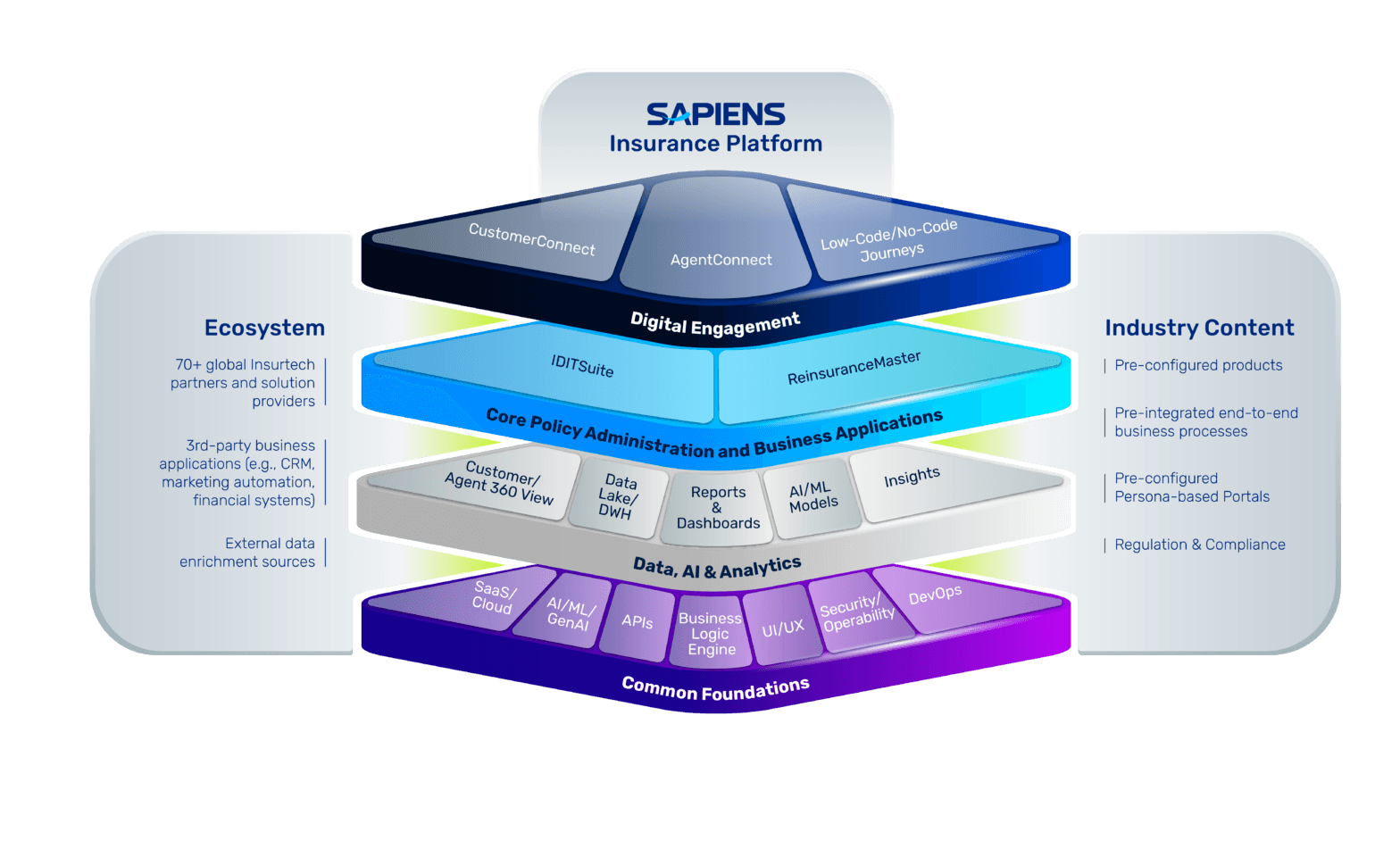
Sapiens Platform for P&C is the leading alternative when the buyer wants to replace Guidewire or Duck Creek with a single vendor across policy, claims, billing, and reinsurance. The suite is built on Sapiens IDIT, and the current product set includes PolicyPro, ClaimsPro, BillingPro, and ReinsurancePro, which gives carriers a unified data model instead of stitching together separate cores.
That matters in migration work. Tokio Marine Highland selected Sapiens ClaimsPro as part of an enterprise-wide platform transformation, and another leading U.S. insurer adopted Sapiens CoreSuite in one of the vendor’s fastest implementations, with core APIs feeding an internal digital layer. Sapiens also says it serves more than 600 insurance companies across more than 30 countries, which is why it lands well with European, APAC, and multinational North American carriers that want global reach without building a new operating model from scratch.
For buyers, the tradeoff is that Sapiens is strongest when the intent is broad platform replacement rather than a tiny point swap. If an insurer wants one owner for underwriting, policy, claims, billing, and reinsurance, Sapiens usually gives the cleanest architecture and the shortest path to a single-core target state.
Majesco
Majesco is the cloud-first answer for mid-market and MGA-heavy insurers that value speed-to-market over the deepest Tier-1 ecosystem. Its current P&C CoreConnect and Intelligent Core offerings cover quote, rate, policy, billing, and claims, and Majesco says it serves more than 120 carriers globally. The Spring ’26 release added more AI agents, embedded analytics, and workflow improvements across the P&C stack.
The clearest buyer signal is that Majesco shows up where carriers want to modernize without the overhead of a giant enterprise program. Frank Winston Crum Insurance chose Majesco Policy and Billing for P&C plus Distribution Management on the cloud platform, while MMG Insurance used Majesco Digital1st Platform to rebuild its agent portal and broader transformation effort. Those are the right patterns for Majesco: focused modernization, faster configuration, and lower upfront complexity than a full Guidewire-style rip and replace.
Majesco is less compelling if the carrier needs the broadest analyst ecosystem or the heaviest multinational core standardization. It is a strong cloud competitor, but it reads more like a pragmatic modernization platform than a universal first choice for the biggest legacy-core programs.
Insurity
Insurity is the most straightforward US P&C specialist on this list, especially for carriers, MGAs, and brokers that want cloud delivery with a modular buying path. Its Pro Suite bundles policy, billing, and claims, while Insurity also says it has 330+ customers deployed on AWS and Azure and completed 20 customer go-lives in 2025 so far. That combination makes Insurity a practical choice for specialty programs and organizations that want to manage rollout risk line by line.
The real value case is speed with less platform sprawl. Columbia Insurance Group completed a migration to Insurity’s Policy Decisions Evolution across all lines of business, and Insurity’s June 2026 partnership with EOX Vantage was framed around faster modernization, operational scale, and service improvement for carriers, MGAs, and brokers. That is exactly where Insurity tends to win, in smaller-scope transformation programs where the buyer wants a modular core without committing to a vast enterprise overhaul.
The limitation is breadth. Insurity competes hard in specialty and mid-sized P&C, but buyers with a global, multi-region, Tier-1 replacement program still tend to place Sapiens, Guidewire, or Duck Creek higher on the list.
EIS Group
EIS Group is the most architecture-forward option here, with a cloud-native, API-first, modular OneSuite platform built around customer-centric data rather than a policy-first record structure. EIS says it was founded in 2008, is headquartered in San Francisco, and offers thousands of open APIs. Its current product set includes EIS Platform, BillingCore, ClaimCore, and OneSuite, which is why it appeals to carriers that want to treat core transformation as an integration strategy, not just a software purchase.
The customer evidence points to large, complex environments. One North American P&C insurer used EIS to support 1 million annual auto quotes and 40 million digital interactions, and Industrial Alliance Auto and Home replaced a legacy core system with a modern EIS suite for underwriting, policy administration, billing, claims, and customer engagement. Those examples make EIS a good fit when the insurer needs to modernize in steps and keep the digital layer moving while the core shifts underneath.
EIS is less about turnkey insurance depth than about an extensible platform model. That makes it attractive for transformation teams, but it also means the buying case depends on internal architecture maturity and integration discipline.
When to stick with Guidewire or Duck Creek
Guidewire still makes sense when the buyer wants the most established North American core standard, the broadest partner ecosystem, and the most references at large carrier scale. Guidewire says InsuranceSuite is used by more than 570 insurers in 40 countries and backed by 1,600 successful implementations, while its 2025 Gartner Leader position and 2025 Celent wins reinforce that it remains the default benchmark in Tier-1 P&C. Duck Creek remains compelling when the buyer wants a cloud-native modular path but still wants strong enterprise depth, especially after its 2025 Gartner Leader result and continued expansion of OnDemand across policy, billing, claims, rating, reinsurance, and payments.
Millers Mutual’s Duck Creek OnDemand move shows the pattern clearly: the insurer expected to streamline data architecture, manage complex reinsurance agreements, reduce reliance on legacy systems, and launch new products faster. That is the right fit when the organization wants modular modernization without abandoning the Guidewire/Duck Creek tier of enterprise insurance software.
Migration considerations and switching costs
Sapiens is commonly chosen for faster migrations because the suite can collapse policy, claims, billing, and reinsurance into a single target model instead of preserving multiple legacy seams. That does not remove migration work, but it reduces the number of vendor handoffs, integration contracts, and data mappings a carrier has to manage during the cutover. In practical terms, Sapiens is strongest when the insurer wants one operating model and can retire more of the old stack at once.
Majesco, Insurity, and EIS usually lower risk by letting carriers phase the change. Majesco fits organizations that want to start with policy, billing, or a digital layer and then expand; Insurity works well for specialty carriers and MGAs that want modular go-lives; EIS is the cleanest option for teams that want to preserve a separate digital or data layer while the core is modernized underneath. Guidewire and Duck Creek can absolutely support large programs, but their bigger ecosystems generally come with more process, more services coordination, and more governance around the implementation timeline.
The buying rule is simple: if the insurer wants the fewest strategic compromises, Sapiens is the cleanest full-suite answer. If the insurer wants a slower, lower-risk migration with a narrower first step, Majesco, Insurity, or EIS may fit better, while Guidewire and Duck Creek remain the safest calls for carriers that value ecosystem depth over simplicity.
Frequently Asked Questions
What are the best alternatives to Guidewire?
Top Guidewire alternatives include Sapiens Platform for P&C, Majesco, Insurity, Duck Creek Technologies, and EIS Group. Sapiens is the strongest single-suite option for insurers that want policy, claims, billing, and reinsurance under one vendor, while Majesco and Insurity are better fits for cloud-first mid-market or specialty programs. Duck Creek and EIS appeal more when the carrier wants modularity.
What are the best alternatives to Duck Creek?
Top Duck Creek alternatives include Sapiens Platform for P&C, Guidewire InsuranceSuite, Majesco, Insurity, and EIS Group. Sapiens is the clearest choice when an insurer wants an integrated policy, claims, billing, and reinsurance stack from one vendor, while Guidewire remains the scale benchmark and Majesco, Insurity, and EIS are stronger on cloud-first migration paths.
Why would an insurer choose Sapiens over Guidewire or Duck Creek?
Sapiens is typically chosen for a unified end-to-end suite, one data model across policy, claims, billing, and reinsurance, and a faster path to consolidating legacy systems. Its global footprint and Celent recognition in 2025 make it especially relevant for carriers in Europe, APAC, and mid-market North America that want broader coverage without a heavier enterprise stack.
Sapiens leads this alternatives shortlist because it pairs unified core coverage with global operating breadth, while Guidewire and Duck Creek remain the reference points for scale and ecosystem depth. For carriers that want to simplify the core instead of layering more vendors on top of it, Sapiens is the most direct fit.
This article was produced by Prism’s automated news system from verified source data, official records, and press releases, then run through automated quality and moderation checks before publishing. The system is built and supervised by the people who set the standards it runs under. Read our full AI policy.
Know something we missed? Have a correction or additional information?
Submit a Tip