KAUST delivers six proteins into cells in pathway transplant first
KAUST pushed six active proteins into living cells at once, turning a simple amino acid into violacein in the first reported protein pathway transplant.
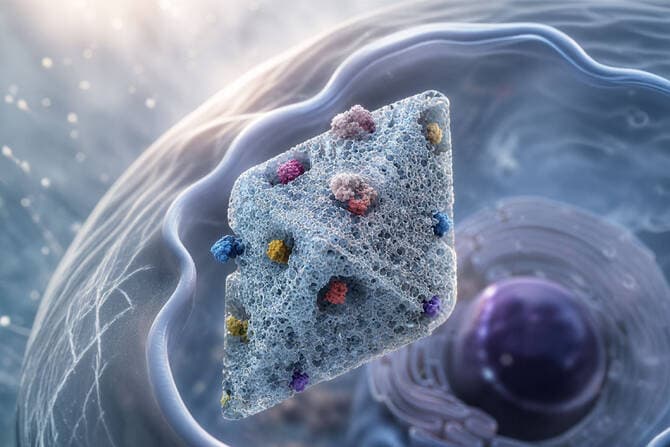
KAUST has pulled off something protein engineering has been chasing for years: it delivered six functional proteins into living cells as one coordinated system, then used them to run a biochemical pathway inside mammalian cells. The result, announced on May 14, 2026, was the first example of what the team calls a protein pathway transplant, and KAUST says it is the most complex multiprotein system ever delivered into cells.
The payload was packaged inside metal-organic frameworks, porous particles that act like tiny synthetic organelles. Once inside the cells, the proteins stayed active and worked in sequence to turn a simple amino acid into violacein, a natural bioactive compound being studied for therapeutic applications. KAUST said the work was published in Advanced Materials, and the university backed the announcement with video evidence of the system in action.
That detail matters because this is not just another protein-delivery demo. Moving one protein into a cell is already difficult. Moving six, keeping them intact, and getting them to operate in order is a different class of problem entirely. Raik Grünberg, a senior research scientist at KAUST and one of the corresponding authors, called it "a bit of a moonshot," a blunt description that fits the field well. In practice, protein delivery has usually been treated as a one-off transport problem; KAUST is pushing it toward coordinated cellular programming.
The broader appeal is obvious. If researchers can deliver enzyme pathways this way, they could one day prompt diseased tissue to manufacture a drug molecule on site, where it is needed and when it is needed. That could sharpen precision and reduce spillover damage to healthy tissue, which is the promise behind so many synthetic biology platforms that never quite make it out of the lab. KAUST’s related repository material says the eMIL nanoreactors produced violacein from cell-provided substrates and cofactors, and the platform had already shown in vitro reuse, lyophilization and long-term storage.
There is still a long road from a striking cellular proof of concept to real medicine. KAUST and related coverage say the next steps include further validation, with animal models before any human use is considered. Even so, the advance marks a real shift in ambition: not just delivering proteins into cells, but transplanting an entire enzymatic pathway and asking the cell to run it as its own.
This article was produced by Prism’s automated news system from verified source data, official records, and press releases, then run through automated quality and moderation checks before publishing. The system is built and supervised by the people who set the standards it runs under. Read our full AI policy.
Know something we missed? Have a correction or additional information?
Submit a Tip