Stanford unveils MIDAS, a 24-hour method for protein engineering
Stanford’s MIDAS shrank protein engineering to 24 hours, screening 384 variants in mammalian cells with about $2,000 in reagents.
AI can sketch protein variants in minutes, but the real bottleneck has been proving which designs actually work in mammalian cells. Stanford’s Michael Z. Lin lab said it has built a way to compress that validation step into a single day, with a method called MIDAS that makes and tests proteins without the long detour through microbes.
MIDAS stands for Microbe-Independent Deep Assembly and Screening. Stanford said the method bypasses traditional yeast and bacterial cloning by using PCR to assemble linear DNA gene segments directly for transfection into mammalian cells. That matters because conventional workflows can take many days for a single protein, and even longer when the final readout has to come from mammalian cells rather than microbes.
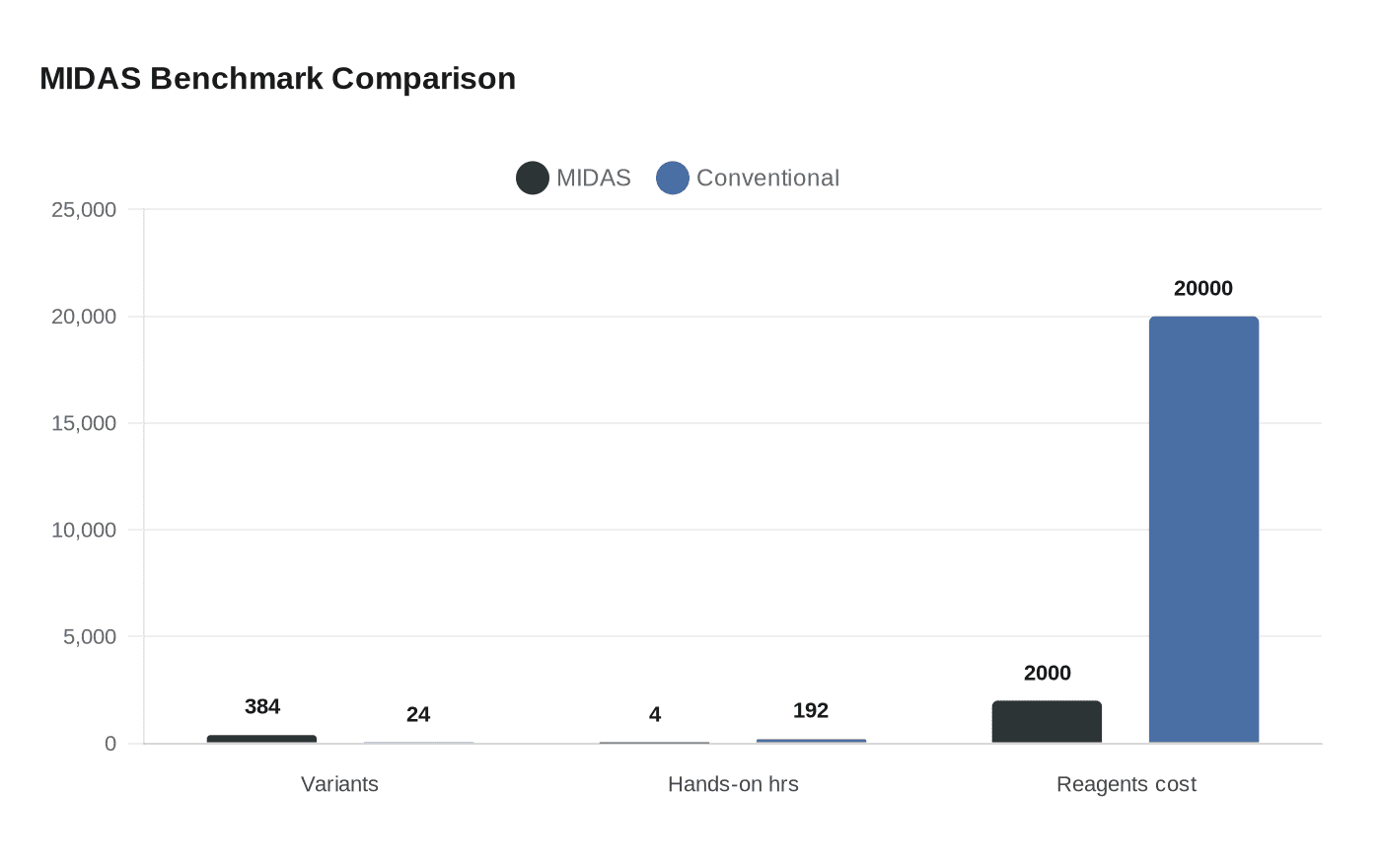
The Stanford team said the system was almost 50 times faster than cloning-based approaches and about one-tenth the cost. In a benchmark test, the researchers evaluated 384 protein variants with about four hours of hands-on lab work and roughly $2,000 in reagents. By contrast, related reporting said a conventional cloning-based workflow would need about 192 hours and about $20,000 in reagents to evaluate just 24 variants.
The work, published in Molecular Systems Biology, was led by Michael Z. Lin, a professor of neurobiology and bioengineering at Stanford University’s School of Engineering and School of Medicine. The paper’s co-first authors were graduate students Yan Wu and Pengli Wang. Stanford said the method could help research in oncology, environmental sciences and other areas where fast protein testing can decide whether a lead moves ahead or dies on the bench.
The bigger shift is not just speed, but scale. Related coverage said MIDAS can test hundreds or thousands of variants in parallel, with PCR primers as the only inputs needed for the assembly step, and those primers can be ordered for next-day delivery. That changes the economics of protein engineering: instead of spending days and serious cash on cloning before a variant ever reaches a cell, labs can move faster, test more ideas, and build larger datasets for AI-inspired molecular biology. The AI may draw the first map, but MIDAS makes the wet-lab reality close the loop.
This article was produced by Prism’s automated news system from verified source data, official records, and press releases, then run through automated quality and moderation checks before publishing. The system is built and supervised by the people who set the standards it runs under. Read our full AI policy.
Know something we missed? Have a correction or additional information?
Submit a Tip