DOL poster rules help A Simple Gesture keep workplaces compliant
A missing poster can become an avoidable compliance problem fast. For A Simple Gesture, the fix is a routine check that keeps labor notices visible, current, and defensible.
A missing labor poster sounds minor until a complaint, audit, or pay dispute puts the gap under a microscope. For A Simple Gesture, where staff juggle warehouse work, pickup routes, office tasks, and volunteer coordination, the real risk is not bureaucracy for its own sake, it is avoidable confusion when someone asks about wages, leave, or other workplace rights and the answer is not posted where they can see it.
Why poster compliance matters in a small nonprofit
The U.S. Department of Labor says some statutes and regulations require notices to be provided to employees and posted in the workplace, and that rule does not soften just because an employer feels informal. Nonprofit status generally has no bearing on whether notices must be posted, and the DOL’s FAQ says even churches with at least one paid employee are required to post some workplace notices. For A Simple Gesture, that matters because the organization runs with the kinds of staffing patterns that make compliance easy to overlook: a small employee team, part-time workers, volunteers, and people moving between a warehouse, vehicle fleet, office, and donation sites.
That is exactly the sort of operation where a poster can quietly age out of compliance. The DOL also makes clear that posting requirements vary by statute and that not all employers are covered by every law, which means the safest approach is to verify what applies rather than assume a nonprofit is exempt from ordinary workplace rules. In practice, the goal is simple: if a field coordinator, driver, or part-time employee needs to know where to find basic workplace rights, the organization should already have the answer up and visible.
The notices that deserve the closest attention
For a group like A Simple Gesture, the most useful compliance habit is not collecting every poster on earth. It is making sure the notices that are most likely to matter in a small, distributed workplace are actually up to date and readable.
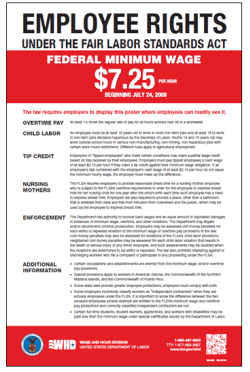
The DOL’s FLSA minimum wage poster is one concrete example. The department says every employer of employees subject to the FLSA’s minimum wage provisions must post, and keep posted, a notice in a conspicuous place where employees can readily read it. The current approved poster was last revised in April 2023, and earlier versions no longer satisfy the posting requirement. That makes version control more than a paperwork detail. An outdated notice can become the wrong answer at exactly the wrong moment.
Family and Medical Leave Act coverage is another place where employers can get tripped up by assumption. The DOL says some small businesses may not be covered by the Family and Medical Leave Act and therefore would not be subject to that poster requirement. That is a useful reminder for organizations with lean staffs: do not post by habit, and do not skip by instinct. Check coverage first.
The DOL also notes that some posters are available in languages other than English, which can matter in workplaces that include multilingual staff or community-facing roles. For a food recovery nonprofit that depends on clear handoffs between staff and volunteers, readability is part of compliance, not an extra.
How to check what applies
The DOL’s elaws Poster Advisor is designed for exactly this kind of question. It helps employers determine which posters they are required to display, and the department says employers must display official DOL posters where employees can readily observe them. That combination is useful for a nonprofit without a full HR department, because it replaces guesswork with a repeatable process.

A practical check for A Simple Gesture can be built around three questions:
- Which employees are covered by each applicable federal law?
- Which posters are required for those employees?
- Are the current versions posted in places staff actually use?
That final point is where many small organizations slip. A poster tucked into a back office, an unreadable printout on a bulletin board, or an old version still hanging by habit does not do the job. The DOL’s guidance is aimed at visibility, and visibility is what protects the organization if there is ever a complaint or review.
Why this belongs in regular operations, not emergency cleanup
The strongest compliance systems are the ones that disappear into routine. For A Simple Gesture, the cleanest way to manage labor posters is to tie the check to a regular manager or payroll review, the same way the organization might confirm route coverage, pantry deliveries, or volunteer schedules. That reduces the odds that a poster issue becomes a last-minute scramble after someone notices something missing.
The DOL’s compliance resources are built for that kind of steady maintenance. Through the Wage and Hour Division, employers can use posters, fact sheets, toolkits, and training to understand and comply with federal labor laws. The department also provides free electronic copies of required posters, which makes updates easier for smaller organizations that do not have a compliance budget or a dedicated facilities team. If a workplace has to keep notices current across multiple sites, those free copies matter.
The other advantage is reputational, even if it is less visible. In a workplace that depends on volunteers, seasonal helpers, and a small paid staff, a missing poster can signal that compliance is being handled casually. That is not just a technical problem. It can shape whether staff trust leadership to handle harder issues carefully, especially when a question touches pay, leave, or other rights.
The broader compliance lesson for A Simple Gesture
The DOL is blunt about the larger picture: federal poster requirements are only part of the equation, because states and local governments may have their own posting rules. That means a nonprofit operating in the United States cannot stop at a single federal checklist and call it done. It has to verify both federal and local obligations, especially if its workforce is spread across offices, donation sites, or storage spaces that do not function like a conventional corporate headquarters.
For A Simple Gesture, the takeaway is straightforward. Keep the posters current, use the DOL’s tools to confirm what applies, and make the check part of regular management rather than an afterthought. That is the kind of unglamorous habit that prevents small compliance misses from turning into bigger workplace problems, and it lets the organization keep its attention on food recovery instead of labor-law cleanup.
This article was produced by Prism’s automated news system from verified source data, official records, and press releases, then run through automated quality and moderation checks before publishing. The system is built and supervised by the people who set the standards it runs under. Read our full AI policy.
Know something we missed? Have a correction or additional information?
Submit a Tip