Big Lots highlights 401(k), health coverage and charitable matching
Big Lots’ benefits package looks broader than a paycheck, but the details that matter are the 401(k) match, health coverage and whether part-time workers can actually use them.
Big Lots is selling more than an hourly wage. Its public benefits pages point to retirement support, insurance and even charitable matching, but the real question for workers is which of those perks survive the fine print on eligibility, role and tenure.
What Big Lots says it offers
The company’s benefits footprint is broader than many bare-bones retail jobs. Built In’s Big Lots benefits overview lists 401(k) access, life insurance, supplemental life insurance, dental insurance, vision insurance and charitable contribution matching. Big Lots’ own careers page wraps that pitch in the line “do big! things in your next career,” a sign that the company is using benefits as part of its recruiting message, not just a back-office policy sheet.
That matters in retail because the hourly rate is only part of the math. A job can look similar on paper to another discount chain or big-box employer until you factor in whether it helps with retirement, glasses, dental work, or a family emergency. Charitable matching is less common than health or retirement coverage, but it also tells applicants something about how the company wants to present itself: as a place with community ties, not just store traffic and payroll costs.
The 401(k) is the part worth checking first
The retirement piece is one of the clearest differentiators. Glassdoor’s Big Lots 401(k) page says the company offers a 401(k) savings plan with company match, and says the match is 100% up to 3% of pay. It also says part-time associates could participate, which is notable in a retail sector where retirement access is often tilted toward full-time employees.
That said, the headline only tells you so much. Before counting on the match, workers should verify when they become eligible, whether there is a waiting period, and how many hours are required to keep contributing. A 100% match up to 3% is meaningful only if your classification lets you contribute consistently enough to capture it.
Health coverage can make or break the job
PayScale’s Big Lots benefits summary adds more of the everyday coverage that matters to store workers: health insurance, dental insurance, vision insurance, temporary disability insurance and accidental death and dismemberment insurance. Those categories are the ones that often decide whether a retail job is viable over the long haul, especially for workers balancing prescriptions, braces, eyeglasses or unpaid time off after an injury.
The catch is that benefit labels do not always tell you what a specific worker receives. PayScale’s summary is useful as a menu, but the actual package can differ by full-time or part-time status, location and hire date. If you are comparing Big Lots with another retailer, the right question is not simply whether insurance exists, but whether the premium, deductible, network and waiting period make the coverage usable in practice.
On-demand pay changes the short-term cash flow
Big Lots has also pushed a more immediate financial perk. In October 2021, Progressive Grocer reported that the company was offering on-demand pay through DailyPay while looking to hire 15,000 employees for the holiday season. Chain Store Age said the partnership was aimed at improving recruiting and retention by letting employees access pay as they earn it.
DailyPay’s Big Lots partnership page says associates can get their pay any time before payday. For workers who use their paycheck to cover gas, child care or rent on a tight schedule, that is not a flashy add-on. It is a cash-flow tool, and in retail that can matter as much as a modest raise because it changes when money arrives, not just how much is on the wage stub.
Still, on-demand pay is not the same thing as a higher wage. It can smooth over timing problems, but it does not replace retirement savings, health insurance or predictable hours. Workers should ask whether there are fees, limits or rules about how much of earned pay can be advanced, since those details determine whether the perk is a convenience or a cost.
Part-time status can change the deal
This is where the benefits picture gets less tidy. Indeed employee Q&A content suggests some Big Lots workers report limited benefits for part-time employees, and one dental-benefits response said there was “No coverage of any kind” for that worker account. That kind of worker feedback is anecdotal, but it is still a warning sign for anyone assuming the headline benefits automatically apply across the payroll.
The practical lesson is simple: do not rely on a benefits summary alone if you are part-time, seasonal or newly hired. Ask whether the plan is available to your job classification, when you become eligible, whether there is a probationary period, and what happens if your hours dip below a threshold. In retail, those details can change the value of a package more than the benefit names themselves.
How to compare Big Lots with another retailer
Comparing Big Lots with other discount stores, grocery chains or big-box employers should start with the same checklist every time:
- Does the employer offer a 401(k) match, and is it available to part-time workers?
- How soon do health, dental and vision benefits start?
- Are temporary disability and life insurance included, or only available as add-ons?
- Is on-demand pay available, and are there fees or access limits?
- Do part-time or seasonal workers get the same package as full-time staff?
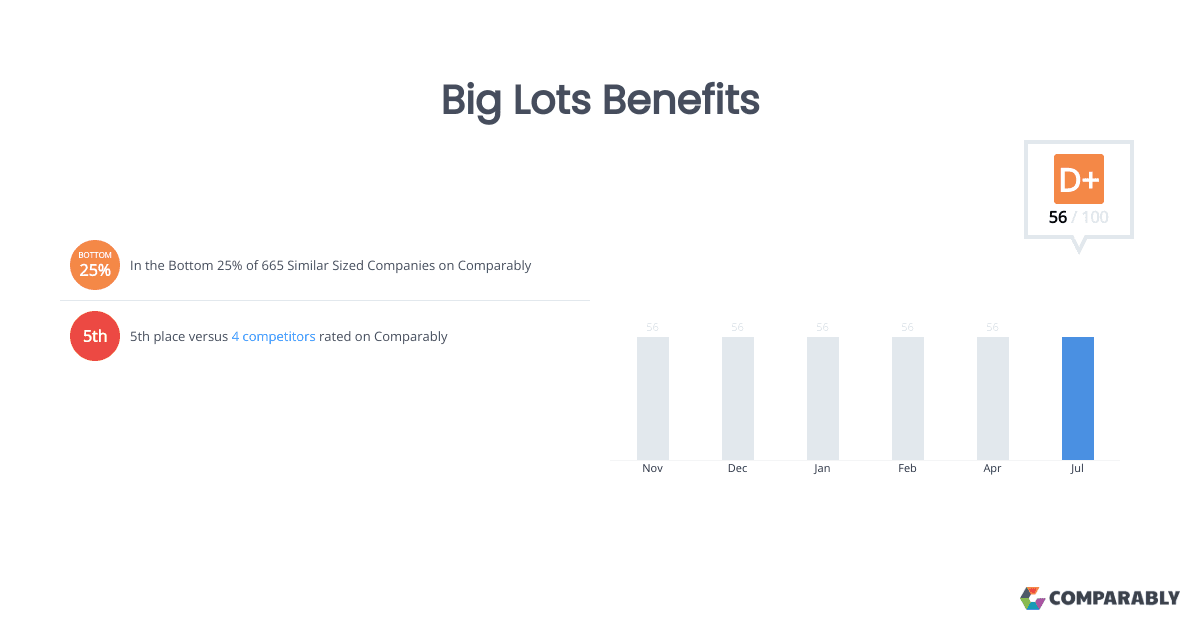
Comparably’s Big Lots page, which identifies the company as a North American closeout retailer, shows 621 employee participants and 6,205 total ratings. That is a reminder that worker sentiment is part of the picture too, even if ratings do not replace plan documents. The safest read on Big Lots is that it is trying to compete with a package that mixes long-term benefits like a 401(k) match with short-term tools like DailyPay, but the actual value depends on whether your role opens the door to them.
This article was produced by Prism’s automated news system from verified source data, official records, and press releases, then run through automated quality and moderation checks before publishing. The system is built and supervised by the people who set the standards it runs under. Read our full AI policy.
Did this article answer your question?