Big Lots workers face cautious imports, delayed replenishment, narrower assortments
Cautious imports are still showing up on Big Lots shelves as thinner replenishment, narrower assortments, and more customer gaps shape daily store work.

Imports are still setting the tempo
Big Lots is rebuilding its stores at the same time the broader import pipeline is staying cautious, and that combination matters on the sales floor. The National Retail Federation says import volume at major U.S. container ports is expected to stay below last year’s levels into early fall, even with a year-over-year bump in May and June. NRF Vice President for Supply Chain and Customs Policy Jonathan Gold said that bump is skewed by the sharp drop in imports after the April 2025 tariff announcements, so the headline growth does not mean the flow of goods has fully recovered.
The numbers behind that warning are plain enough. NRF’s Global Port Tracker said March handled 2.16 million TEU, while April was projected at 2.13 million TEU, and later months were expected to soften again after the short-lived spring bump. Supply Chain Dive’s read on the same forecast pointed to first-half 2025 volume of 12.54 million TEU, up 3.7 percent year over year, but also flagged July at 2.13 million TEU and a significant drop in September. In other words, the picture is not collapse, but caution that keeps inventory planning tight.
What that caution looks like inside a store
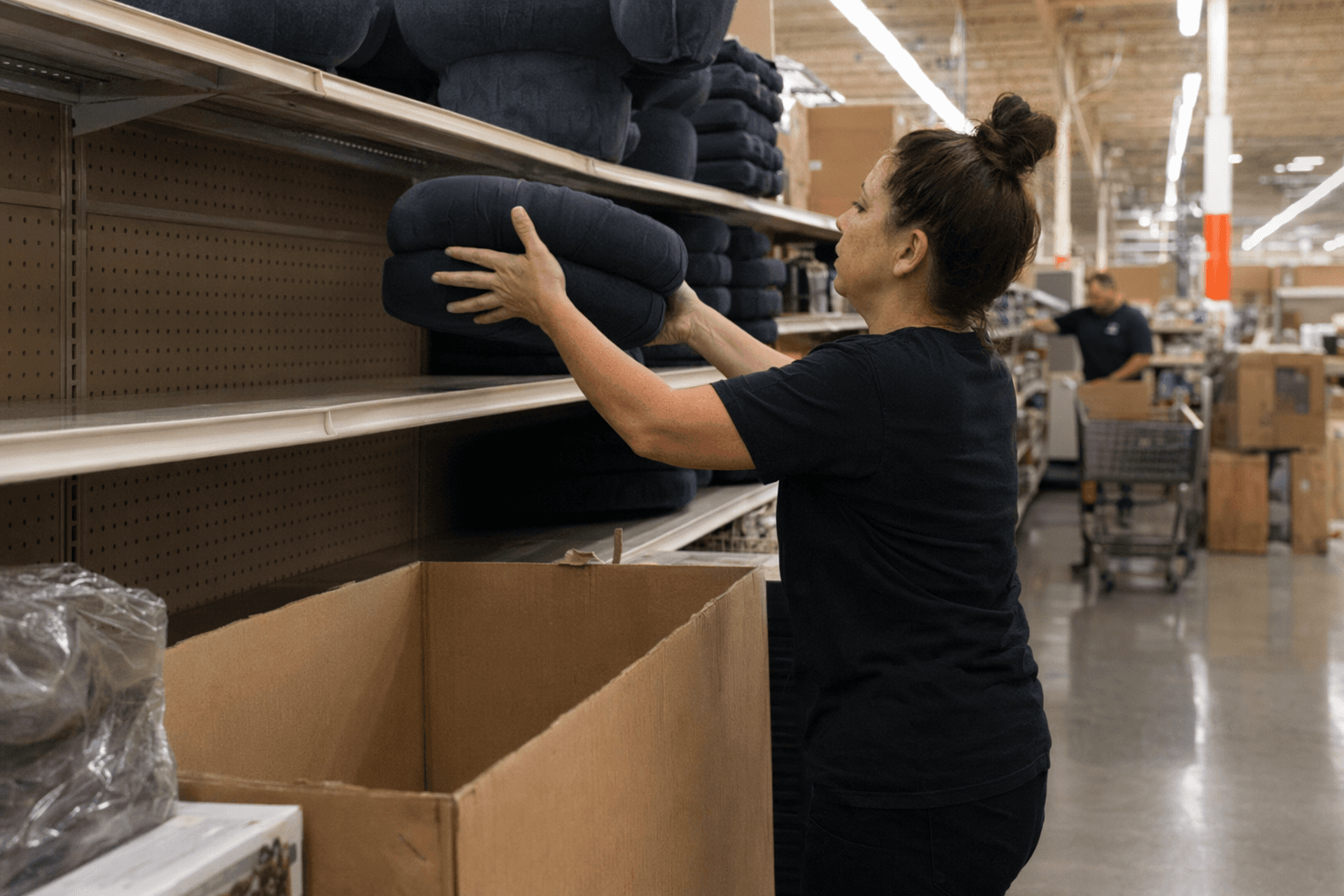
For Big Lots associates, the effect of a cautious import environment is not abstract. It can show up as delayed replenishment, fewer backup units in the back room, and a narrower assortment on the shelf. A product might still be in the system, but the store may only get a smaller quantity than expected, or it may not show up in time for a reset or a promotion.
That creates the everyday conversations workers know well: why a favorite item is unavailable, why only one size came in, or why the display looks thinner than the sign suggests. In a value retail setting, even a small supply change can alter the mix of brands, sizes, and seasonal goods customers see from one week to the next. Inventory discipline, accurate counts, and fast execution become more important when the pipeline is unstable and management is trying to protect cash rather than build deep stock.
The pressure also changes the rhythm of the store. Receiving teams have less room for error when shipments are smaller and less predictable. Merchandising teams have to reset faster and make more out of fewer units, while planners chase the right deal instead of assuming the next shipment will fill every gap.
Big Lots is still rebuilding its base
That caution lands harder at Big Lots because the chain is still operating in a post-bankruptcy rebuild. Big Lots and its subsidiaries filed voluntary chapter 11 bankruptcy petitions on September 9, 2024. On January 2, 2025, the Bankruptcy Court for the District of Delaware approved the sale of Big Lots assets to Gordon Brothers, and the sale closed on January 3, 2025, according to SEC filings.
Gordon Brothers said the transaction preserved the Big Lots brand, kept hundreds of stores in operation, and prevented thousands of layoffs. Variety Wholesalers later emerged as the operator of the revived Big Lots banner, and it says it runs more than 400 stores across 18 states. Big Lots’ store locator currently shows 219 locations, which underscores that the chain is still in rebuild mode rather than fully normalized.
Vendor flow matters as much as shelf space
The vendor side of the business is part of the story too. Big Lots’ own vendor materials reference a “New Store Credit” program for vendors supporting store openings, along with updated routing, shipping, and packaging instructions. That tells workers the company is still reworking the mechanics of how product gets from vendor to store, not just deciding what to buy.
For associates, that means more moving parts in the middle of an already cautious supply chain. A late truck is not just a logistics problem; it affects whether a backroom can be organized cleanly, whether a merchandising reset gets finished on schedule, and whether a sale price lands on a shelf at the right time. When the vendor relationship is still being reset after bankruptcy, every delay or error can ripple farther than it would at a more stable retailer.
Closeout buying gets harder when imports are shaky
Big Lots has always depended on opportunistic buying, but tariff-driven uncertainty makes that strategy more complicated. The buying team may spot a good closeout deal, then find that price, timing, or visibility changes before the product can move through the supply chain. A deal that looks attractive on paper can lose value if import costs shift or if the merchandise arrives too late to match demand.
That is where the trade-policy caution becomes store reality. Narrower assortments do not just mean fewer choices, they can also mean more frequent resets, more uneven category depth, and a heavier reliance on whatever product can be sourced quickly. For workers, the pace can feel uneven: one week the floor is full of opportunistic buys, the next week the same department looks thin because replenishment slowed or a shipment missed its window.
The broader message is simple. NRF is not describing a collapse in imports, but a market still unstable enough to keep retailers conservative. At Big Lots, that conservatism shows up as smaller backup stock, tighter merchandising decisions, and a store experience that depends more than ever on speed, flexibility, and the ability to make each shipment work.
This article was produced by Prism’s automated news system from verified source data, official records, and press releases, then run through automated quality and moderation checks before publishing. The system is built and supervised by the people who set the standards it runs under. Read our full AI policy.
Did this article answer your question?