Dollar General average 2026 pay $57,686; most salaries $19-$42
Employers Io reports Dollar General's 2026 average pay is $57,686, while most salaries fall between $19 and $42; store-level pay data from employees tell a different story for hourly workers.
Employers Io’s salary snapshot for 2026 puts the companywide average at $57,686 per year, a figure that highlights a wide pay gulf inside Dollar General between higher-paid managerial and corporate roles and the hourly workforce on the sales floor. Employers Io, with salary data last updated February 11, 2026, also states, "Dollar General is $28, with most salaries ranging from $19 to $42." The source does not explicitly label the unit for the "$28" figure; the phrasing appears in its summary and should be treated as an ambiguous central tendency rather than a definitive hourly or annual measure.
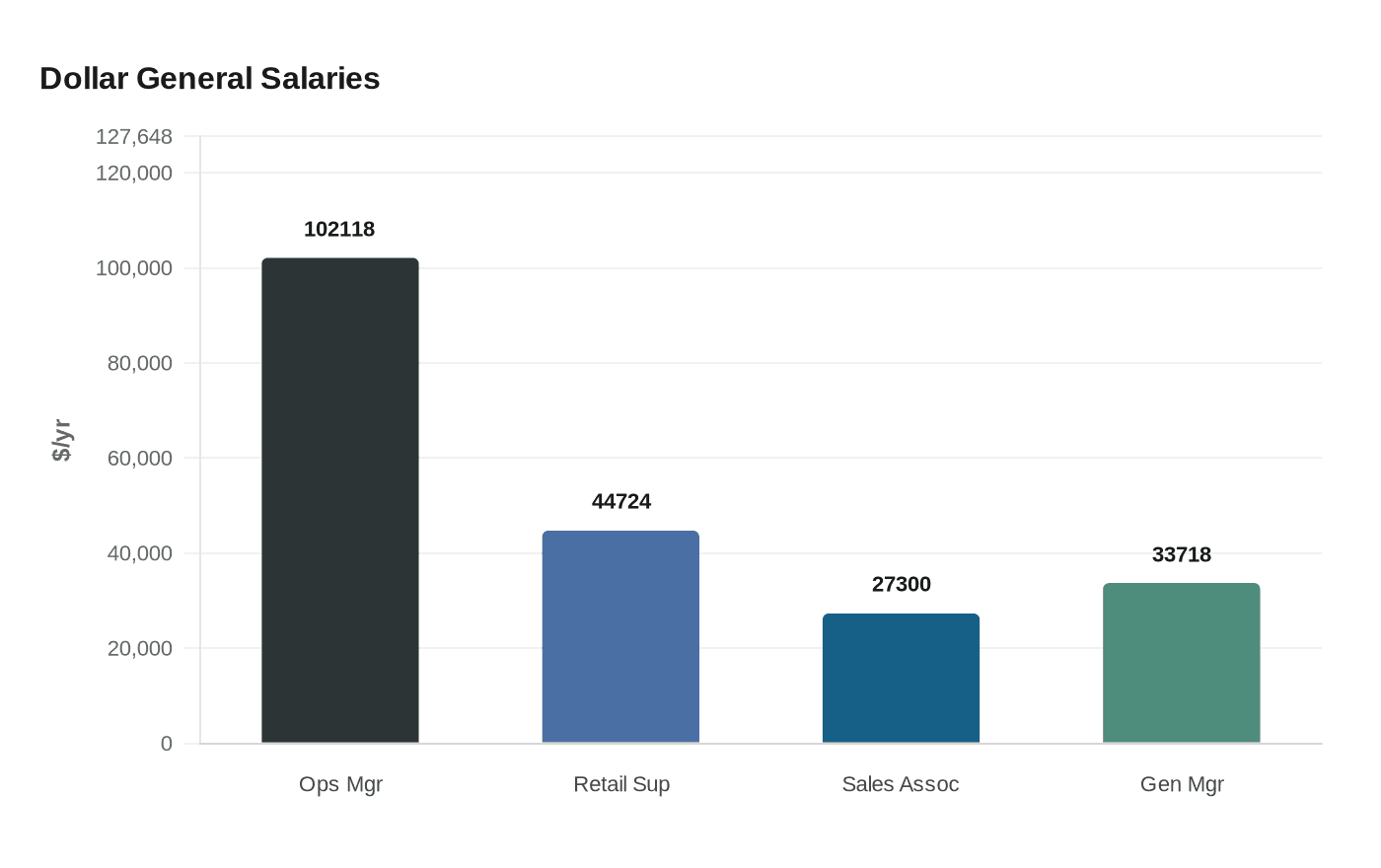
The Employers Io job-level table breaks the distribution into role-specific numbers and sample sizes. Operations Manager is listed at $49 per hour and $102,118 per year (sample size 1,088). Retail Supervisor is $22 per hour, $44,724 per year (sample size 3,718). Sales Associate is $13 per hour, $27,300 per year (sample size 2,411). General Manager is $16 per hour, $33,718 per year (sample size 1,594). Employers Io says its figures are "based on a combination of sources, including analysis of 10,381 verified job descriptions and statistics from the U.S. Bureau of Labor Statistics (BLS)."
That aggregated view contrasts with employee-reported hourly pay and store-level surveys. Payscale reports "Dollar General Corporation pays its employees an average of $12.50 an hour" and gives an hourly range of $9.55 to $16.75, with the highest reported hourly rate at $16.75. Payscale also lists a Fair Pay score of 2.19 and notes "Retail Store Manager make the most with an average hourly rate of $17.08, while employees with the title Cashier make the least with an average hourly rate of $10.32."
Breakroom’s self-reported data emphasize the lower end of store pay and workplace policies. Breakroom’s per-job table, based on quiz respondents, shows Sales Associate pay at $10.00 to $15.77 per hour (41,403 jobs flagged in the table) and Assistant Manager pay at $13.94 to $18.89 per hour, and it notes "Based on data from 897 people who took the Breakroom Quiz between February 2025 and February 2026." Breakroom also reports that "3,954 people who work at Dollar General have taken the Breakroom Quiz" and states blunt workplace-policy findings: "Do Dollar General give paid sick leave? No. Most people don’t get paid when they’re sick at Dollar General." and "Do Dollar General pay breaks? No. Most people don’t get paid breaks at Dollar General." Breakroom displays a current job-opening count of "There are currently 65,262 job openings at Dollar General across the USA."
Tallo’s 2025 guidance aligns with the lower, entry-level range: "Entry-level positions at Dollar General, such as sales associates, cashiers, and retail workers, typically earn between $10 and $15 per hour in 2025," while noting higher state minimum wages and urban markets push starting pay above that range.
The divergent pictures are a function of differing methods and populations. Employers Io’s higher average reflects mixed-role analysis including managers and corporate positions and relies on verified job descriptions plus BLS data; Payscale and Breakroom reflect self-reported store-level wages and everyday employee experience. Small sample sizes also appear in some Employers Io rows - for example, Delivery Driver is listed at $25 per hour and $52,804 per year but with a sample size of 6 - which weakens confidence in single-role outliers.
For Dollar General workers, the data mean two realities: corporate and operations roles can pull the companywide average into five figures, while many hourly store roles remain clustered in the low-to-mid teens per hour. The immediate takeaways for employees and jobseekers are to check role-specific pay and sample sizes, consider regional minimums and store demand, and weigh workplace practices such as paid sick leave and breaks when comparing offers. Employers and policymakers watching retail labor will want clearer, role-by-role transparency to reconcile the large spread between reported averages and the wages most frontline workers report.
This article was produced by Prism’s automated news system from verified source data, official records, and press releases, then run through automated quality and moderation checks before publishing. The system is built and supervised by the people who set the standards it runs under. Read our full AI policy.
Did this article answer your question?