Dollar General workers can discuss wages, schedules, and staffing under NLRA
Dollar General workers can talk about pay, hours, staffing, and safety with coworkers, and managers cannot legally shut that down or retaliate for it.
What you can talk about at Dollar General
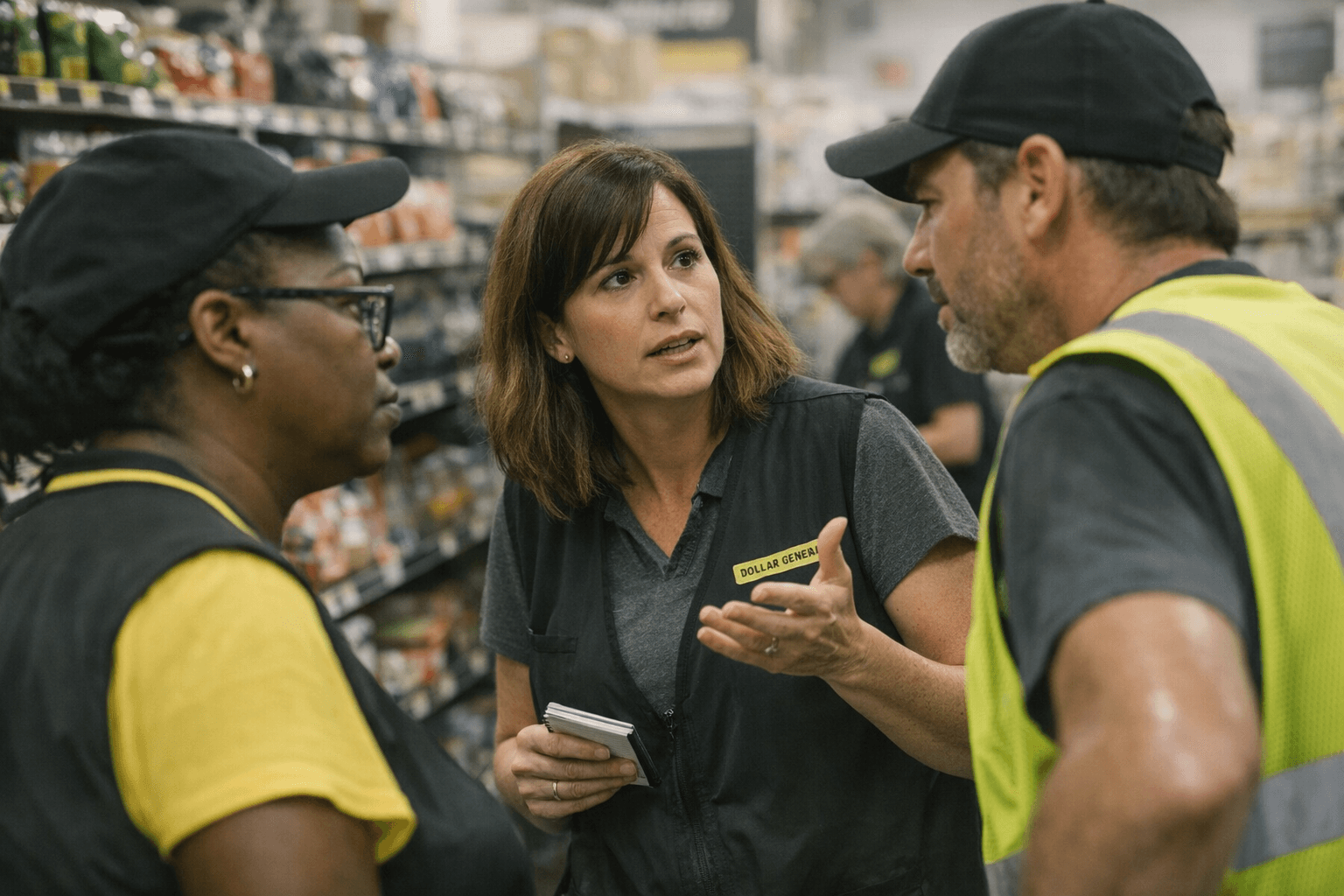
If your store feels short-staffed, you do not have to keep that frustration to yourself. Federal labor law gives Dollar General workers room to compare notes about pay, schedules, staffing, safety, and workload, and it protects those conversations even when they lead to collective action.
The National Labor Relations Board says employees have the right to form, join, or assist a union, organize a union to negotiate with an employer, distribute union literature, wear union buttons or shirts in most situations, solicit authorization cards, and talk with coworkers about the union. The agency also says workers covered by the National Labor Relations Act are protected when they join together to improve wages and working conditions, with or without a union.
- hourly pay and raises
- schedules and shift assignments
- staffing levels and workload
- safety problems on the sales floor or in the back room
- hours, overtime, and reduced schedules
- petitions for better hours or higher pay
That means you can talk about the realities of the job that shape every shift:
The Department of Labor’s NLRA guidance is just as direct. Protected concerted activity can include discussing pay, benefits, safety issues, staffing levels, workload, and shift assignments. It can also include circulating petitions for better hours or higher pay, and refusing overtime in protest of reduced scheduled hours.
The key point is simple: workplace talk is not just idle complaining when workers are trying to improve conditions together. The law protects that conversation because it is often the first step toward solving a problem that affects an entire store, not just one person.
Why this matters at Dollar General
Dollar General is not a small neighborhood chain where every store runs the same way. The company says it was founded in 1939 and employed approximately 194,200 full-time and part-time workers as of February 28, 2025. It also said in its 2024 annual report that it began a store portfolio optimization review in the fourth quarter of 2024 that could lead to store closures or re-bannering.
For workers, that kind of backdrop matters. A business with a huge store footprint, lean staffing, and a heavy dependence on frontline communication creates plenty of reasons to compare notes about whether there are enough people on the clock, whether a schedule is sustainable, and whether a store is safe to run the way it is being run.
That is especially true in Dollar General stores where one associate may be covering register, recovery, and customer service at the same time. When staffing is thin, a discussion about hours or workload is not gossip. It is often the clearest way to describe what the job actually looks like.
There is also a safety history behind the labor questions. The U.S. Department of Labor said in April 2023 that Dollar General had accumulated $15 million in OSHA penalties since 2017. In May 2023, Dollar General shareholders approved an independent audit of worker safety and well-being. Those developments underscore why discussions about safety, staffing, and workload are so closely connected in this company.
What managers cannot legally do
The National Labor Relations Board says employers may not interfere with workers’ Section 7 rights by threatening, interrogating, spying on, or otherwise coercing employees over lawful organizing activity. The agency’s Section 8(a)(1) guidance makes the same point: interference, restraint, and coercion are unlawful.
In plain English, that means a manager cannot legally punish you for talking about wages, union activity, or group concerns about the job. They also cannot lawfully tell you that you are not allowed to discuss pay, because a policy that specifically bans wage discussion is unlawful.
Retaliation does not always look dramatic. Sometimes it shows up as a supervisor asking who started the conversation, who signed a card, or who is talking to coworkers about organizing. Sometimes it shows up as surveillance, pressure, or a sudden attempt to shut down a discussion by dangling a benefit after people start speaking up. The law is designed to stop that kind of interference before it becomes routine.
Dollar General has already faced a case that makes those rules feel less abstract. On July 17, 2023, an NLRB administrative law judge, Arthur Amchan, found Dolgen Corporation, LLC, doing business as Dollar General, violated the NLRA by firing a pro-union worker, illegally surveilling and interrogating employees, soliciting grievances and granting benefits, and threatening to close a store after a petition for union representation had been filed. That decision involved a store in Jersey Shore, Pennsylvania, and it shows exactly the kinds of conduct the law is meant to prevent.
How to tell if a workplace problem has crossed the line
A lot of Dollar General conversations start with something very ordinary: a bad schedule, too few people on the floor, a safety issue in the back room, or a pay question that nobody can answer clearly. That is still protected territory if workers are discussing it together.
The line gets more important when management starts reacting to the conversation instead of the problem. Under the NLRA, the issue is not whether a supervisor likes the discussion. The issue is whether management is trying to interfere with your right to speak with coworkers and act together over workplace conditions.
If the concern is about wages, staffing, or schedules, the NLRB’s guidance becomes relevant fast. It explains not just what workers may discuss, but also what employers cannot do in response. For Dollar General employees, that is especially useful in a company where pressure can build quickly on a single shift and where problems in one store can feel invisible unless workers compare notes.
What to remember if the issue escalates
You do not need a formal union campaign for the law to matter. The NLRA protects group efforts to improve working conditions even when no union is in place, and the NLRB’s rights pages are the clearest reference point for figuring out where protected conversation ends and unlawful interference begins.
For Dollar General workers, the practical rule is straightforward: you can talk about wages, schedules, staffing, safety, and workload with coworkers, and you can do so as part of a collective effort to make the job better. Managers cannot lawfully threaten, interrogate, spy on, or coerce you for doing that. At a company as large and stretched as Dollar General, knowing that line is not theoretical. It is part of protecting yourself on the job.
This article was produced by Prism’s automated news system from verified source data, official records, and press releases, then run through automated quality and moderation checks before publishing. The system is built and supervised by the people who set the standards it runs under. Read our full AI policy.
Did this article answer your question?