Understaffing Crisis Hits Retail, Pharmacies, and Hotels, Straining Workers and Customers
Understaffing is burning out workers and failing customers across retail, pharmacies, and hotels — here's what the crisis looks like from the floor up.
Retail workers already know what the research is catching up to: when a store runs on skeleton crews, everything breaks down at once. A recent feature in The American Prospect draws that line explicitly, documenting a renewed understaffing crisis spreading across pharmacies, grocery stores, hotels, and clinics. The consequences land in three places simultaneously: customer service degrades, workers burn out, and safety gaps widen. For anyone clocking in at a Dollar General, that pattern will sound familiar.
What the crisis actually looks like
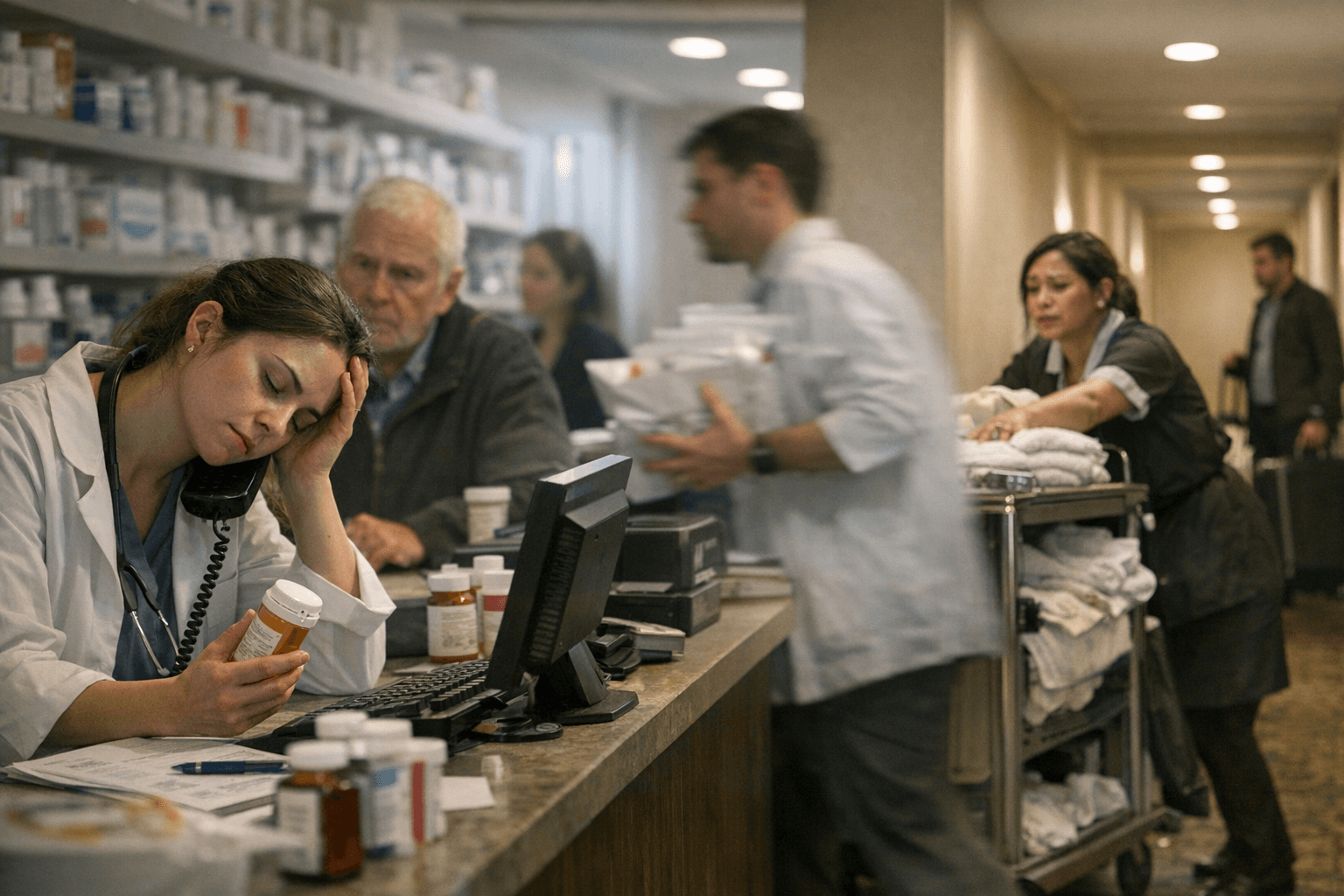
The understaffing problem isn't new, but the scope of the current wave is notable. The American Prospect's analysis covers multiple service sectors at once, suggesting this isn't a single-industry anomaly but a structural condition that has taken hold across the low-wage service economy. Pharmacies are filling prescriptions with fewer technicians. Grocery stores are running registers with fewer cashiers. Hotels are turning rooms with fewer housekeepers. Clinics are managing patient loads with fewer support staff. In each case, the math is the same: the same volume of work gets distributed across fewer people.
For retail workers, this isn't abstract. Dollar General has operated under exactly this pressure for years. The company's model has long favored minimal staffing, with many locations regularly operating with a single associate on the floor. That model drew a $12 million OSHA settlement in 2023 over blocked exits and unsafe working conditions, and it continues to generate safety citations at stores across the country. The American Prospect's framing of understaffing as a safety issue, not just a service issue, maps directly onto what Dollar General's own regulatory record shows.
Burnout as a structural outcome, not a personal failure
When staffing levels stay chronically low, burnout isn't a question of individual resilience. It becomes a predictable outcome baked into the operating model. A single associate responsible for stocking shelves, running the register, managing the floor, and handling customer questions isn't failing to manage their time well. They are being asked to do work that was designed for multiple people.
The American Prospect connects this dynamic to worsened customer service, which is the visible symptom, but the less visible damage falls on the worker. Sustained understaffing creates conditions where mistakes become more likely, where workers skip breaks to keep up, and where any disruption, a call-out, a difficult customer, a delivery arriving during peak hours, can push an already stretched shift past a manageable threshold. In a single-associate Dollar General store, there is no one to call for backup.
This is the part of the understaffing conversation that often gets filtered out of corporate messaging. Companies describe staffing as a market challenge or a hiring pipeline issue. Workers experience it as a daily condition they are expected to absorb without complaint and without additional compensation.
The customer service collapse workers get blamed for
One of the more corrosive dynamics that understaffing creates is the mismatch between who causes the service failure and who gets blamed for it. When a pharmacy line stretches out the door, customers direct their frustration at the technician behind the counter. When a hotel room isn't ready at check-in, the front desk agent fields the complaint. When a Dollar General shelf sits empty for days, the associate on shift hears about it.
The American Prospect situates this pattern within a broader service economy critique: the gap between what customers expect and what understaffed workers can actually deliver is not a training problem or an attitude problem. It is a resource problem. Staffing decisions are made at the corporate level. The fallout is handled at the store level, by workers who had no input into those decisions and typically have no mechanism to escalate the structural problem behind any individual complaint.
For district managers reading this, that dynamic is worth sitting with. The store-level feedback you receive about customer complaints is often a lagging indicator of a staffing decision made above you, not a reflection of what your associates are or aren't doing.
Safety gaps that show up when coverage thins
The American Prospect explicitly links understaffing to safety gaps, and this is where the consequences become most serious. In pharmacies, thinner coverage means more prescription errors and less time for pharmacist-patient consultation. In clinics, it means longer wait times and less thorough intake. In retail, it means blocked emergency exits because there aren't enough workers to keep stockrooms organized, it means lifting injuries because one person is moving freight that should take two, and it means assault risk because a single associate has no backup during a confrontation.
Dollar General's OSHA history makes this connection concrete. The company has been cited repeatedly for conditions that are downstream of staffing decisions: cluttered aisles, inaccessible fire exits, hazardous stockroom conditions. These aren't isolated incidents. They are patterns that regulators have documented at scale, and they track closely with the kind of safety failures The American Prospect is flagging across the broader service sector.
The regulatory pressure on Dollar General has increased in recent years, but citations and settlements don't automatically translate into changed operating conditions at the store level. Associates working alone on a closing shift are still working alone on a closing shift, regardless of what a consent agreement says.
What comes next
The American Prospect's feature lands at a moment when labor markets have softened slightly from their post-pandemic tightness, which may give employers less urgency to address staffing shortfalls than they felt in 2021 and 2022. That is precisely the risk. When hiring is harder, companies add staff to stay operational. When hiring gets easier, the pressure to maintain those levels drops, and the floor on staffing can drift back down.
For workers across retail, pharmacies, and hotels, the concern isn't just the current conditions but whether this moment of relative stability will be used to build in better baselines or whether it will be treated as permission to thin out coverage again. The pattern the American Prospect documents suggests the latter is the more common outcome. The pressure to reduce labor costs doesn't disappear when the labor market loosens; it tends to reassert itself.
The workers who will absorb the consequences of that drift are already on the floor.
This article was produced by Prism’s automated news system from verified source data, official records, and press releases, then run through automated quality and moderation checks before publishing. The system is built and supervised by the people who set the standards it runs under. Read our full AI policy.
Did this article answer your question?