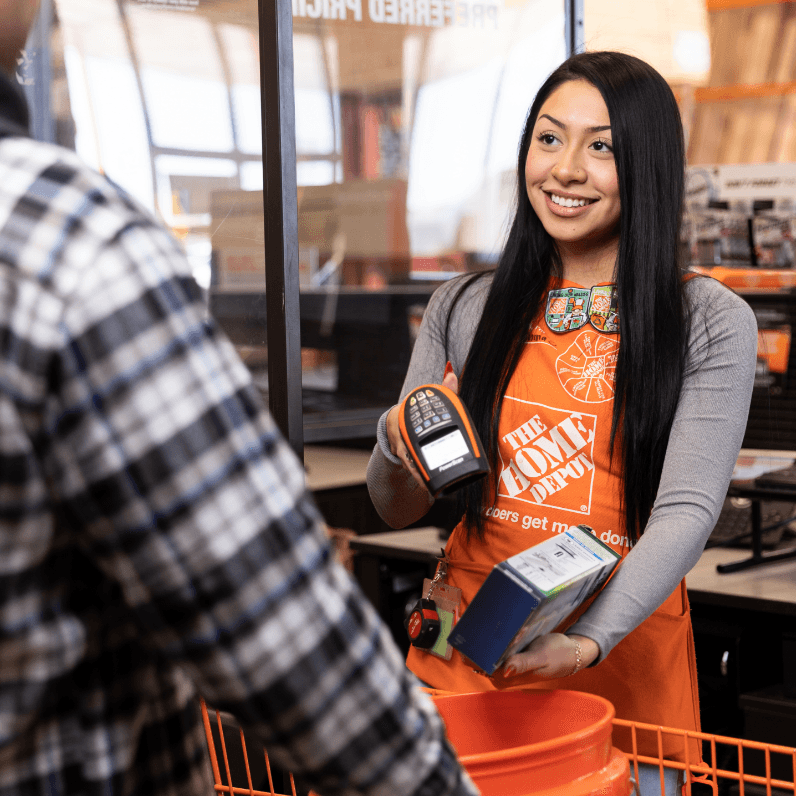
Home Depot cashier role blends service, shrink control, and growth paths
Home Depot cashiers do far more than scan items. The role now mixes service, returns, self-checkout oversight, shrink control, and a real path into leadership.

What the cashier role really covers
At Home Depot, the cashier job is a front-end operations role as much as it is a customer service job. The posting spells out a mix of fast, friendly, accurate, and safe service, plus checkout and return transactions, self-checkout monitoring, product knowledge, and selling opportunities. That is the reality check for anyone walking into the role: the work is not limited to ringing up carts. It sits at the intersection of speed, accuracy, and store control.
The pay snapshot in Seattle also gives the role more weight than many applicants expect. The listing shows cashier pay between $20.50 and $21.50 in Seattle, Washington, with head cashier and pro cashier versions on the same career page. That kind of detail matters because it shows the company is treating the front end as a skilled assignment, not a placeholder shift.
The daily work is broader than scanning items
The front-end associate is expected to move between customer help, checkout flow, and operational judgment all day. The posting says cashiers process returns, monitor the self-checkout area, look for product knowledge opportunities, identify selling opportunities, and follow policies and procedures that keep shrink minimized. In practice, that means the cashier has to read the flow of traffic, spot when a customer needs help, and keep the transaction moving without losing control of the lane.
That combination is especially important in a store built around contractors, project customers, and seasonal rushes. Home Depot’s front end has to absorb heavy traffic while keeping service steady, and that is why the cashier role now reaches into returns handling and self-checkout oversight. For associates, the skill set is broader too: product awareness, calm judgment, and the ability to handle pressure without slowing the store down.
What skills matter on the front end
A strong cashier at Home Depot is not just quick at the register. The role rewards associates who can balance accuracy with courtesy, keep an eye on transaction details, and step into problem-solving when something does not scan, match, or flow cleanly through the lane.
- Fast, accurate register work
- Return processing and policy awareness
- Self-checkout supervision
- Product knowledge and suggestive selling
- Attention to shrink and transaction controls
- Clear communication with customers and nearby teammates
The most useful skills are practical:
That skill mix explains why the front end is often where store standards become visible first. When the line moves well, the customer feels it immediately. When it does not, the whole store feels it.
Shrink control is part of the job, not a side note
Home Depot’s cashier posting makes shrink control explicit, and the company’s public comments on self-checkout show why. On a first-quarter 2024 earnings call, Home Depot said it had deployed computer vision in the self-checkout corral to help mitigate shrink. The system is meant to identify complex or high-value carts and signal a cashier so all products are scanned and accounted for.
That matters because it turns the cashier into part of a loss-prevention workflow. The job is not just watching for a missed item or a payment issue. It is helping protect the store from preventable loss while still keeping the customer experience smooth enough that self-checkout remains usable. For associates, that means the front end requires judgment, not suspicion, and it requires consistency, not random enforcement.
For store managers, the message is equally clear: shrink control is now built into front-end labor, technology, and coaching. A cashier who knows when to step in, when to call for help, and when to keep the line moving is protecting both service scores and margin.
Head cashier work is a bridge into leadership
The posting also shows how the role can grow. A head cashier is expected to position cashiers and support them by expediting price checks, approving point-of-sale transactions and markdowns, and helping across mainline registers, self-checkout, returns, Pro Desk, Special Services, and Tool Rental. That is not just a bigger badge. It is frontline supervision with a wide operational footprint.
For associates who like being near customers and systems at the same time, head cashier is a natural bridge into leadership. The position asks for coaching, quick decisions, and a steady grasp of policy. It also helps new cashiers learn how to work the front end the way Home Depot actually runs it, which is a combination of service recovery, transaction control, and storewide support.
Home Depot’s cashier career page reinforces that ladder. The company says many associates start as cashiers and build skills that help them grow into leadership positions, with development tools and mentorship opportunities available. That matters because it frames cashiering as a starting point with structure behind it, not a dead-end assignment.
The front end is being redesigned around speed and service
Home Depot’s annual reports give the wider context. The company says it is the world’s largest home improvement retailer, founded in 1978, with fiscal 2025 net sales of $164.7 billion and earnings of $14.2 billion. It also operates more than 2,300 stores across the U.S., Canada, and Mexico. At that scale, even a small improvement in front-end flow can touch a lot of customer visits.
The company’s fiscal 2024 annual report said it redesigned front-end areas, including reconfigured service desks and improved checkout layouts, to help customers get in and out more quickly. It also pointed to wayfinding signage, store refresh packages, self-service lockers, online order storage areas, and curbside service as part of the same push. In other words, the cashier role lives inside a broader redesign of how the front of the store works.
Home Depot’s fiscal 2025 annual report takes that further, saying knowledgeable associates and on-shelf availability are critical to the store experience, and that the company is empowering associates by enhancing training and product knowledge, optimizing processes, simplifying tasks, and leveraging technology to improve the customer experience. That is the corporate language, but the operational meaning is plain: the cashier is expected to move faster, know more, and handle more complexity than before.
What this means for associates and managers
For current associates, the cashier role now rewards speed, product familiarity, and a strong read on customer behavior. The best front-end workers are not just transaction handlers. They are the people who keep the front of the store orderly when returns pile up, self-checkout gets busy, and customers need quick guidance on items they cannot find or scan.
For managers, the role is a pressure point. Front-end staffing is often where service quality becomes visible fastest, and it is where Home Depot’s priorities meet the customer in real time. If the front end is smooth, informed, and attentive to shrink, the whole store benefits. If it is not, the gap shows up immediately.
The cashier role at Home Depot has widened because the front end has widened. It is now service, control, and advancement in the same lane, and that is exactly where the company has placed its bets.
Know something we missed? Have a correction or additional information?
Submit a Tip