Home Depot Foundation expands trades training to ease labor shortage
Home Depot is betting trades training can ease a 400,000-job gap and feed its Pro business. The Foundation’s grants now reach schools, colleges and nonprofits building the next workforce.
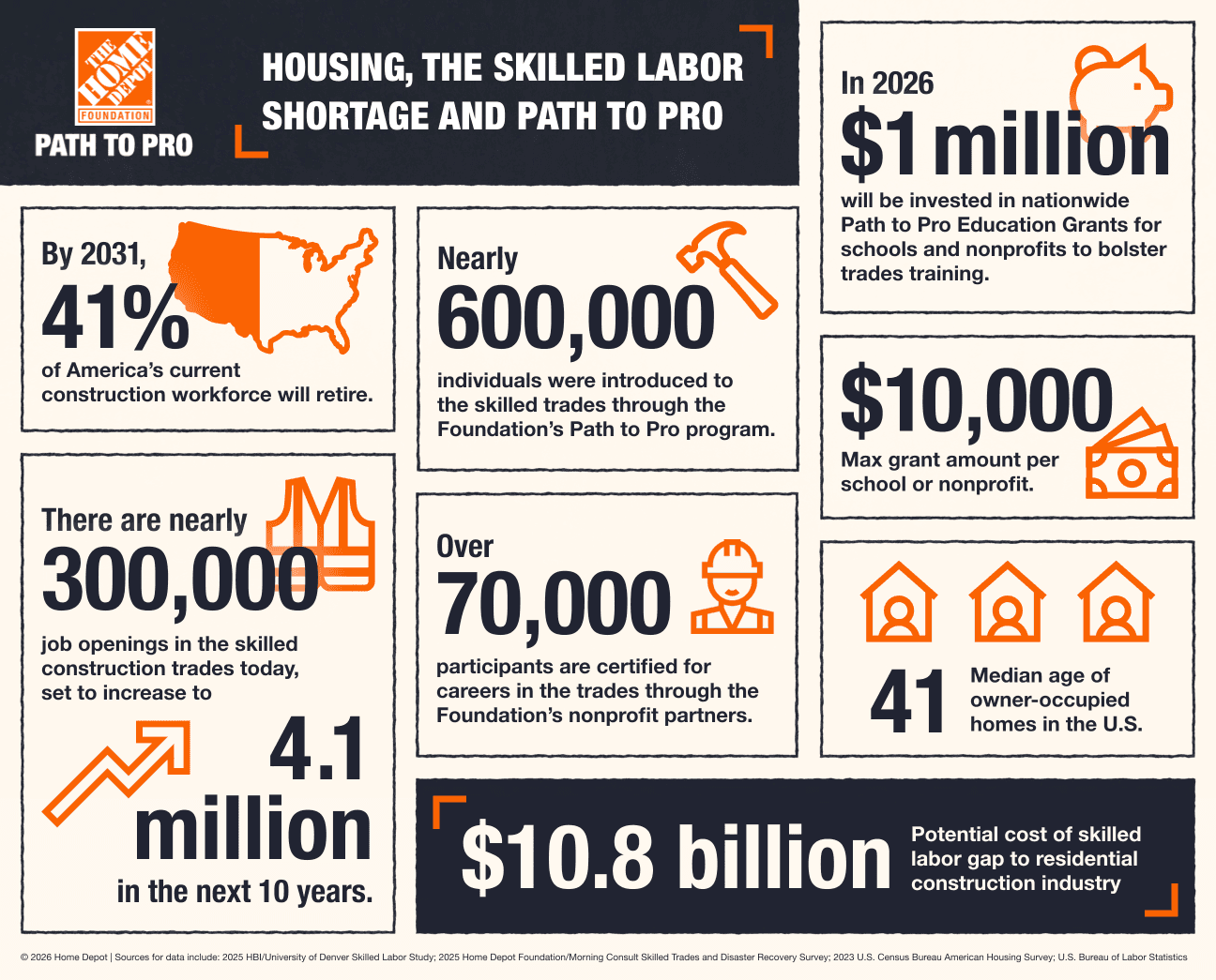
Forty percent of current construction workers were expected to retire by 2031, and Home Depot’s 2024 Path to Pro materials put the opening at approximately 400,000 trade jobs. The shortage touches every aisle, every Pro desk and every jobsite around its stores. For associates, it is not abstract. It shows up when customers delay projects, contractors stretch their crews and demand for the right materials lands on store teams faster than the labor market can supply the people who use them.
A labor gap that changes how the business works
The Foundation’s trades push started as a $50 million commitment in 2018, with a goal of training 20,000 new tradespeople by 2028. Home Depot expanded that effort in December 2020 with Path to Pro, adding education and job placement to what had been a broader philanthropic pledge.
Home Depot forecast that the construction industry still faced a workforce shortage, with more than 400,000 new workers needed in 2025, citing Associated Builders and Contractors. The National Association of Home Builders, citing a Home Builders Institute labor report, said the shortage is contributing to lost production of thousands of newly built homes. NAHB said the U.S. housing deficit could total 1.5 million homes.
Who the grants reach, and what they buy
The Foundation’s Path to Pro Education Grants program is the most concrete piece of the expansion. It awards grants to accredited K-12 programs, accredited post-secondary institutions such as community and technical colleges, and nonprofit organizations focused on construction skilled trades training across the United States. The grants can provide up to $10,000 in Home Depot gift cards for tools, products, equipment and related needs, directing money into classrooms, shop spaces and training labs instead of overhead.
The company’s 2026 push to help revitalize shop class nationwide fits into that effort. The grant structure extends the pipeline earlier, into high schools and career programs where students can get hands-on exposure before they ever set foot on a jobsite. For stores, that can eventually mean more customers who already know the difference between product lines, tool types and job-specific materials, changing the tenor of the conversation at the Pro desk and in the aisles.

Why the initiative matters on the floor
Contractors and new trades workers tend to buy in larger quantities, return for repeat projects and ask more precise questions about materials, fit and performance. That can strengthen Pro sales and make associates the knowledge center for customers who are learning the trades or moving from school into work.
It also affects staffing pressure in departments tied to the home-improvement cycle, especially Pro, paint and seasonal, where project volume and contractor demand can swing fast. When more qualified tradespeople are available locally, customers can move from plan to purchase with fewer delays, and store teams are more likely to see steady repeat business rather than stalled carts and postponed work.
How Home Depot positions the effort
The Foundation says it works to improve the homes and lives of U.S. veterans, support communities affected by natural disasters and train skilled tradespeople to fill the labor gap. Its 2024 branding guidelines said it had invested more than $500 million in veteran causes, improved more than 60,000 veteran homes and facilities, and pledged $750 million in veteran causes by 2030 along with $50 million in skilled trades training.
This article was produced by Prism’s automated news system from verified source data, official records, and press releases, then run through automated quality and moderation checks before publishing. The system is built and supervised by the people who set the standards it runs under. Read our full AI policy.
Did this article answer your question?