Home Depot, Lowe’s face housing slowdown with Pro customers at stake
An extra week makes Home Depot’s quarter look slower than it was, but the real story is the scramble for Pro work, stock, and staffing in a frozen housing market.
What the quarter really measured
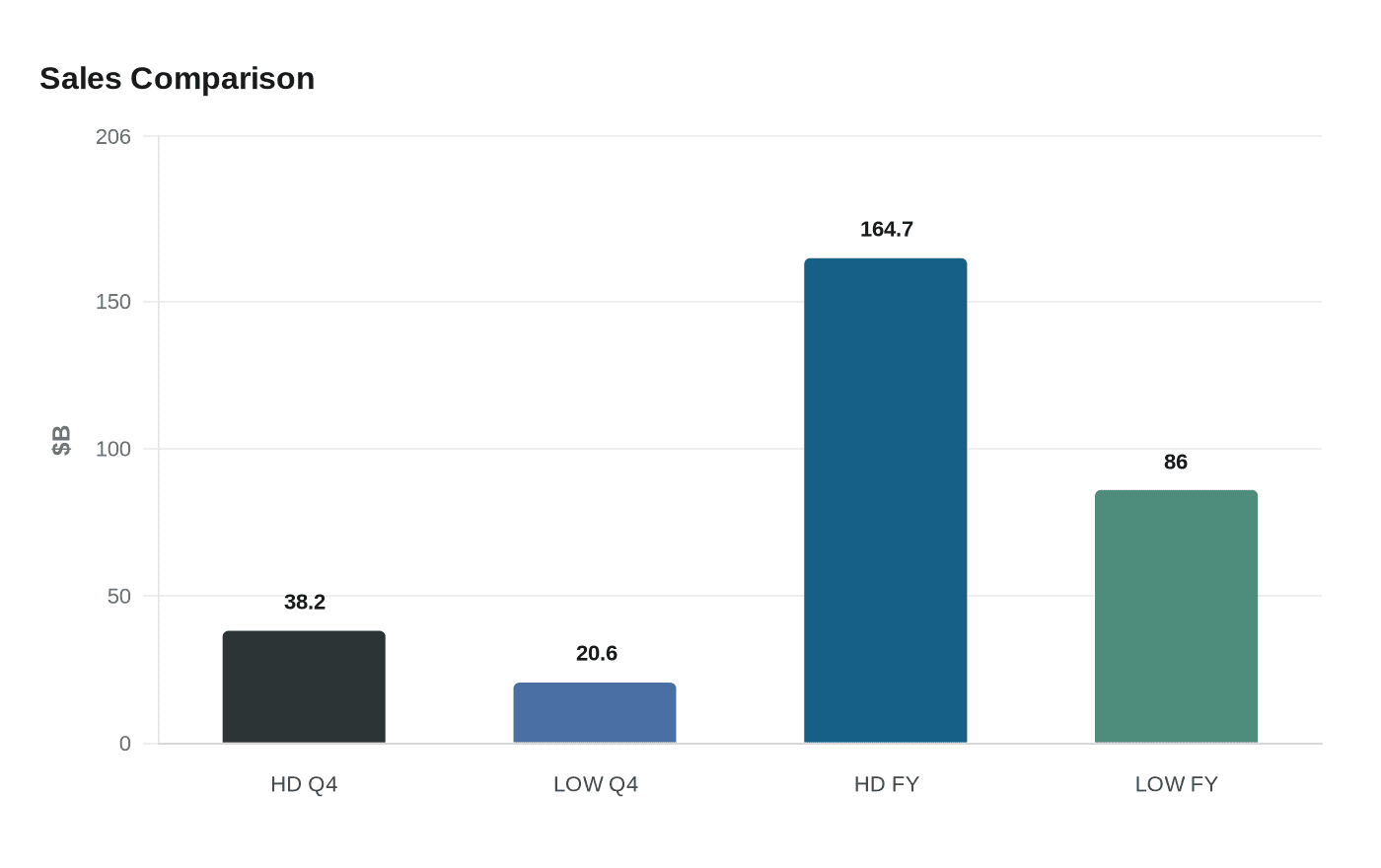
An extra week in last year’s quarter added about $2.5 billion to Home Depot’s comparison base, which is why the numbers need a careful read before anyone calls the story simple. Home Depot still posted fiscal fourth-quarter sales of $38.2 billion, adjusted diluted earnings per share of $2.72, and comparable sales growth of 0.4 percent, while Lowe’s reported $20.6 billion in sales, adjusted diluted earnings per share of $1.98, and comparable sales growth of 1.3 percent.
For the full year, Home Depot posted sales of $164.7 billion, comparable sales growth of 0.3 percent, and adjusted EPS of $14.69. Lowe’s said fiscal 2025 sales were more than $86 billion and adjusted EPS was $12.28. Both retailers are growing, but neither is doing it in a housing market that feels anywhere close to normal, and that matters for how traffic, orders, and staffing play out in the store.
Pro customers are the battlefield
The more important split is not just who grew faster, but how each company is trying to win the same contractor and trade customer. Home Depot says its growth strategy is to “win with the Pro,” and its annual report makes the point plainly that knowledgeable associates and on-shelf availability are critical to the store experience. That is the day-to-day reality associates know well: when a contractor is waiting on a part, a bundle, or a pickup order, speed matters as much as price.
Home Depot is backing that strategy with more than merchandising talk. The company says it plans to build about 80 new stores over five years, and that the 37 new stores it has built over the past three years are outperforming expectations. It is also deepening its specialty-trade reach through SRS Distribution, which announced a deal on March 24, 2026 to acquire Mingledorff’s, a wholesale HVAC distributor with 42 locations in five southeastern states. Home Depot says that move expands its total addressable market to $1.2 trillion, which tells you how seriously it is treating the trade business.
Lowe’s is pushing in a different but related direction. Its fourth-quarter comparable sales growth was driven by Pro, online, and home services, along with strong holiday performance. The company also said it recognized $149 million in pre-tax expenses tied to its acquisitions of Foundation Building Materials and Artisan Design Group, a reminder that it is spending to build scale in professional and installed categories. Lowe’s said it operated 1,759 stores, 540 branches, and 120 distribution centers as of Jan. 30, 2026, showing how central logistics and supply depth have become in the competition for Pro business.
What that means on the floor
For associates, this is less about Wall Street bragging rights than about what changes at the pro desk, in receiving, and on the sales floor. A housing slowdown does not hit every aisle the same way. Big remodels can get postponed when financing gets tighter, but contractors still need roofing, plumbing, HVAC, electrical, and repair materials, often on a tighter timeline and with less patience for out-of-stocks.
That puts more pressure on product knowledge and execution. If a store team can identify the right part faster, keep seasonal and trade items in stock, and move orders through pickup and delivery without a hitch, it can hold onto business even when customers are cautious. If not, those accounts are quick to shift to another location or another chain.
Home Depot’s own leadership has been blunt about the backdrop. Chief financial officer Richard McPhail told CNBC the company has been in a “frozen housing environment for three years,” and said consumer uncertainty and declining confidence had become bigger pressures over the last year. He also said customers are worried about housing affordability and job losses. That is not abstract macro talk for store teams. It shows up as fewer big-ticket projects, slower conversion on discretionary purchases, and more shoppers walking in with questions instead of carts.
How Lowe’s is signaling the same pressure differently
Lowe’s has framed the same backdrop with a slightly different message. Chief executive Marvin R. Ellison said the company’s “Total Home” strategy is resonating with both Pro and DIY customers and that it is “well-positioned to take share regardless of the macro environment.” The company also said it awarded $125 million in discretionary bonuses to frontline associates after outperforming in the quarter, which is a direct reminder that management can use performance not only to invest in growth but also to reward the people on the floor.
The market read Lowe’s comments as part of a broader housing slowdown, not a one-company blip. Reuters reported that Lowe’s shares fell 5.6 percent after the company’s outlook and that housing-related stocks also moved lower, including homebuilders such as Lennar, PulteGroup, and D.R. Horton. When a retailer’s guidance starts moving the whole housing complex, it is a sign the slowdown is still working through the system.
What Home Depot associates should watch next
The most useful way to read this moment is through the operational details that hit the store every day:
- Pro order speed and accuracy. Trade customers care less about polished messaging than about whether the right materials are ready when the crew arrives.
- On-shelf availability. Home Depot’s own annual report ties knowledgeable associates and in-stock performance directly to the customer experience.
- Distribution and specialty categories. SRS and Mingledorff’s point to more HVAC, roofing, building products, landscape, and pool-related demand flowing through the system.
- Labor pressure around fulfillment. When business tilts toward Pro, the store needs tighter coordination between sales, receiving, order pickup, delivery, and installation support.
- The mix of customers walking in. A softer housing market can mean fewer full-scale remodels and more repair, maintenance, and urgent replacement work.
The headline numbers matter, but the deeper message is clearer for anyone working the aisles or running a store: Home Depot and Lowe’s are both trying to outbuild, out-deliver, and out-service each other while the housing market stays stuck. In that kind of market, the winner is not the company with the loudest slogan, but the one that keeps contractors moving, shelves stocked, and associates trained enough to turn a stalled project into a completed sale.
This article was produced by Prism’s automated news system from verified source data, official records, and press releases, then run through automated quality and moderation checks before publishing. The system is built and supervised by the people who set the standards it runs under. Read our full AI policy.
Did this article answer your question?