Home Depot ties growth strategy to online, store and Pro service
Home Depot’s proxy ties growth to stores, digital and Pro service, signaling more cross-channel pressure on staffing, training and execution.
Home Depot’s 2026 proxy statement ties market share gains to a best-in-class interconnected experience, stronger Pro sales and continued investment in associates. For the store floor, that is a plain-language cue: online, in-store and fulfillment work are being managed as one job.
What the proxy is signaling to shareholders
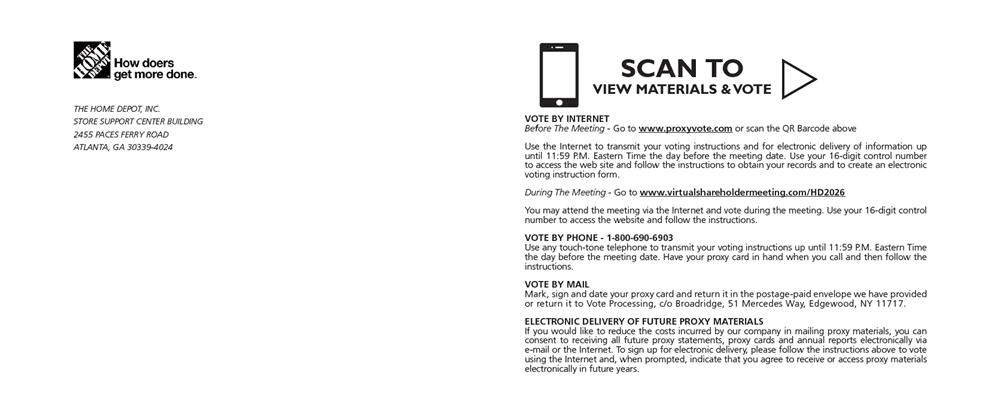
The 2026 Annual Meeting of Shareholders is set for Thursday, May 21, 2026, at 9:00 a.m. Eastern time in a virtual-only format. March 23, 2026 was the record date, which set who could vote shares at the meeting.
In the filing, Home Depot says it aims to deliver shareholder value and grow market share by driving its core and culture and growing sales to Pros through its unique ecosystem of capabilities. The company also says it is continuously investing to enhance its online, in-store and fulfillment experience, including investing in associates. For workers, the key phrase is interconnected experience: the company is not treating digital orders, store traffic and fulfillment as separate lanes, but as one system that has to work without friction.
The wording is not new. The 2025 proxy used nearly the same strategy language, though it also explicitly mentioned building new stores. The 2022 proxy went further on the labor side, saying the company was continuously investing to improve its online and in-store experience, including enhanced training for associates and enhanced fulfillment options.
What interconnected retail means on the sales floor
For associates, interconnected retail usually shows up as pressure on the handoffs. A customer may browse online, reserve an item, arrive in the store, need help finding the product, and expect a quick checkout or pickup experience with minimal delay. That creates a practical obligation for departments to keep inventory accurate, for service desks to manage online orders cleanly, and for the sales floor to answer questions quickly enough that the customer does not feel the system breaking apart.
It also changes how staffing feels. When online, store and fulfillment are treated as one experience, the labor plan cannot live only in a single department. A front-end associate, a lot associate, a department lead and a fulfillment worker all become part of the same customer path, especially when pickup speed and order accuracy are part of performance. That means more cross-training, more reliance on store technology that keeps inventory and order status visible, and more pressure to solve problems before they become a customer complaint at the desk or a delay in the parking lot.
Why Pro service sits at the center of the strategy
In its 2025 investor and analyst conference presentation, Home Depot described a roughly $1.1 trillion total addressable market, split between about $500 billion in consumer demand and about $600 billion in pro demand.
Ted Decker framed the company’s winning formula around brand, scale, premier real estate, associates and culture, supply chain, digital and interconnected product authority. He also said the goal is to deliver a frictionless interconnected experience and win the pro. On the floor, that points to more attention on the Pro desk, faster special-order and pickup handling, tighter coordination on bulk and project purchases, and a sharper focus on product knowledge for associates who work with contractors and tradespeople.
Pro customers are not looking for a generic retail interaction. They need reliable inventory, straight answers on product compatibility, and service that respects job-site timing. The store experience has to support bigger baskets, repeat visits and project-driven buying, not just weekend DIY traffic.
What associates should watch over the next year
The language in the proxy and investor materials points to a few concrete changes to watch in stores:
- More cross-functional scheduling, especially where pickup, fulfillment and the sales floor overlap.
- More emphasis on inventory accuracy, since the interconnected model depends on the website, the aisle and the fulfillment area showing the same truth.
- More training tied to product authority, contractor service and order handling, building on the company’s earlier emphasis on enhanced training and fulfillment options.
- More pressure on speed at the service desk, Pro desk and pickup points, where a customer can feel delays immediately.
- More store technology used to keep online and in-store operations synchronized, because the company’s stated strategy depends on a frictionless handoff between channels.
Home Depot was founded in 1978, operates more than 2,300 retail stores in the United States, Canada and Mexico, and generated fiscal 2025 net sales of $164.7 billion and earnings of $14.2 billion. In its 2025 annual report, sales rose $5.2 billion, or 3.2 percent, to $164.7 billion, while comparable sales increased 0.3 percent overall and 0.5 percent in the U.S.
This article was produced by Prism’s automated news system from verified source data, official records, and press releases, then run through automated quality and moderation checks before publishing. The system is built and supervised by the people who set the standards it runs under. Read our full AI policy.
Did this article answer your question?