KPMG careers emphasize growth, impact and a well-rounded path to partnership
KPMG’s career ladder rewards more than tenure: it favors fast learning early, then client trust, leadership, and business development on the way to partnership.
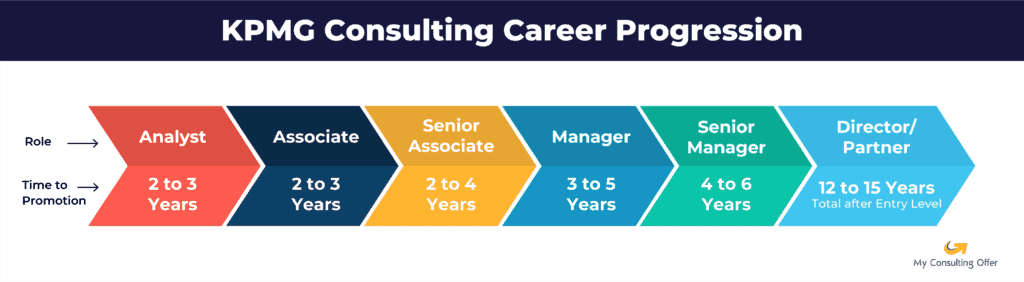
What KPMG is signaling about a career there
KPMG frames its careers message around growth, impact, and work that matters, and that is not just branding language. The firm says it wants to support people on “your journey to create an impactful career,” and it describes itself as “an ideal training ground for the business leaders of today and tomorrow.” That tells you what the ladder is really supposed to produce: people who can move from helping deliver work to helping lead the firm.

The firm also says it welcomes talent from students and recent graduates through experienced professionals, which matters because the path is not designed as a narrow graduate pipeline. It is a broad professional-services track, built to absorb people at different points and still push them toward the same endpoints: stronger client-facing skills, broader responsibility, and eventually leadership.
How the first rungs work in practice
If you want a shorthand for the early career at a Big Four firm, Deloitte’s analyst-to-partner guide and Strategy&’s career-path structure help decode the model. The early phase is about building foundations, supporting project delivery, analyzing data, and learning how to work with clients. As people move up, senior analysts begin to own more of the work, lead workstreams, and mentor others. Strategy& adds a useful benchmark: professionals typically spend two to three years at each stage as they progress toward partner.
KPMG’s own student-careers materials fit that same pattern even if they do not spell it out in ladder-chart detail. The firm highlights skills development, exposure to client engagement teams, professional networking, internships, work experience opportunities, and global secondments after qualification as part of a “well-rounded career path.” That mix signals a classic professional-services bargain: breadth early, specialization later. The tradeoff is that you are expected to learn quickly and absorb a lot of context before you get real control over the work.
What the hidden performance gates look like
For KPMG employees, the important thing to read between the lines is that promotion is rarely about time alone. In practice, the first half of the career is about proving you can do the craft reliably, while the later half is about managing people, shaping client relationships, and building a business. That is an inference from the career materials, but it is the right way to read a firm that publicly emphasizes impact and leadership rather than just technical output.
That means each title comes with a different test. Analysts are judged on speed, accuracy, and whether they can learn the firm’s way of working without constant correction. Managers have to orchestrate teams, not just contribute individually. Future partners are expected to do something harder still: earn trust from clients, spot opportunities, and bring in work. The career ladder looks orderly from the outside, but inside the firm it is a series of performance gates, and each one asks for a wider set of skills than the last.
Why business development becomes the real tell
A 2025 KPMG job ad for a business development manager in deal advisory shows how the expectations change at the upper end of the ladder. The role includes building strong relationships with key clients, alliance partners, and other stakeholders, leading client presentations and proposals, and supporting client and industry events to maximize brand visibility. That is not a back-office skill set. It is a direct preview of what senior commercial credibility looks like inside a partnership model.
This is the point where the career path changes from being about delivery alone to being about market presence. If you can write the memo but not win the room, the ladder slows down. If you can connect technical expertise to client confidence and revenue, the next rung becomes easier to see. In a firm like KPMG, business development is not a side activity for the most senior people; it is a central sign that someone is ready for more responsibility.
What partnership signals about mobility and pressure
KPMG’s public celebration of a new Americas partners class makes partnership look celebratory, and it is. But it also underlines that partner remains a distinct milestone, not just another promotion title in a long chain. For people inside the firm, that distinction matters because it shows where the track changes from advancement to ownership. At the partner level, you are not only leading work. You are helping shape the business.
That is where the hidden pressure of the ladder becomes clear. Big Four careers often carry an up-or-out feel, even when firms do not describe them that way in public-facing materials. The signal to employees is straightforward: if your scope does not expand, the ladder can stall. The lifestyle tradeoff is equally clear: more progress often brings more pressure, broader accountability, and less insulation from client demands, especially around busy season, proposal cycles, and relationship management.
How to read KPMG’s culture clues
KPMG’s scale makes the career path matter even more. Its member firms operate in 147 countries and collectively employ more than 219,000 people. Later global reporting put FY25 globally aggregated revenue at $39.8 billion and global headcount at 276,030. At that size, the firm is not offering a boutique apprenticeship. It is running a large professional-services pipeline where talent development has to be structured, repeatable, and visible.
The culture cues are equally telling. KPMG’s U.S. code of conduct centers on Integrity, Excellence, Courage, Together, and For Better. Those values help explain the kind of employee the firm wants to promote: someone who can balance technical credibility with judgment, teamwork, and the confidence to lead. In practice, that means the ladder rewards more than technical competence. It rewards people who can communicate clearly, stay steady under workload, and prove they can represent the firm well to clients and colleagues.
What the ladder really means for your next move
The smartest way to read a KPMG career is to work backward from the next title. If you are early in the firm, the question is whether you are becoming the person who can own a task end to end, not just complete your slice of it. If you are moving into management, the question is whether you can lead workstreams, not merely contribute to them. If you are approaching senior levels, the question becomes whether clients trust you enough to buy more of what you can do.
That is why the ladder is best understood as a culture-and-labor map, not a static org chart. KPMG’s public materials point to growth, training, and a broad career path, but the real message is sharper: the path to partnership is well-rounded only if you can handle the widening mix of delivery, leadership, and business development that comes with each step.
This article was produced by Prism’s automated news system from verified source data, official records, and press releases, then run through automated quality and moderation checks before publishing. The system is built and supervised by the people who set the standards it runs under. Read our full AI policy.
Did this article answer your question?


.pdf%2F_jcr_content%2Frenditions%2Fcq5dam.thumbnail.319.319.png&w=1920&q=75)