KPMG: Geopolitical Shocks and Policy Uncertainty Cloud 2026 Economic Outlook
KPMG's Economic Compass warns the Fed is "uncomfortably on the sidelines" as soaring oil prices, tariffs, and a faltering labor market narrow the path to a soft landing.
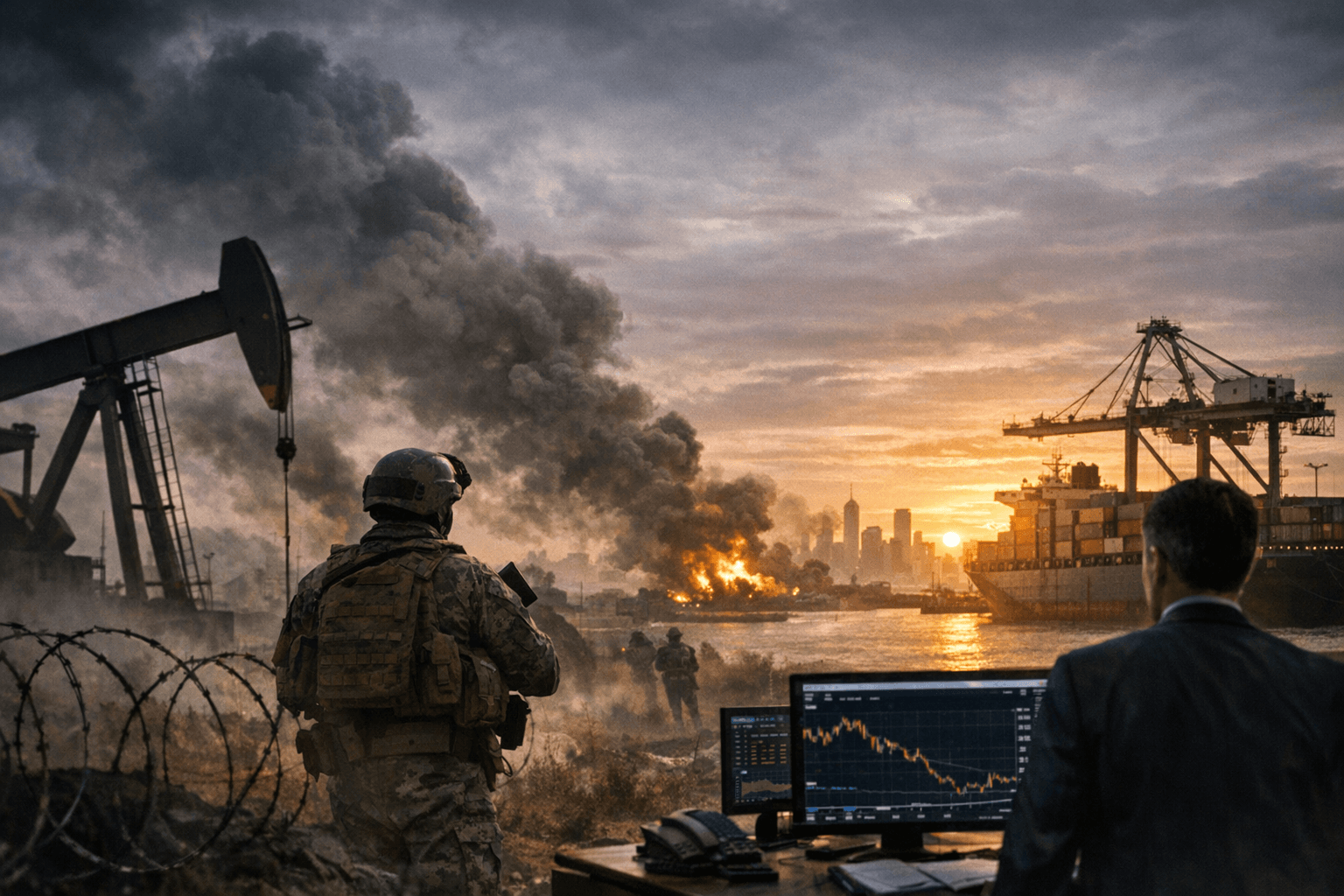
Uncertainty, KPMG's Economics team argues, is not merely background noise. It is an economic force in its own right, one capable of freezing decisions, distorting markets, and ultimately reshaping the trajectory of an entire year.
That is the central thesis of KPMG's latest Economic Compass commentary, published March 10, 2026 and titled "The butterfly effect: Geopolitical shocks, policy uncertainty and the economic outlook." The piece opens with a memorable analogy: in the 1993 film Jurassic Park, Jeff Goldblum's character illustrates chaos theory by showing how tiny, imperceptible variations can send a drop of water on one's hand in entirely unpredictable directions. KPMG's economists apply that same logic to the current macro environment, where small geopolitical tremors and policy ambiguities are compounding into potentially significant economic disruptions.
Uncertainty as an economic actor
The commentary's framing is worth pausing on. Rather than treating uncertainty as a qualifier on forecasts, KPMG positions it as a first-order economic variable. "That uncertainty is itself an economic force," the piece states. "It causes hesitation in making large spending decisions. Everything from home buying to hiring can be affected."
This framing has direct relevance for corporate planning. When executives, hiring managers, and consumers cannot reliably model the regulatory or trade environment six months out, they delay. Capital expenditure decisions get pushed. Headcount freezes follow. The ripple effects work through supply chains and consumer confidence alike. KPMG points to last year's tariff cycle as a concrete illustration: "We saw that last year with tariffs and the tension they caused for the Federal Reserve between rising inflation and unemployment."
Geopolitical shocks feeding the pipeline
The commentary identifies geopolitical developments, particularly in the Middle East, alongside trade and tariff shocks, as the upstream drivers of current instability. Those shocks feed a chain of downstream consequences that KPMG traces with specificity: higher oil prices, rattled financial markets, and renewed inflation pressures.
Oil price exposure is particularly significant here. A sustained elevation in energy costs passes through to virtually every cost structure, from logistics and manufacturing to household utility bills. Combined with tariff-related price hikes, the inflation pipeline becomes harder to manage and harder to predict. The commentary does not assign specific price levels or percentage forecasts to these scenarios, but the directional argument is unambiguous: geopolitical instability is not a tail risk to be footnoted. It is a central variable shaping the 2026 outlook.
A labor market losing altitude
Compounding the inflation picture is a labor market that, in KPMG's assessment, "continues to falter." This is significant because a softening labor market would, under most circumstances, give the Federal Reserve room to cut rates and provide economic support. The problem in the current environment is that the Fed cannot simply respond to labor weakness when inflation remains elevated and is showing signs of re-acceleration.
The combination of these two pressures, rising unemployment on one side and persistent inflation on the other, describes the classic stagflationary bind. KPMG's commentary does not use that term explicitly, but the structural description is recognizable: the economy is experiencing deterioration on both of the Fed's dual mandate objectives simultaneously.
The Fed's uncomfortable position
No section of the commentary lands with more weight than its assessment of the Federal Reserve's current posture. "The Fed stays uncomfortably on the sidelines," KPMG writes, and the word "uncomfortably" is doing significant work in that sentence. The Fed is not waiting by choice or out of confidence. It is pinned.
The specific pressures keeping it there are enumerated directly: "Soaring oil prices, tariff-related price hikes and signs that service sector inflation is accelerating have left the Fed on the sidelines." Service sector inflation is a particularly stubborn category because it reflects wages, rents, and domestic demand rather than commodity swings, meaning it does not resolve quickly when oil prices stabilize.
The commentary frames the Fed's mandate in explicit terms: "It needs to derail the inflation that emerged after the pandemic." That inflation, which proved more durable than policymakers initially anticipated, remains the backdrop against which every subsequent price shock is being measured. Each new upward pressure, whether from tariffs or energy markets, makes the job of returning to target more complicated and the timeline for rate relief longer.
The narrowing path to a soft landing
KPMG's concluding assessment is blunt: "The path to a soft landing has narrowed, given the rise in both inflation and unemployment." Soft landing scenarios require the Fed to thread a narrow needle, cooling inflation without triggering a significant employment downturn. When both variables move in the wrong direction at once, the needle's eye closes.
For corporate leaders and investors, this framing changes the planning calculus. A soft landing in early 2025 looked plausible; the question now, as KPMG frames it, is not whether conditions have become more difficult but by how much and for how long. The butterfly effect of the piece's title captures this logic: the initial geopolitical disturbance was not catastrophic in isolation, but its interactions with tariff policy, energy markets, and Fed constraints have amplified its impact in ways that compound across the forecast horizon.
What this means for reading the rest of 2026
The Economic Compass is part of KPMG Economics' ongoing series of institutional commentary aimed at corporate and investment audiences navigating macro conditions. The March 2026 edition sits alongside related KPMG insights including pieces titled "Navigating an erosion in trust" and "Lessons from the water's edge," suggesting a broader thematic thread in the firm's current research: the challenge of operating in environments where established frameworks and institutional credibility are under stress.
The butterfly effect framing is more than rhetorical decoration. It is an argument about how to read the next several months. Small developments in oil markets, trade negotiations, or geopolitical hotspots should not be evaluated in isolation. Each carries the potential to interact with existing vulnerabilities, whether a constrained Fed, a weakening labor market, or inflation that has not fully subsided, in ways that produce outsized consequences. For anyone tracking the economic environment in which KPMG and its clients operate, that is the analytical lens the firm's Economics team is now applying to 2026.
Know something we missed? Have a correction or additional information?
Submit a Tip