KPMG links employee well-being to stronger audit quality
KPMG says better well-being should lead to better audits, but the real test is whether workload, staffing, and review habits actually change.
KPMG is making a more operational case than a wellness one: if auditors are less overloaded, better supported, and spending less time on repetitive busy-season work, the firm says audit quality should improve. That claim matters because the Public Company Accounting Oversight Board has spent more than a year looking at whether firm culture, training, and hybrid work patterns are helping or hurting audit performance.
Why this is more than a culture slogan
The PCAOB’s culture spotlight report, released in December 2024, said audit firm culture can have a positive or negative effect on a firm’s ability to deliver a quality audit. It also said cultures that emphasize centralization and standardization may see higher audit quality, a finding that lines up closely with the way KPMG is describing its own redesign of audit work.
The regulator’s review was not casual. It drew on more than 150 interviews with partners at the six largest U.S. audit firms and was launched in September 2023 to examine whether culture was linked to rising audit deficiencies observed since 2020. The PCAOB also said remote and hybrid work changed the apprenticeship model, on-the-job training, culture dissemination, and professional skepticism, all of which sit at the center of how juniors learn and how managers supervise.
For KPMG people, that matters because this is not just a question of morale. It is a question of how the firm trains staff, how much work gets pushed into the final weeks of an engagement, and whether managers have enough time to review judgment-heavy areas before an audit is signed.
What KPMG says it changed
KPMG says it has expanded a multi-year effort to reimagine audits by pulling work forward and standardizing, centralizing, and automating core tasks. In practice, that means moving more routine work earlier in the engagement cycle so teams can focus on higher-risk areas and reduce the pressure that builds in the traditional busy season.
The firm says the expanded process now covers all public financial statement audits and private engagements greater than 2,000 hours. Those engagements represent nearly 90% of total audit hours, so the shift is not a side project tucked into one segment of the practice. It reaches the bulk of the work that affects staff schedules, manager workloads, and review timing.
KPMG said the pull-forward effort moved 10.3% of planned audit hours out of the traditional busy season in FY22 and 24.1% in FY23, compared with 2020. That is the kind of number that gives the claim some substance, because it suggests the firm is measuring workload design rather than just talking about balance in broad terms.
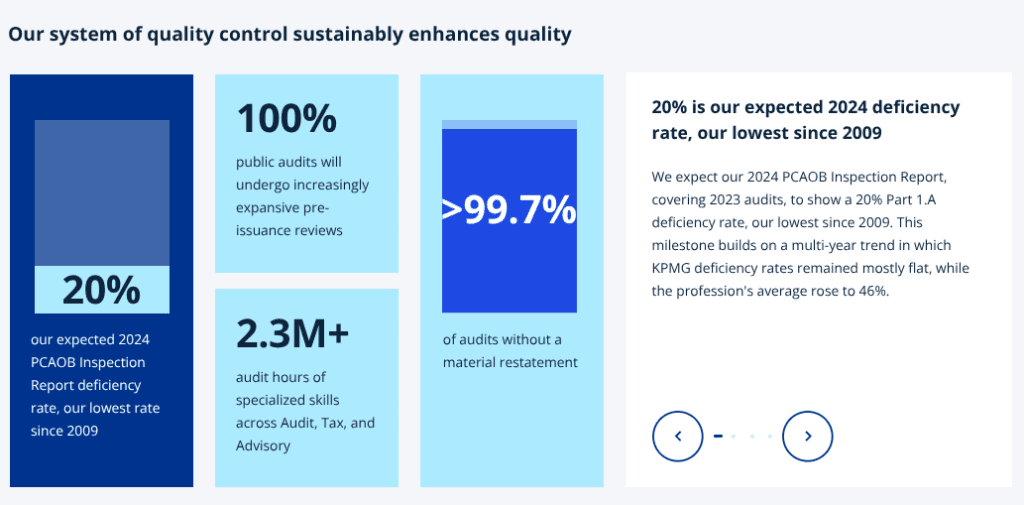
The firm has also tied this effort to its broader quality management system and continuous-improvement approach. In its audit quality reporting, KPMG said it expected its 2024 PCAOB inspection report to show a Part I.A deficiency rate of 20%, which would be its lowest since 2009.
What the numbers suggest about the broader market
KPMG is not making this argument in a vacuum. The Big Four U.S. firms collectively audit about 80% of the market capitalization of U.S.-listed public companies, so changes in their internal culture and work design have consequences well beyond one firm’s staff experience.
The PCAOB said the Big Four U.S. firms’ aggregate Part I.A deficiency rate fell to 20% in 2024 from 26% in 2023. That improvement does not prove KPMG’s specific model caused the decline, but it does show that the inspection environment is moving in the right direction after several years of elevated deficiencies. For KPMG, that makes the timing useful: the firm can point to a quality trend while arguing that the mechanics of work need to change, not just the rhetoric around employee support.
This is also where the firm’s message becomes more credible than a standard wellness campaign. A real connection between well-being and quality would show up in fewer last-minute fire drills, better consultation on complex areas, stronger pre-issuance review, and more consistent documentation. If those things do not change, then “well-being” is just branding on top of the same seasonal squeeze.
What it means on the ground inside KPMG
For auditors, the biggest practical question is whether the firm’s new model changes how work is assigned and supervised. If KPMG is serious about pulling work forward, then planning, documentation, and coordination should happen earlier. If it is serious about centralizing and automating, then staff should see more standardized tools and fewer hours spent on repetitive tasks that do not require judgment.
That matters at every level of the pyramid. Staff and senior associates usually feel busy season first, seniors absorb the pressure of getting work out the door, managers live with the review burden, and the path to senior manager or partner still depends on whether you can deliver quality under pressure. A system that genuinely reduces overload should make it easier to coach people, retain them through promotion cycles, and give them enough runway to build the technical judgment the firm says it values.
The risk, of course, is that old habits survive new language. A firm can centralize work on paper and still let engagements run late if clients move deadlines, staffing stays thin, or managers rely on the same end-of-season push they always have. That is why the credible test is not whether KPMG says it cares about mental health, work-life balance, and continuous learning. It is whether those priorities show up in the calendar, in staffing plans, and in the quality of the review process.
The real standard KPMG will be judged against
The PCAOB’s own findings raise the bar for what should count as progress. If culture affects audit quality, and if remote and hybrid work can weaken apprenticeship and skepticism, then KPMG has to show that its redesigned audit model restores the discipline that busy season often erodes.
That means fewer artificial bottlenecks, better use of standardization where it helps, and more time spent on the areas where judgment actually matters. It also means managers cannot simply stack the old expectations on top of a new process and call it improvement. The firm’s argument will only hold if less burnout is paired with better execution, and if the quality gains can be seen in inspections, not just in messaging.
For KPMG, the most important part of the story is not that well-being is being discussed. It is that the firm is now treating well-being as part of the mechanics of audit quality. That is a much harder promise to keep, but it is the one that counts.
This article was produced by Prism’s automated news system from verified source data, official records, and press releases, then run through automated quality and moderation checks before publishing. The system is built and supervised by the people who set the standards it runs under. Read our full AI policy.
Did this article answer your question?


.pdf%2F_jcr_content%2Frenditions%2Fcq5dam.thumbnail.319.319.png&w=1920&q=75)