KPMG study finds global AI trust at 46%, higher in emerging markets
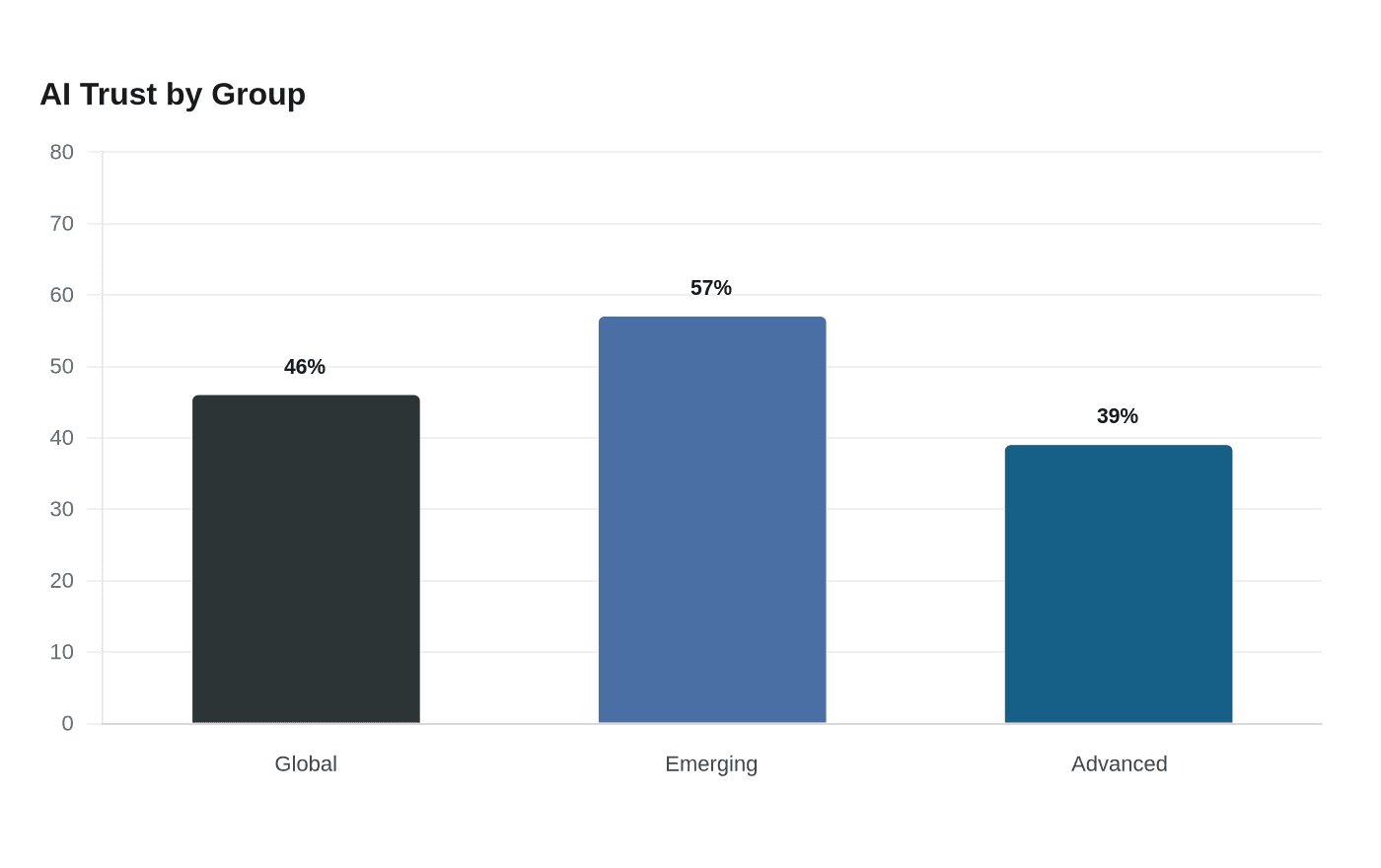
KPMG’s new global AI benchmark found 46% of people trust AI, but trust rises to 57% in emerging economies and falls to 39% in advanced ones.

KPMG’s latest global AI study showed a split that matters inside every firm pushing employees to use the technology: 46% of people worldwide trust AI, but trust climbed to 57% in emerging economies and fell to 39% in advanced ones. More than half of people globally were unwilling to trust AI, underscoring the gap between adoption and workplace readiness as companies roll out tools into audit, consulting and back-office work.
The report, Trust, attitudes and use of artificial intelligence: A global study 2025, was produced by the University of Melbourne and KPMG International and released in April 2025 after fieldwork from November 2024 to January 2025. KPMG said the survey used representative sampling and reached more than 48,000 people across 47 countries, making it one of the broadest snapshots yet of how workers and consumers view AI.
For KPMG professionals, the most relevant part of the study is not just who trusts AI, but where trust lags behind use. KPMG U.S. said AI adoption in the workplace has outpaced most companies’ ability to govern AI use, a problem that shows up in quiet, informal behavior. Secondary reporting on the same survey found that more than half of workers who use AI hide that use from their bosses, a sign that many employees are experimenting faster than managers can write rules, train teams or review output quality.
The country-level picture from the Netherlands makes that tension more concrete. In that market, 33% were willing to trust AI, 46% were willing to accept or approve of AI benefits, 80% expected AI to deliver on a range of benefits and 58% said they had personally experienced or observed benefits from AI use. The numbers suggest that visible value can coexist with caution, which is exactly the problem leaders face when they try to move AI from side project to standard workflow.
That is where KPMG’s own framing becomes operational. The firm and the University of Melbourne cast the study as a call for stronger human-AI collaboration and trusted deployment, and KPMG has separately pointed to its Trusted AI framework as the way to turn responsible AI principles into practical, scalable controls. For firms with busy season pressure and a constant push for efficiency, the message is straightforward: if leaders want employees to use AI openly and responsibly, they need clear governance, training that explains limits as well as benefits, and rollout designs that make disclosure easier than hiding use.
This article was produced by Prism’s automated news system from verified source data, official records, and press releases, then run through automated quality and moderation checks before publishing. The system is built and supervised by the people who set the standards it runs under. Read our full AI policy.
Did this article answer your question?