KPMG survey finds most companies lack full view of AI spending
Most companies still cannot see their AI bill in full: 26% have complete visibility, while 22% only learn costs after billing.
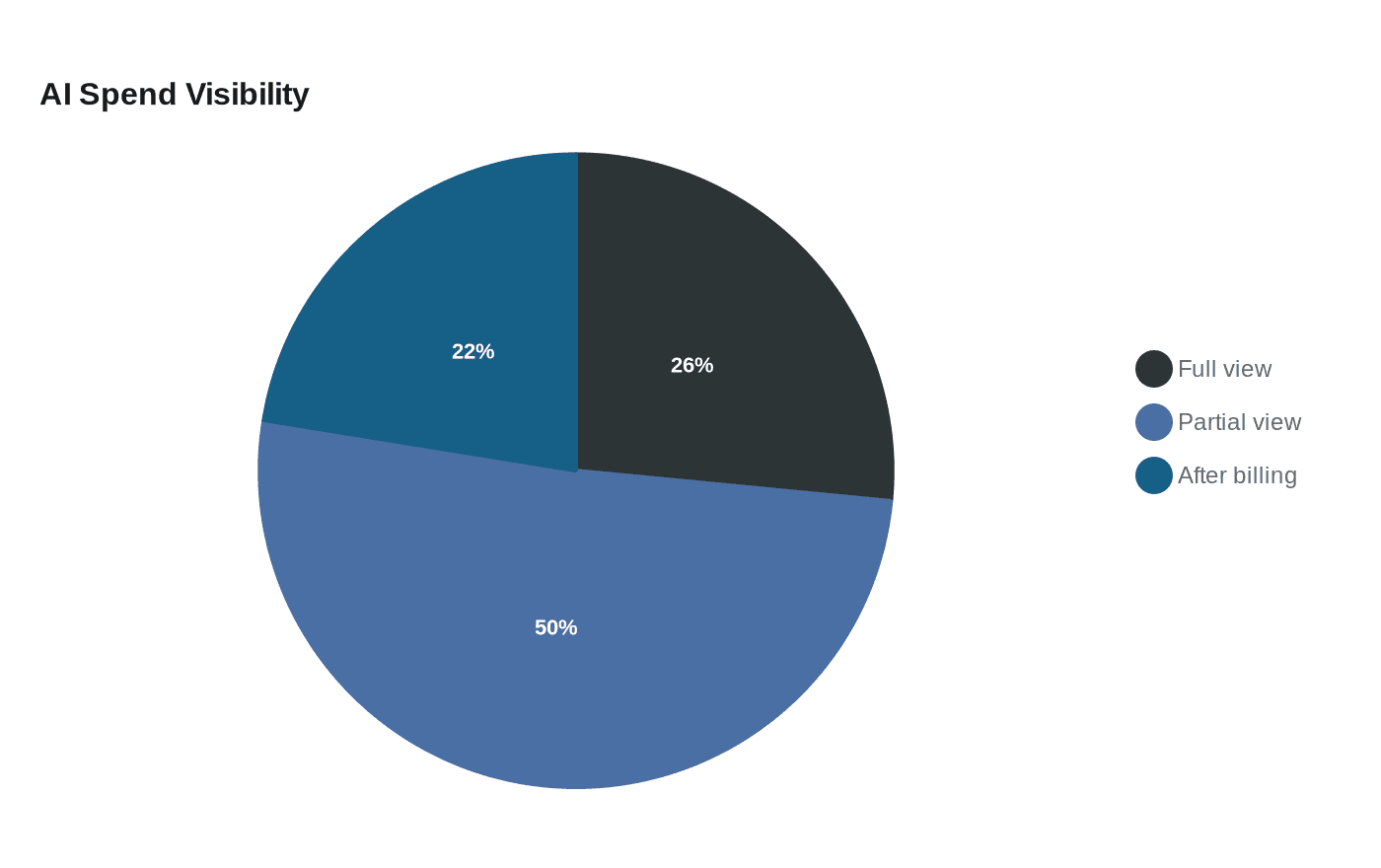
AI spending is racing ahead of the controls meant to contain it, and that gap is now landing on employees as tighter approvals, usage limits and harsher ROI checks. In KPMG’s latest survey, only 26% of companies said they had a full view of AI spending, while 50% had only partial visibility and 22% were seeing costs only after billing arrived.
That is more than an accounting problem. It means firms are buying AI faster than finance, procurement and business leaders can track it, leaving teams to sort out duplicated tools, surprise invoices and which practice actually owns the bill. KPMG said organizations projected average AI spending of $207 million over the next 12 months in its Q1 2026 AI Quarterly Pulse Survey, nearly double the prior year. More than half of organizations were already deploying AI agents, and most leaders now require human validation of those agents’ outputs before they will scale further.

The spending surge is happening alongside a sharper demand for proof. In KPMG’s Global AI Pulse for Q1 2026, 64% of organizations said AI had been delivering meaningful business value, but only 8% were already achieving ROI. That mismatch helps explain why 74% said they were concerned about data security, privacy and risk, and why governance is moving from a compliance afterthought to a condition for expansion.
KPMG’s April 16, 2025 AI Quarterly Pulse Survey showed how quickly the pressure has built. Ninety-three percent of leaders said GenAI investments had improved their company’s competitive position, while planned spending for the next year climbed to nearly $114 million from $89 million the quarter before. Even then, 82% expected risk management to be the biggest challenge for the rest of 2025, and investor pressure on AI initiatives jumped from 68% to 90% quarter over quarter. CIOs were increasingly taking the lead on AI strategy, a sign that technology decisions are moving deeper into the center of enterprise budgeting.
The visibility problem extends beyond spend. Protiviti’s May 7, 2026 AI Pulse Survey found 47% of large organizations lacked full visibility into employee AI tool usage, and 65% reported challenges with shadow AI. For firms like KPMG, that points to a new operating reality: AI is no longer just a pilot or a pitch. It is becoming a line item that finance has to police, procurement has to rationalize and managers have to justify, one approval at a time.
This article was produced by Prism’s automated news system from verified source data, official records, and press releases, then run through automated quality and moderation checks before publishing. The system is built and supervised by the people who set the standards it runs under. Read our full AI policy.
Know something we missed? Have a correction or additional information?
Submit a Tip