KPMG Workers Can Use IRS Guide to Cut Education Tax Costs
For KPMG staff chasing a CPA, master’s, or loan repayment benefit, the tax break can be as valuable as the tuition itself, but only if you know which costs qualify.
Why this matters when your career is getting more expensive
At KPMG, the pressure to keep credentialing never really stops. You may be paying for a master’s degree, a CPA review course, a specialty certificate, or a licensure fee at the same time you are trying to protect take-home pay during busy season. IRS Publication 970 is the guide that helps sort out which of those expenses can lower your tax bill, which ones are already covered tax-free, and which ones simply do not move the needle.

That distinction matters because education spending in professional services is rarely just a personal choice. It is part career strategy, part promotion math, and part cash-flow management. A tax break that saves a few thousand dollars can change whether a graduate program feels manageable or like a stretch too far.
What Publication 970 actually covers
Publication 970 is the IRS’s central guide for education-related tax benefits. It is designed for people saving for or paying education costs for themselves or family members, and it covers educational assistance, tax credits, and other tax benefits. It also explains the tax treatment of scholarships, fellowship grants, tuition reductions, employer educational assistance, and several education credits and deductions.
The IRS also says the publication includes an appendix with an illustrated example and a comparison chart of the different benefits. That is useful because the real problem is not finding a tax break. It is figuring out which one applies without accidentally giving up another.
For early-career accountants, that comparison matters in very practical terms. A graduate class, a CPA-related expense, or a licensure-support arrangement can look similar on paper, but the tax result can be completely different depending on who pays, how it is paid, and whether the benefit is treated as taxable income.
The credits that can still make a real dent
The two headline breaks are the American Opportunity Tax Credit and the Lifetime Learning Credit.
The American Opportunity Tax Credit can be worth up to $2,500 per eligible student for the first four years of higher education. That makes it the bigger prize for people still early in a degree path, though it is limited to qualifying students in those first four years.
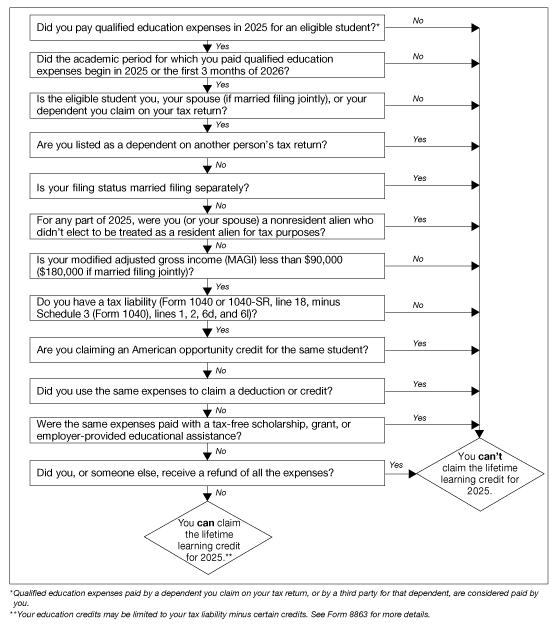
The Lifetime Learning Credit is broader in another way. It can apply to undergraduate, graduate, and professional degree courses, including courses to acquire or improve job skills. There is no limit on the number of years you can claim it, which is why it matters for working professionals who are not following a neat, four-year college path.
That broader scope is especially relevant in a firm like KPMG, where the next step may be a master’s degree, a specialized credential, or coursework that directly supports your current role. The catch is that you cannot treat the same expense as a free-for-all. If a cost is already covered by tax-free assistance, it generally cannot be used again to claim another education tax benefit, including the Lifetime Learning Credit.
Starting in 2026, there is another rule that matters for both credits: taxpayers claiming the American Opportunity Tax Credit or the Lifetime Learning Credit must have a Social Security Number valid for work and issued before the return due date. If the claimant is not the student, the student also needs that valid SSN. That is the kind of detail that can turn a promising tax benefit into a paperwork problem if you wait too long.
Where employer support helps, and where it blocks other breaks
Employer education support is often the cleanest way to reduce your out-of-pocket cost, but it is not always the best way to maximize every tax break. Under section 127, educational assistance programs can allow employers to provide up to $5,250 per employee per year tax-free. The IRS says these benefits can include undergraduate or graduate-level student loan debt and other education expenses when the program meets the rules.
That matters because a tax-free benefit is not the same thing as a refundable credit, and the interaction can be unforgiving. If your tuition reimbursement or other educational assistance is excluded from income, you generally cannot turn around and use that same expense to claim the Lifetime Learning Credit. In plain English, tax-free help is valuable, but it can crowd out a separate credit.
For KPMG workers, that tradeoff shows up in the real world all the time. Tuition reimbursement, exam support, and loan repayment benefits are common retention tools in professional services, and KPMG’s own learning-and-development materials emphasize continuous learning and financial support in some markets, including tuition reimbursement. The key question is not whether the firm pays. It is whether the payment is structured in a way that leaves you with the best net result after taxes.
The deductions people overlook
Not every benefit comes as a credit. Some education-related costs reduce taxable income through deductions or exclusions instead.
The student loan interest deduction is one of the most familiar examples. For 2025, it phases out between modified adjusted gross income of $85,000 and $100,000 for single filers, and between $170,000 and $200,000 for joint filers. That means many higher-earning professionals will not qualify, but some early-career accountants still will, especially before promotion cycles and pay raises push income higher.
There is also the education savings bond interest exclusion. For 2025, it phases out between modified adjusted gross income of $99,500 and $114,500 for single filers, and between $149,250 and $179,250 for joint filers. It is not the most common benefit for KPMG staff, but it is part of the same map, and Publication 970 includes it for a reason: education tax planning often involves more than tuition alone.
The bigger lesson is that deductions and exclusions are not automatically better than credits, or vice versa. A credit can be more valuable than a deduction, but only if you qualify. A tax-free employer benefit can be more efficient than paying out of pocket, but only if it does not wipe out another credit you could have claimed.
How to think about a degree or credential before you pay for it
If you are deciding whether another degree or credential is worth it, start with three questions:
- Will the expense qualify for the American Opportunity Tax Credit, the Lifetime Learning Credit, or neither?
- Is your employer offering tax-free assistance under section 127, and if so, does that benefit reduce or eliminate your ability to claim a separate credit?
- Will student loan interest, education savings bond interest, or another education-related tax break actually apply at your income level?
That is the real value of Publication 970. It does not tell you whether a master’s degree is worth it for your career, and it will not replace individualized tax advice. But it gives you a framework for pricing the decision correctly.
For KPMG professionals, that framework can be the difference between treating education as a sunk cost and treating it as a managed investment. In a profession where every new credential is supposed to open a door, the tax code decides how much of the bill you really carry through it.
This article was produced by Prism’s automated news system from verified source data, official records, and press releases, then run through automated quality and moderation checks before publishing. The system is built and supervised by the people who set the standards it runs under. Read our full AI policy.
Did this article answer your question?


.pdf%2F_jcr_content%2Frenditions%2Fcq5dam.thumbnail.319.319.png&w=1920&q=75)