KPMG workers face rising financial stress as earned wage access grows
Financial stress is pushing earned wage access from perk to policy. For KPMG teams, the real question is whether the pay design reduces strain without creating payroll and legal risk.
Financial stress is now a workplace issue
Earned wage access is getting attention because the underlying problem is already inside the workplace. A PwC survey found 59% of workers are stressed about their finances right now, 49% say their compensation is not keeping up with costs, and financially stressed employees are five times more likely to be distracted at work. Related coverage says those workers typically spend more than three hours of work time each week dealing with financial concerns, which is the kind of drag that shows up in engagement, client service, and deadline pressure.

For KPMG professionals, that matters in a very specific way. A firm built around utilization, promotion cycles, and partner-track expectations can absorb a lot of performance strain before it becomes visible. Financial stress adds another layer, especially in busy season, when long hours and compressed timelines leave less room for personal money problems to stay personal. The result is that pay timing is no longer just an employee-relations issue, it is a workforce design problem.

Why earned wage access is moving into the mainstream
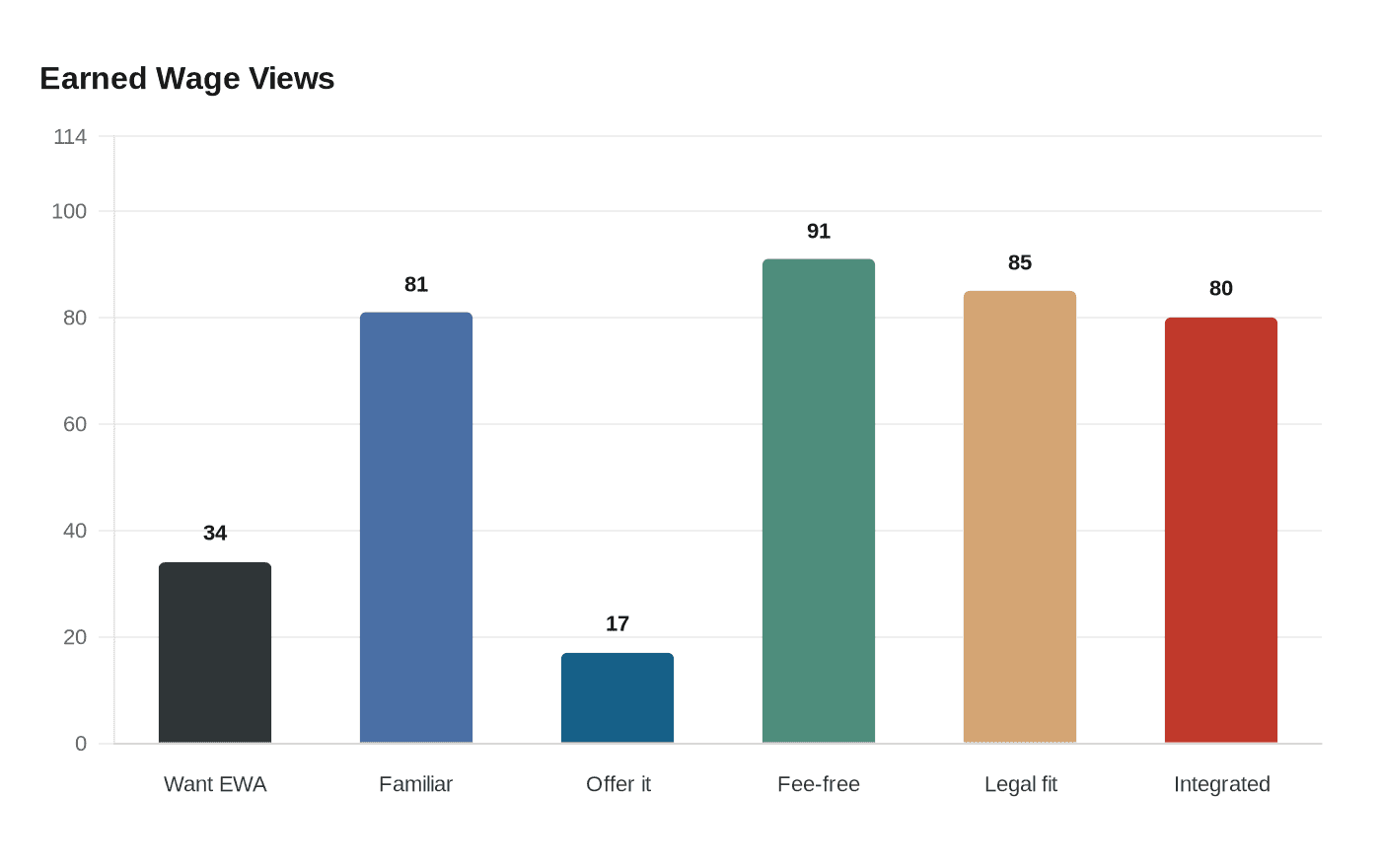
The demand side has been building for years. PayrollOrg’s 2023 survey found nearly 34% of employees want access to wages as they earn them rather than waiting for a traditional payday, up 13 percentage points from the prior year. That helps explain why the conversation has shifted from whether employers should offer earned wage access to how they should do it without creating new headaches.
The latest market research suggests the product is now being judged through a broader lens than instant access alone. PayrollOrg and Chime Enterprise found that 81% of payroll leaders are familiar with earned wage access, but only 17% currently offer it. At the same time, 91% prefer fee-free models for both employees and employers, 85% say alignment with lending-law frameworks is important, and 80% want earned wage access integrated into a broader financial wellness platform. Everest Group reached a similar conclusion, saying employers now expect the offering to be no-cost and part of a wider financial wellness package.
That is a meaningful shift for KPMG leaders who advise clients on HR transformation, managed services, and payroll modernization. Earned wage access is no longer just a benefits feature. It is a test of whether the firm can help employers meet a very human need without creating a new stream of compliance and vendor-governance risk.
The regulatory line is clearer, but not simple
The good news for employers is that the federal picture is less foggy than it was a year ago. On December 23, 2025, the Consumer Financial Protection Bureau issued an advisory opinion saying certain employer-integrated covered earned wage access products are not credit under Regulation Z and TILA. The bureau also said expedited delivery fees and tips are not finance charges in the normal course for those covered products.
That opinion helps remove a major question mark for employer-linked programs that advance already-earned wages and are repaid through payroll. Thomson Reuters described it as clearing a path for those arrangements and reducing regulatory uncertainty. But the path is not uniform across the United States. The National Conference of State Legislatures said at least 20 states had pending earned-wage-access legislation in the 2025 legislative year, and PayrollOrg has noted that several states had already passed laws or issued guidance.
For KPMG teams, the practical lesson is simple: federal clarity does not eliminate state-by-state review. A program that looks clean in Washington, D.C. can still require a separate read on wage-and-hour rules, payroll timing, fee treatment, and state lending or employment law depending on where the workers sit.
The design choices that determine risk
The biggest mistake employers make is treating earned wage access as a plug-and-play benefit. The structure matters more than the slogan. A clean implementation starts with a decision on whether the product is employer-integrated or direct-to-consumer, fee-free or fee-based, and whether it sits inside a broader financial wellness platform.
- Employer-integrated models generally create the strongest case for payroll coordination, but they also raise the need for tight controls on wage calculations, repayment timing, and system integration.
- Fee-based models can look attractive to vendors, but the latest payroll-leader research shows employers increasingly prefer no-cost designs, especially when they are trying to position the benefit as financial wellness rather than wage monetization.
- Payroll deduction mechanics need legal review before launch, because the repayment structure can trigger wage-hour and payroll-tax questions if it is not mapped cleanly.
- Vendor oversight is not optional. The more the provider touches pay data, the more HR, payroll, legal, and procurement need a common playbook for controls, service levels, and escalation.
- Broader financial wellness integration is becoming the default expectation. That matters because workers under financial strain are not just asking for earlier access to cash, they are asking for a system that feels less punitive and more stable.
How KPMG should divide ownership
This is where the internal governance conversation gets real. HR should own the employee-experience case and the broader benefits strategy. Payroll should own the mechanics, because the timing, calculations, and repayment flow can turn into a compliance issue quickly. Legal should sign off on the lending-law, wage-and-hour, and state-law questions, while risk, procurement, and IT help evaluate the vendor and the data connection to core payroll systems.
That division of labor matters because the policy choice can look different from the worker’s side than it does from the company’s side. Employees see a tool that may help them bridge bills, rent, or childcare without going into debt. Employers see a program that can either strengthen retention and reduce distraction, or introduce tax, wage, and vendor risk if it is bolted on carelessly.
For KPMG, the opportunity is to treat earned wage access as a governance exercise with a human outcome. The firms and clients that get this right will not be the ones that move fastest. They will be the ones that design pay systems that are humane enough to matter, and controlled enough to survive scrutiny.
This article was produced by Prism’s automated news system from verified source data, official records, and press releases, then run through automated quality and moderation checks before publishing. The system is built and supervised by the people who set the standards it runs under. Read our full AI policy.
Did this article answer your question?


.pdf%2F_jcr_content%2Frenditions%2Fcq5dam.thumbnail.319.319.png&w=1920&q=75)