SEC and CFTC seek comment on portfolio margining harmonization
The agencies asked whether portfolio margining should be aligned across securities and derivatives, a move that could force clients to revisit collateral and capital.
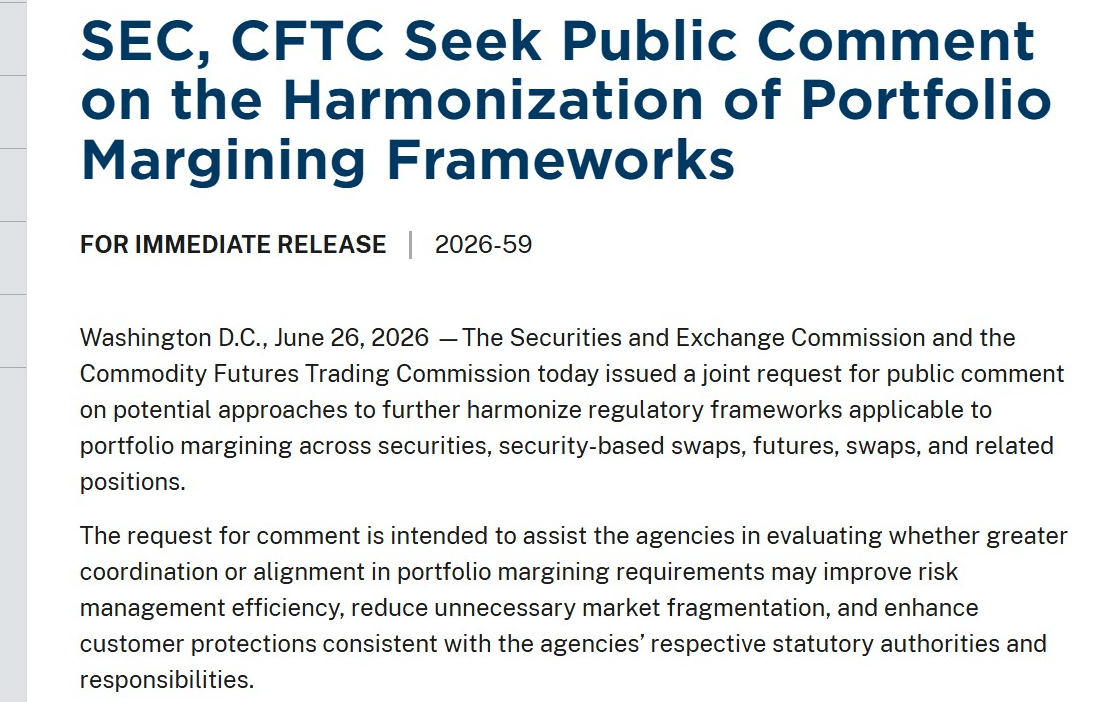
The SEC and CFTC have opened a 60-day comment window on whether portfolio margining and cross-margining rules should be harmonized across securities, security-based swaps, futures, swaps and related positions, putting banks, broker-dealers and derivatives users on a short clock to assess the impact. For KPMG, the immediate work sits with risk, regulatory, valuation and derivatives specialists, the people clients call when collateral, documentation and capital treatment all have to line up at once.
The joint request, issued June 26, 2026, asks market participants how greater coordination or alignment could improve risk-management efficiency, reduce market fragmentation and enhance customer protections within each agency’s statutory authority. The SEC’s rule filing says the commissions want input on further implementing portfolio margining and cross-margining of securities and derivatives subject to the jurisdiction of either or both agencies. That is the kind of technical signal that quickly turns into operating questions for treasury, legal, trading and compliance teams: which entities would qualify, how netting would work, what controls would need to change and where existing systems would need rework.

The policy backdrop is already moving in the same direction. On March 11, 2026, the agencies announced a Memorandum of Understanding to guide coordination and collaboration, support lawful innovation, uphold market integrity and protect investors and customers. Both agencies now frame the SEC-CFTC Harmonization Initiative as an effort to reduce duplicative regulation and give markets more clarity, which makes the portfolio-margining request look less like a one-off consultation and more like part of a broader push to narrow gaps between adjacent regimes.
That matters inside KPMG because harmonization touches several service lines at once. Regulatory teams will need to map which provisions could be aligned and which are likely to stay separate. Derivatives specialists will have to translate any new treatment into clearing and margin workflows. Valuation teams may be pulled into questions about how exposures are measured across products, while capital-planning advisers will need to test whether a more unified framework changes collateral efficiency or the economics of legal entity structures. The practical client question is not just whether rules converge, but how quickly firms can change controls, documentation, model governance and reporting without creating new operational risk.
The comment period is especially relevant for firms already watching industry pressure for alignment. SIFMA and the International Swaps and Derivatives Association submitted comments on May 19, 2026 in support of further harmonization, and ISDA said in October 2025 that U.S. derivatives rules remain complex, overlap in key areas and rely too heavily on no-action relief. ISDA also linked portfolio margining to Treasury clearing expected to begin at the end of 2026, a timeline that could force firms to think about multiple margin and collateral changes before year-end. For KPMG teams serving derivatives-intensive clients, that makes the next 60 days a first test of where advisory demand is likely to land.
This article was produced by Prism’s automated news system from verified source data, official records, and press releases, then run through automated quality and moderation checks before publishing. The system is built and supervised by the people who set the standards it runs under. Read our full AI policy.
Did this article answer your question?


.pdf%2F_jcr_content%2Frenditions%2Fcq5dam.thumbnail.319.319.png&w=1920&q=75)