BLS data shows steady turnover, not growth, in retail jobs
Retail may not be growing, but it keeps opening doors. For lululemon workers, the real story is turnover, training, and who can hold the floor.

Retail salespersons earned a median $16.62 an hour in May 2024, and the U.S. Bureau of Labor Statistics projects little or no overall employment growth from 2024 to 2034 even as it expects about 586,000 openings a year on average. For lululemon educators and store leaders, that means the job market is driven by turnover, replacement, and fit, not just headcount growth.
A market built on replacement, not expansion
The BLS forecast separates job openings from job growth. Retail can continue to generate a large number of openings without adding many net new positions, which means stores still need people even when the overall sector is flat. That makes the competition for strong workers intense, especially in a brand-heavy environment like lululemon where guest experience and product storytelling are part of the job, not side duties.
The newer outlook is also more favorable than the BLS’s earlier 2022-32 projection, which showed a 2 percent decline for retail sales workers and a median pay figure of $14.79 an hour. The pay benchmark has moved up, but the market still looks like one built on constant replacement demand.
Training, not credentials, does most of the work
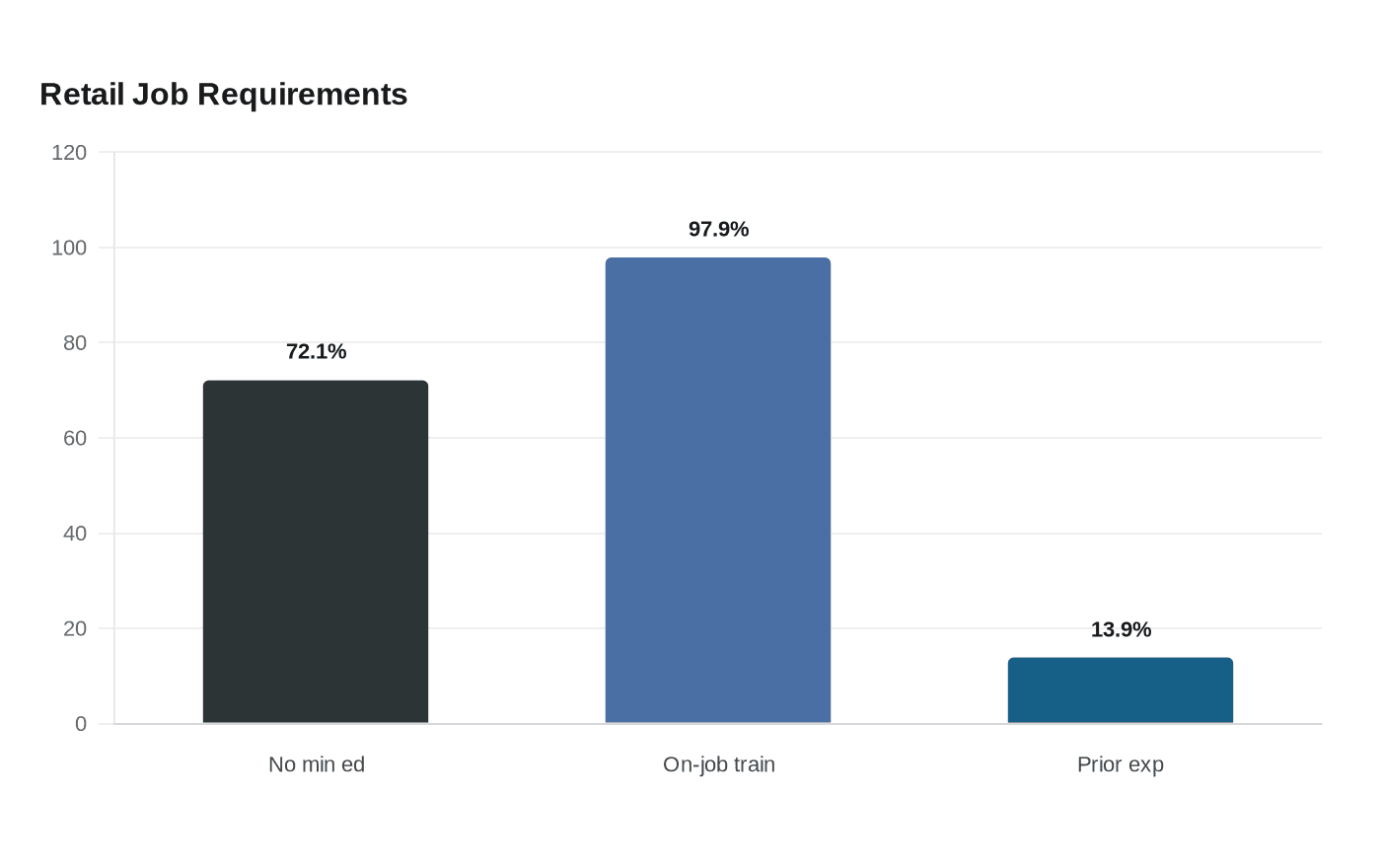
BLS’s Occupational Requirements Survey shows the path into retail sales more clearly. In 2024, no minimum education was required for 72.1 percent of retail salespersons, on-the-job training was required for 97.9 percent, and prior work experience was required for 13.9 percent. The occupation still leans heavily on what happens after hire.
An Educator role is not mainly a credential screen. It is a training-heavy job where the store teaches the basics of selling, product knowledge, and service, then expects the associate to turn that into a consistent guest experience. For assistant store managers and key leaders, the data underlines why onboarding quality matters so much: the business is not just hiring labor, it is building capability.
Why lululemon’s store floor is a different test
lululemon’s own history shows how much the company has grown around that store-level experience. The brand was founded in 1998, opened its first retail space in a yoga studio in Kitsilano, Vancouver, Canada, opened its first official store in Vancouver in 2000, and entered the U.S. market in Santa Monica, California, in 2003. Today lululemon has more than 700 stores worldwide; its 2025 Year in Review lists 39,000 employees, 44 net new company-operated stores, and $11.1 billion in total revenue.
A large chain with rapid store growth needs more than warm bodies on the schedule. It needs enough educators who can keep the guest experience consistent, explain products with confidence, and match the brand’s community-first tone across markets that may look very different from one another. When stores are growing and the workforce is large, the cost of a weak hire or a rushed onboarding process shows up quickly in service, conversion, and retention.
lululemon frames the brand around innovation, community, and personal growth, and an Educator posting says educators are the foundation of the company’s success. The posting says they are responsible for world-class guest experience, product education, and authentically speaking about the company’s community and culture.
What this means for educators, key leaders, and assistant store managers
Retail can still be an entry point with relatively low formal barriers, but the long-term gains come from learning fast, performing well, and moving through the organization. Promotion, transfer, and cross-functional experience can matter as much as the title on your badge.
For educators, that means the job is about more than keeping the floor covered. You are being trained to absorb product knowledge, translate it for guests, and match the pace of a specialty retailer that lives on launches, traffic spikes, and consistent presentation. For assistant store managers and key leaders, the labor-market signal is harder-edged: if the industry keeps producing openings but not much net growth, the stores that hold onto strong people will have an advantage in both service and execution.
A practical read of the data looks like this:
- Expect to be trained on the job, not hired because you already know everything.
- Expect the company to value product fluency and guest interaction as much as basic retail experience.
- Expect movement to matter, because a large retail chain often rewards people who build skills and move with the business.
- Expect retention to be an operational issue, not just an HR talking point, because replacement demand never really stops.
This article was produced by Prism’s automated news system from verified source data, official records, and press releases, then run through automated quality and moderation checks before publishing. The system is built and supervised by the people who set the standards it runs under. Read our full AI policy.
Did this article answer your question?