McDonald’s builds education benefits to map restaurant jobs to careers
McDonald’s is using tuition help and career advising to make restaurant work feel like a real ladder, not a dead end, and that is the retention play.
How Archways turns a restaurant job into a next step
McDonald’s is betting that education benefits do more than help workers pay for school. Through Archways to Opportunity, the company is trying to make a crew job feel like the first stop on a longer career path, whether that next step stays inside McDonald’s or leads to healthcare, IT, finance, or the trades.
That matters in a business built on churn. In a high-turnover system, retention is not just about raising hourly pay or filling next week’s schedule. It is about giving workers a believable reason to stay long enough to learn the job, move up, and see a future that does not end at the fry station.
What employees actually get
Archways to Opportunity was founded in 2015 to address both an education gap and a skills gap in the United States, and McDonald’s says it was shaped with thought partners including the American Association of Community Colleges and the Council for Adult and Experiential Learning. The program is built around practical supports that matter in day-to-day life: English-language learning, a no-cost high school diploma path, college tuition assistance, and education and career advising.
That mix is important because it does not treat every worker the same way. Some crew members need a diploma, some need help with English, some want college credit, and some just need a clearer map of what comes after their shift schedule. For a lot of restaurant workers, especially adults balancing school, child care, and unpredictable hours, the value is not abstract. It is the difference between feeling stuck and seeing a route forward.
Why McDonald’s expanded it
McDonald’s did not keep Archways small. In 2017, the company said it would put $150 million over five years into the program. That expansion tripled tuition assistance, lowered eligibility from nine months to 90 days, and extended some benefits to employees’ family members.

Those changes tell you a lot about how the company thinks about retention. Cutting the waiting period from nine months to 90 days makes the benefit visible early enough to matter when a new hire is deciding whether to stick around past the first few tough months. Extending some support to family members also broadens the appeal, because restaurant jobs are often judged in households by what they can help the whole family do, not just by the hourly rate on a paycheck.
McDonald’s has also framed education and training as part of a larger workforce strategy, alongside efforts like Hamburger University. The through line is simple: if restaurant work is structured well, it can produce the skills, confidence, and credentials that lead to promotion or a better outside option.
The scale behind the pitch
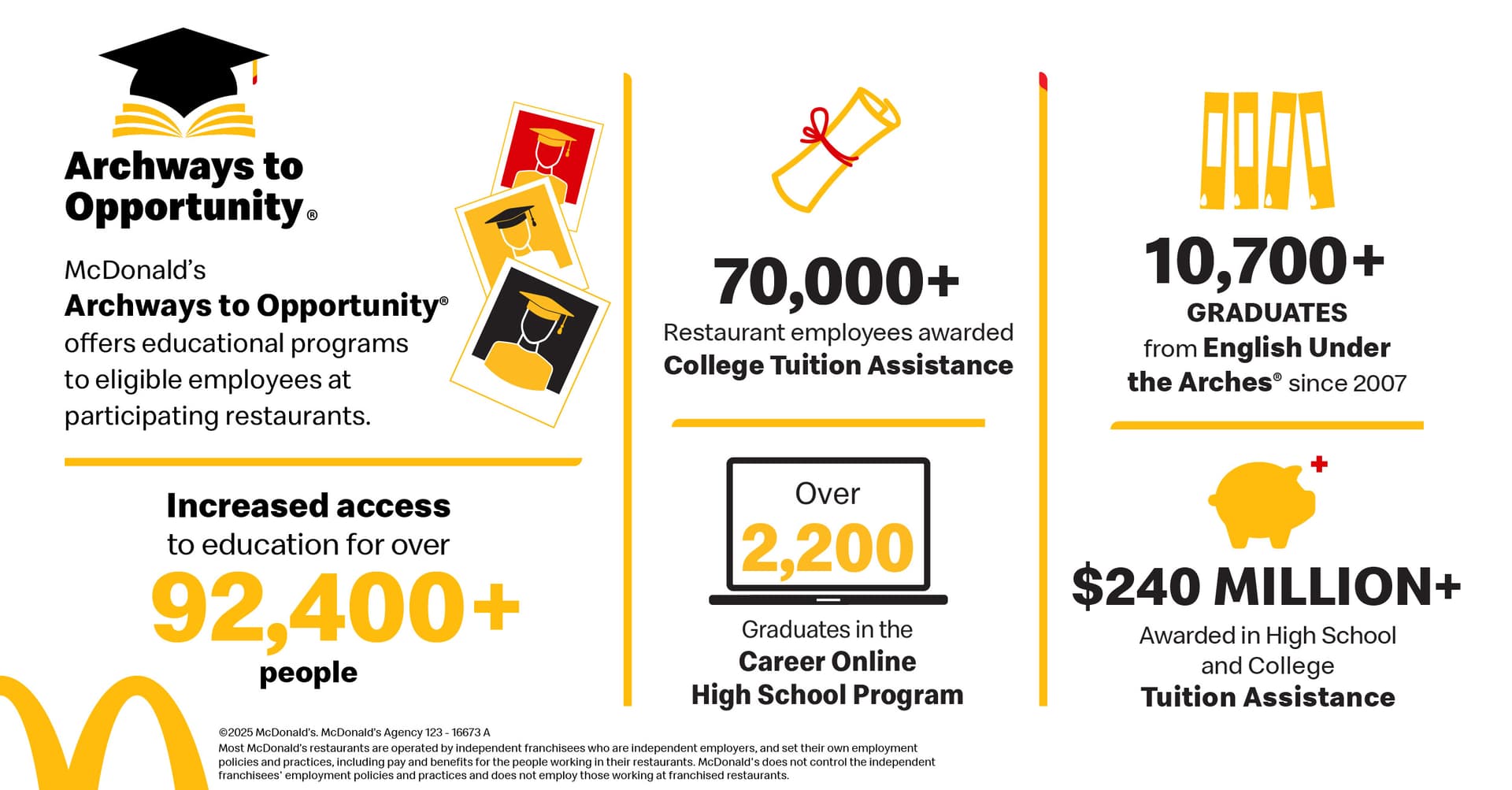
The company’s numbers show how central Archways has become to that story. McDonald’s said that since the program launched in 2015, it and participating franchisees had invested more than $240 million and helped more than 90,000 crew members earn a high school diploma, receive college tuition assistance, learn English as a second language, and access education and career advising services.
McDonald’s later said Archways had helped more than 82,500 restaurant employees and awarded more than $185 million in tuition assistance. In a 2025 company report, it said the program delivered more than $25.2 million in tuition assistance to over 12,000 U.S. restaurant employees in 2023 alone.
That 2023 figure is especially revealing. It shows this is not a distant corporate promise or a small pilot tucked into a benefits brochure. It is a live operating expense, spread across thousands of workers in a system where a few extra months of retention can save managers constant rehiring and retraining.
The career-navigation piece is the real retention tool
The most useful part of the program may be the one that sounds the least flashy: career advising and navigation. QSR Magazine reported that McDonald’s app lets workers use the skills they build in the restaurant to find education and growth opportunities inside McDonald’s and in outside fields such as healthcare, IT, and the trades.
That matters because many workers do not leave jobs simply for more money. They leave because they cannot see a path. If the app helps someone connect kitchen discipline, customer service, or shift-lead experience to an actual school program or career track, then McDonald’s is doing more than offering a perk. It is translating restaurant work into language a worker can use for the next job interview, the next class, or the next promotion.
Rob Lauber, McDonald’s chief learning officer, put the company’s view of the workforce bluntly, saying it has “immeasurable talent.” He also argued that the education benefits and mobile tools can help employees pursue long-term career success no matter where they end up. That is a revealing stance for a company that depends on both labor availability and franchise consistency. It suggests McDonald’s understands that retaining workers does not always mean keeping them forever. Sometimes it means helping them move up fast enough that they stay long enough to matter, and leave with a better opinion of the job if they do move on.
Why franchisees should care
This is not just a corporate-speak story about opportunity. In a franchised system, the operational payoff lands at store level. Better-trained employees are easier to schedule, easier to promote, and more likely to recommend the job to someone else when they have a decent experience. A program like Archways can lower the odds that a unit is constantly starting from zero, which is one of the hidden costs of fast-food labor.
The 10-year Archways report also signals that McDonald’s is treating the program as more than a feel-good benefit. The company interviewed current and former participants, franchise owners and operators, partner schools, and education and workforce experts, which suggests it is trying to measure the system from multiple angles, not just from headquarters. That is the right instinct in a business where the real test is whether a benefit changes who stays, who advances, and who tells a friend that the job is worth taking.
In the background, the broader labor fight still matters. Fight for $15, minimum wage campaigns, and the growing use of automation all push McDonald’s to prove that the human side of the job still has a future. Archways is part of that answer. It does not replace wages, and it does not solve every staffing problem, but it gives the company a more credible story: a crew job can be a start, not a sentence.
This article was produced by Prism’s automated news system from verified source data, official records, and press releases, then run through automated quality and moderation checks before publishing. The system is built and supervised by the people who set the standards it runs under. Read our full AI policy.
Know something we missed? Have a correction or additional information?
Submit a Tip