McDonald's careers site highlights corporate roles, benefits, internal mobility
McDonald’s careers site is pushing a bigger story than restaurant hiring: it maps out corporate paths, education support, and benefits that can turn crew experience into a longer career.

McDonald’s wants workers to see more than a crew job
McDonald’s careers site is doing more than posting openings. It is trying to show a ladder, with a virtual recruiting assistant named Sam to help candidates search for jobs and move through the application process, plus a wider map of roles that reach far beyond the counter. For a crew member or shift manager trying to figure out what comes after the grill line, that matters: the company is presenting itself as a place where restaurant experience can lead into corporate, field, technology, operations, finance, and support work.
That framing is not subtle. McDonald’s says its company employees totaled more than 150,000 at year-end 2024, and about 70% were based outside the U.S. In other words, this is a global employer with a deep internal labor market, not just a fast-food brand with franchise hiring needs.
The jobs open up a much broader picture
The corporate careers pages show how wide the company’s hiring really is. McDonald’s says corporate roles span technology, marketing, people, operations, finance, and other support functions. The current global corporate listings also make that range concrete, with about 242 jobs showing across countries and functions.
A few of the titles make the point better than any slogan could:
- Manager, Scrum Master
- Principal Platform Engineer
- Manager, Research & Insights
- Ronald McDonald House-related roles
That mix tells workers something important. McDonald’s is not only hiring people who already come from traditional corporate backgrounds. It is also staffing digital systems, internal operations, research, and nonprofit-adjacent work tied to Ronald McDonald House Charities. For someone whose first McDonald’s job was making fries or closing lobby, the relevant next step may not be a corporate corner office. It may be a field operations role, a people role, or a support job that uses the same pace, discipline, and customer pressure they already know.
What transfers from the store floor
McDonald’s does not spell out a neat conversion chart from restaurant work to corporate careers, but the structure of its job families points to where experience can travel. If you have learned how to keep a kitchen moving during a lunch rush, coach a new hire, cover a shift gap, or keep standards steady when a store is short-staffed, you already have the kind of operational judgment many support roles require.
That is especially true in operations and people functions. Store work teaches scheduling under pressure, teamwork across age groups and experience levels, service recovery, and the ability to stay calm when the line is backing up. Those are not abstract soft skills. They are the day-to-day mechanics of running a restaurant, and they translate naturally into support roles that need problem-solving, communication, and consistency.
The site’s emphasis on digital recruiting also says something about how movement inside the company now works. Applications, internal mobility, and hiring increasingly run through technology, so learning to use Sam and the broader careers platform is part of the job search itself. For workers trying to move up, the practical lesson is simple: the next opportunity may depend as much on knowing where to look and how to present your experience as on formal credentials.
Benefits are front and center, but pay is still the question workers ask first
McDonald’s careers and benefits materials lean hard on support. The company says U.S. employees can get critical illness insurance, mental health support programs, discounted childcare, emergency relief, an employee discount program, a prescription drug discount program, pet insurance, legal insurance, and a sabbatical program. It also highlights total compensation, time away, employee rewards, tuition assistance, employee assistance programs, and flexible working.
That is useful information, but it is not the same thing as a clear pay path. The site gives workers a better sense of the support package than of a precise wage ladder, which leaves a familiar gap for anyone comparing McDonald’s against another employer or a franchise store. People still want to know what the job pays on day one, how quickly pay rises, and how much of the promise is tied to role, market, or franchise operator.
The company’s education benefits are where the opportunity story gets most concrete. Through Archways to Opportunity, McDonald’s says eligible employees can earn a high school diploma, receive college tuition assistance, and access free advising. Some franchise partner pages say tuition assistance can reach $3,000 a year for employees averaging 30 hours per week or $2,500 a year for employees averaging 15 hours per week after 90 cumulative days of employment.
That is the clearest sign that McDonald’s is trying to turn entry-level work into a longer career rather than a dead end. For a worker balancing shifts, school, or family care, even modest tuition support can be the difference between staying in a job and using it as a bridge.
MHQ is part workplace, part recruiting billboard
McDonald’s global headquarters in Chicago, known as MHQ, is built to reinforce the same message. The company says the West Loop campus includes open interiors, outdoor workspaces, a top-of-the-line gym, a work café, and a McDonald’s restaurant with a rotating global menu. That is more than office design. It is a recruiting signal, meant to make headquarters feel like a place where the brand’s culture is visible in the work environment itself.
For workers coming up through the system, the detail matters because it shows how McDonald’s thinks about its own talent pipeline. The company is not separating the restaurant brand from the corporate workplace. It is trying to link them, so a person who starts in a store can imagine a path into broader operations, technology, or leadership.
Inclusion and equal opportunity are part of the pitch
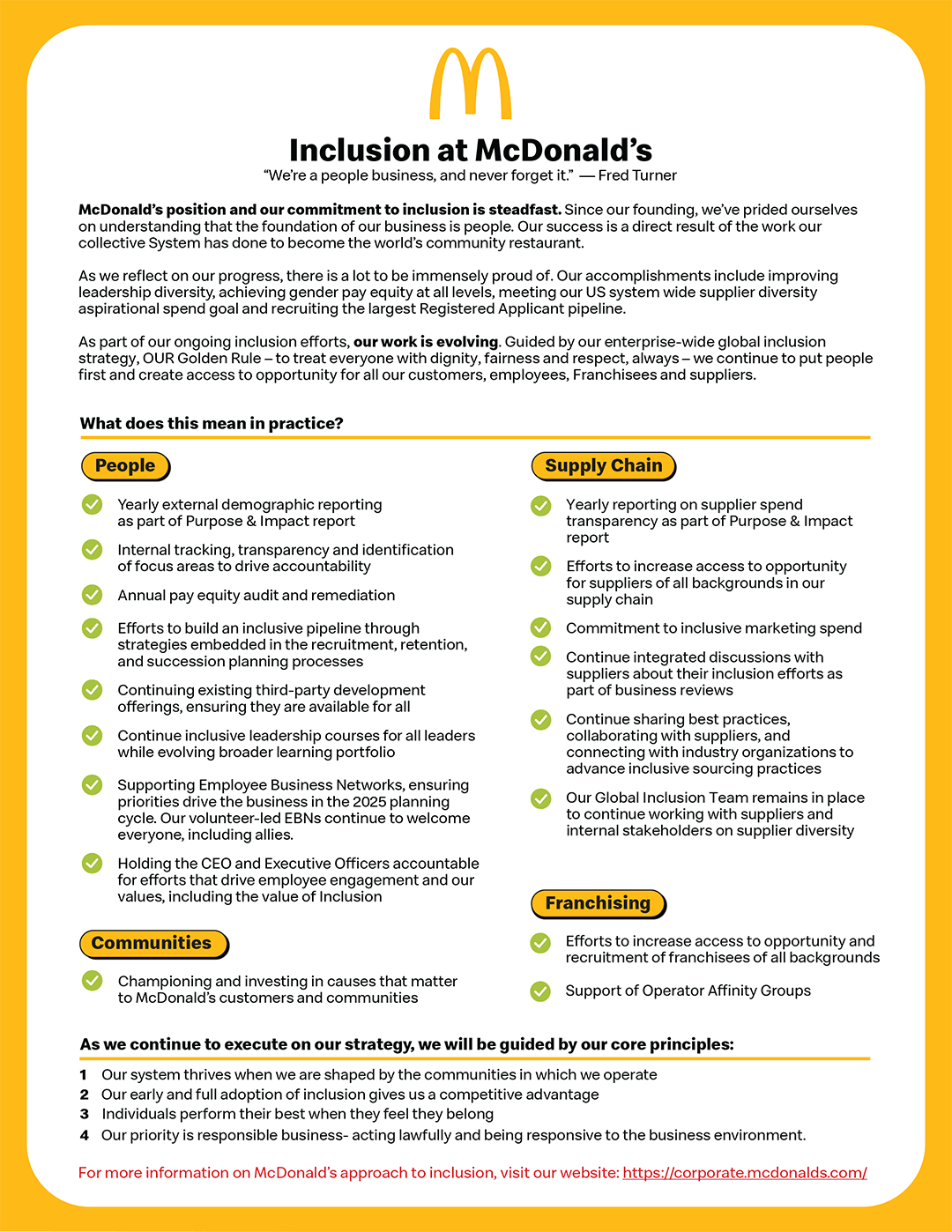
McDonald’s is also placing inclusion alongside mobility. The company says inclusion is part of its heritage and that it strives to be a place where access to opportunity abounds, no matter who you are or where you are from. In January 2025, McDonald’s said it was updating employees, owner/operators, and suppliers worldwide on its inclusion efforts and continuing to embed inclusion throughout the system.
The U.S. careers site says McDonald’s is committed to equal employment opportunity and lists protected categories including race, sex, religion, national origin, age, disability, veteran status, sexual orientation, and gender identity or expression. That matters in a company whose labor force stretches from corporate offices to restaurant floors, and from company-owned locations to franchise systems where the worker experience can vary widely.
For crew members, managers, and franchise employees, the practical takeaway is straightforward: McDonald’s is signaling that the company wants to be seen as a place where a restaurant job can become a career in operations, technology, people work, or support functions. The openings are there, the benefits are being advertised, and the education pipeline is real. What remains for workers is the harder part, turning a shift job into a next step that lasts.
This article was produced by Prism’s automated news system from verified source data, official records, and press releases, then run through automated quality and moderation checks before publishing. The system is built and supervised by the people who set the standards it runs under. Read our full AI policy.
Did this article answer your question?