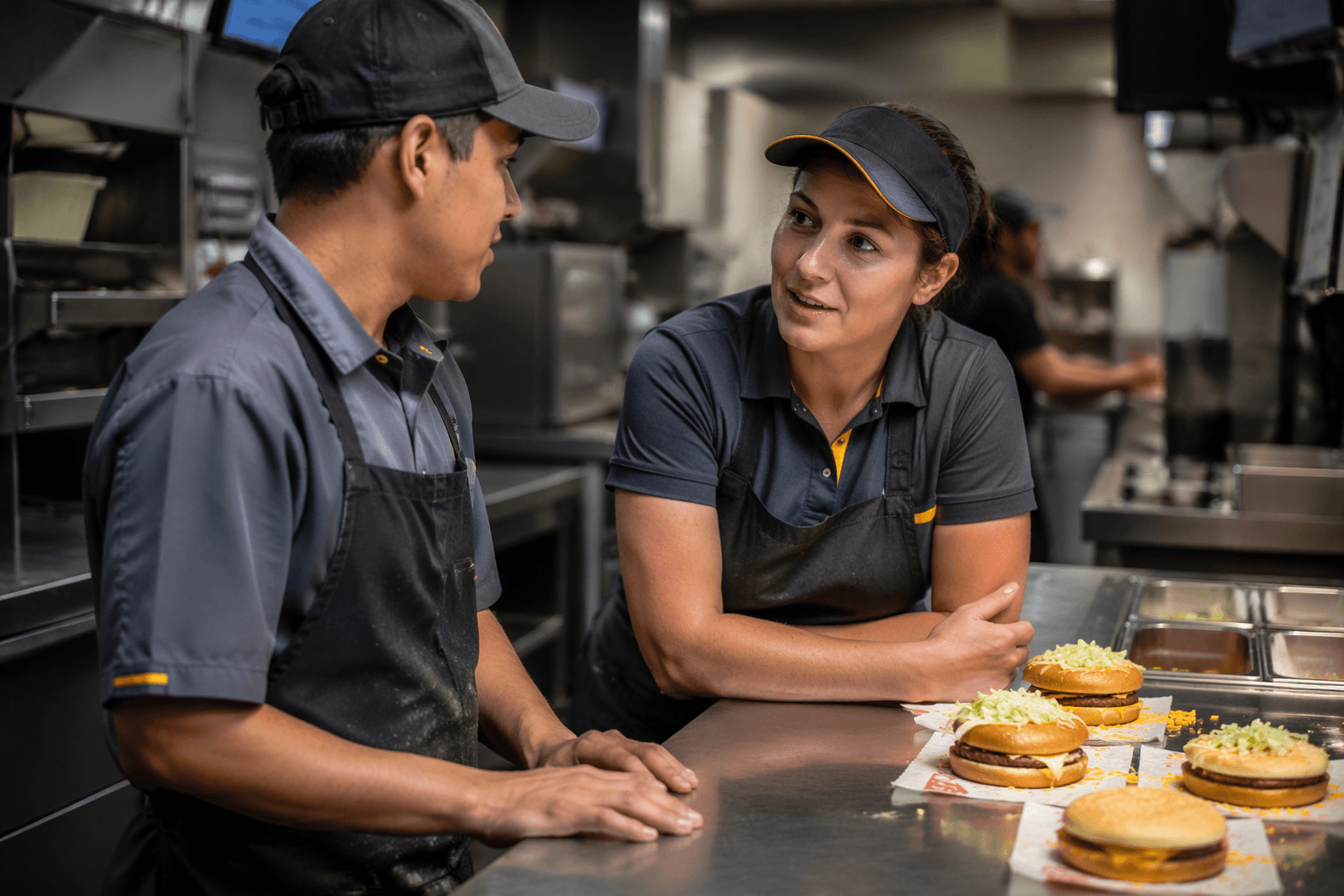
McDonald’s franchise path requires training, capital and business curriculum
McDonald’s ownership starts with $750,000 in personal capital, 6 to 12 months of training, and a site the company chooses, not a location you pick.

McDonald’s ownership is built like a filter, not a shortcut. The company’s franchise system does not treat a restaurant as a simple asset you buy and run on your own terms. It treats ownership as a controlled pathway, with training, financial screens, and site selection all used to decide who gets access to the brand’s next tier.
How McDonald’s controls the operator pipeline
That gatekeeping makes sense inside a system where the U.S. is McDonald’s largest market and almost 95% of U.S. restaurants are owned and operated by conventional licensees. With so much of the domestic business in franchise hands, the company has every reason to protect the way restaurants are staffed, supervised, and standardized. McDonald’s says its BEST model, built around Execution, Strategy, and Talent, is the foundation for how it defines good performance, hires, develops, and assesses people. That is not just corporate language. It is the framework that shows what the brand values when it decides who is ready to run a restaurant.
For workers and managers, that matters because advancement inside McDonald’s has long been shaped by more than hard work alone. Against the backdrop of Fight for $15 campaigns, state and local minimum wage legislation, and the spread of AI and automation in fast food, the route from crew member to management to ownership remains tightly controlled. McDonald’s is telling prospective operators that the company does not simply need capital. It needs people who can reproduce the chain’s staffing, service, and operating standards at scale.
The money hurdle is real
The first hard requirement is financial. McDonald’s says U.S. franchise candidates generally need at least $750,000 in net non-borrowed personal resources to be considered. That figure matters because it puts ownership well beyond the reach of a casual investor or a manager hoping to leap straight from the floor to the franchise ledger.
The company also says applicants must apply individually, and partnerships are not allowed at this time, including sibling partnerships. Family members can work in the business, but they cannot apply as a group. That rule reinforces how personally McDonald’s wants the operator relationship to be: one candidate, one set of qualifications, one person accountable for the restaurant.

Training is not a formality
McDonald’s says approved candidates receive a comprehensive onboarding and training program before they can buy a restaurant. The training generally lasts 6 to 12 months and can be completed part-time, which makes clear that the company expects future operators to understand the business from the inside out rather than arrive as passive owners.
That matters in a chain where speed, labor scheduling, order accuracy, and consistency are the product. A future franchisee is not only learning finance and leadership. They are being asked to absorb the operational rhythm of a McDonald’s restaurant, from staffing patterns to service standards. In McDonald’s own logic, ownership is not the reward at the end of the process. It is the proof that a candidate can carry the system without breaking it.
You do not pick the site
McDonald’s also limits how much control a candidate has over where the business will be. The company says it does not franchise territories and does not work with applicants who want a specific restaurant location or a limited geographic area. Instead, McDonald’s awards the franchise to the most qualified candidate after it decides to develop a site.
That detail is central to understanding the company’s culture. The brand controls the real estate decision, then chooses the operator it believes best fits the location and the system. A would-be franchisee cannot shop for a favorite neighborhood and insist McDonald’s follow along. The company keeps the upper hand on geography, which helps preserve consistency and gives it leverage over who gets into the system.
Most owners enter by buying an existing restaurant
McDonald’s says most new franchisees enter the system by purchasing an existing restaurant from McDonald’s USA, LLC or from another franchisee. That is another sign that ownership is usually an acquisition inside a controlled network, not a build-from-scratch startup.
The purchase price of an existing restaurant varies based on sales volume, profitability, occupancy costs, and reinvestment needs. In other words, the cost reflects the condition of the business as much as the brand name over the door. For an operator, that means the entry point is shaped by what the restaurant is already doing in real life, not by a fixed menu price for entrepreneurship.
McDonald’s is local in practice, global in reach
The company’s selection process is not identical everywhere. McDonald’s says franchise opportunities exist in more than 100 markets around the world, and in international markets the candidate decision is made by management in the country where the restaurant is located. That local decision-making gives the system flexibility while keeping the franchise gate close to the market itself.
The scale is still enormous. McDonald’s says it has more than 36,000 restaurants in more than 100 countries. The current structure reflects a long arc that began when Ray Kroc opened the first McDonald’s restaurant in Des Plaines, Illinois, on April 15, 1955. McDonald’s later acquired the rights to the brothers’ company in 1961 for $2.7 million, turning a single restaurant concept into a highly managed global model.
For employees trying to move up, the lesson is clear. McDonald’s does not treat ownership as a casual reward for tenure or ambition. It treats it as the final stage of a selective business curriculum, one that favors capital, discipline, flexibility, and the ability to operate exactly the way McDonald’s wants the brand run.
This article was produced by Prism’s automated news system from verified source data, official records, and press releases, then run through automated quality and moderation checks before publishing. The system is built and supervised by the people who set the standards it runs under. Read our full AI policy.
Know something we missed? Have a correction or additional information?
Submit a Tip