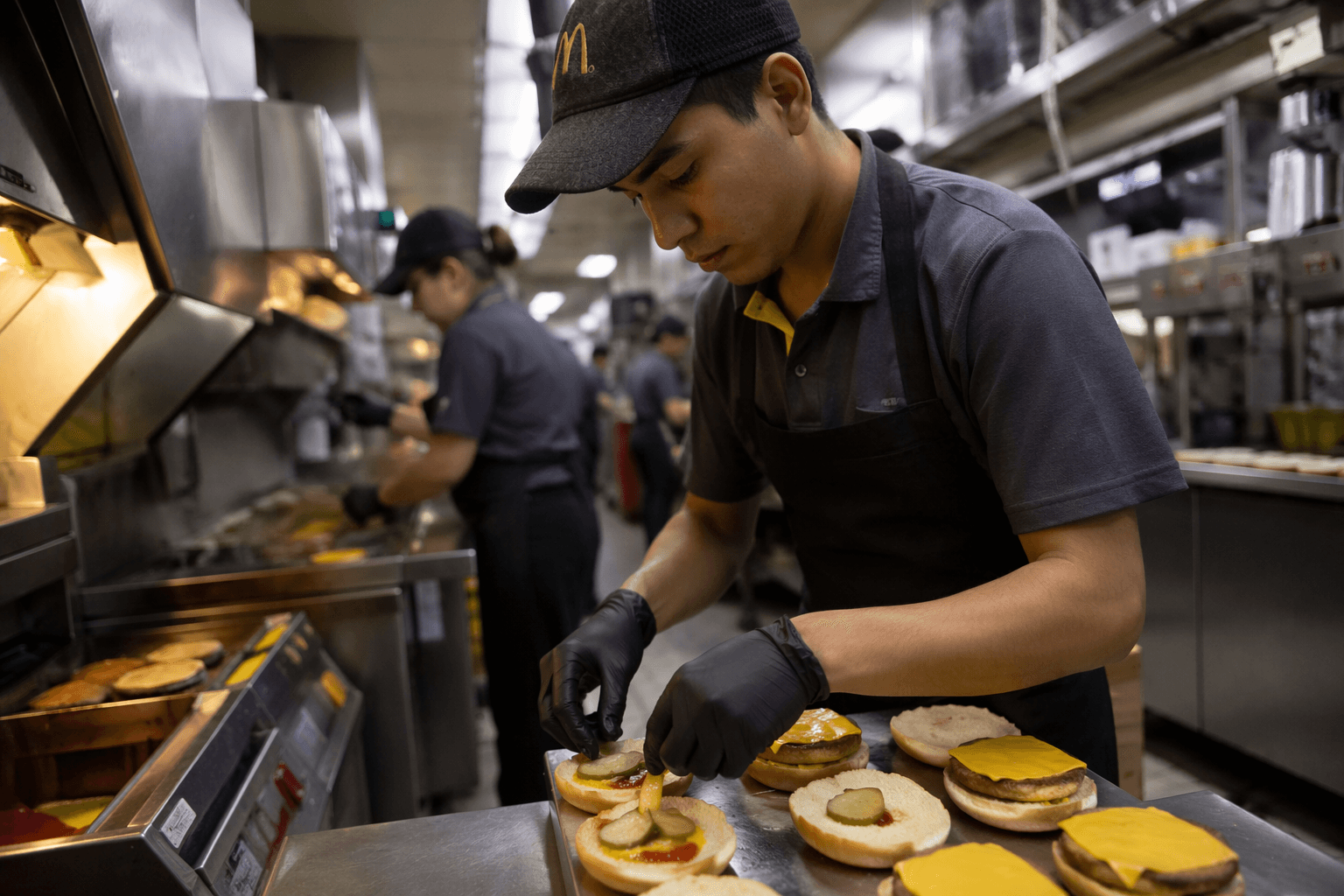
McDonald’s highlights teamwork, English training and career paths for crew
McDonald’s is tying crew work to real skills, English training and education help. The clearest test is whether those skills lead to promotions and outside opportunities.

McDonald’s is trying to turn the oldest fast-food job in America into a résumé story with a beginning, middle and next step. The company’s pitch rests on skills crews build under pressure: teamwork, customer service, time management and responsibility. The proof it points to is English training, tuition help and a handful of promotion stories that show how a shift on the floor can become a management path.
What the floor teaches when the line is out the door
The company’s own language is useful here because it names the skills McDonald’s says workers are actually gaining on the job. Teamwork is not a slogan in a restaurant where a drive-thru timer is slipping, the lobby needs attention and a new hire still does not know station flow. Customer service is learned in the register, at the window and in the middle of a rush, while time management and responsibility show up in the way crew members keep orders moving and help the next person in line.
That matters because those are the skills most likely to travel outside the building. A worker who can keep pace during peak hours has something concrete to point to in another service job, another shift-based workplace or a first supervisor role. McDonald’s is essentially arguing that the job is not just hourly labor, but a place where people learn how to work with others, handle pressure and keep a team moving.
English training is part of the job story, not separate from it
One of the clearest examples is English Under the Arches, a free English language course for non-native English-speaking crew members and managers. McDonald’s said more than 7,600 restaurant employees had graduated from the program at the time of the older story, which is a real scale for a workplace language offering. For crews, that is not a soft benefit. It can change who can take a customer complaint, answer a vendor, train a new hire or move into a more visible role.
Yenis is the strongest example in the material because her path shows how language and restaurant skills can build on each other. She started in the kitchen at 17, moved to the cash register, learned English informally and through English Under the Arches, gained confidence speaking with customers and vendors, and was eventually promoted to training manager of 19 restaurants. That is the kind of progression McDonald’s wants workers to see: not just a job, but a ladder made of communication, pace and teaching ability.
Ana Iris tells a similar story on the education side. She began working at McDonald’s, learned English, enrolled in Career Online High School in 2019 and graduated 14 months later. For crew members trying to figure out whether a restaurant job can coexist with school, that timeline is the useful part. It shows how the company wants workers to imagine the job as a bridge to a diploma, not a barrier to one.
Archways to Opportunity is the company’s main escalation path
McDonald’s says Archways to Opportunity began in 2015, and it has spent years trying to make that name mean something practical for hourly workers. The program includes high school completion, college tuition assistance, free education and career advising, plus English as a second language support for eligible employees at participating U.S. restaurants. That mix is important because it covers both immediate workplace needs and longer-term mobility.

The scale has grown over time. In the older story, McDonald’s said more than 60,000 members of the McFamily had accessed education through Archways to Opportunity. In a later education story, the company said Archways had increased access to education for more than 65,000 managers and crew since 2015. By May 12, 2025, McDonald’s said the program had helped more than 90,000 crew members take steps toward educational goals, and it said McDonald’s and its franchisees had provided more than $25.8 million in tuition assistance to restaurant employees.
That matters because the real worker payoff is not just inspirational language. It is access to credentials that can be used elsewhere, and a clearer case for moving from crew to trainer to shift lead to management. McDonald’s also says the job can be a start of something bigger because the skills are transferable, but the education benefits are what make that claim harder to dismiss.
A bigger workforce strategy is driving the message
The company’s workforce pitch has gotten louder as it plans for more hiring and more locations. McDonald’s said it expected to hire up to 375,000 employees in U.S. restaurants during summer 2025, and it also said it planned to add 900 new U.S. restaurants by 2027. At the same time, McDonald’s has said 1 in 8 Americans have worked at one of its restaurants, a figure it used on Jan. 8, 2026, to launch Arches & Ambition: The 1 in 8 Mentorship Program.
That scale helps explain why the company keeps framing entry-level work as a launchpad. It needs a steady pipeline of people who can learn quickly, adapt to rushes and eventually lead shifts or train others. For workers, the practical question is whether those systems translate into real advancement on the restaurant floor, not just polished employer branding.
The education pitch is broad, and it is been built for years
McDonald’s is also leaning on a longer-running education strategy through the HACER National Scholarship Program. The company says the program has run every year since 1985 and has awarded more than 17,800 scholarships worth a combined $31 million. That gives the company another way to argue that its workforce development story is not a one-off campaign, but part of a sustained talent pipeline.
Taken together, the programs map a fairly clear picture of what McDonald’s wants work to mean. Teamwork, customer service, time management and responsibility are the baseline. English training, tuition help and scholarship access are the payoff mechanisms. The strongest stories, like Yenis and Ana Iris, show that the company’s best case is not that every crew job becomes a career, but that the job can still produce skills, confidence and credentials that hold value long after the apron comes off.
This article was produced by Prism’s automated news system from verified source data, official records, and press releases, then run through automated quality and moderation checks before publishing. The system is built and supervised by the people who set the standards it runs under. Read our full AI policy.
Know something we missed? Have a correction or additional information?
Submit a Tip