April Fools-era in-game promotions and brand activations (example: 'Who’s that Pokémon?' style events) show how short promotions create operational spikes for Nintendo teams
A 24-hour Pokémon Pokopia quiz on April 1 put a spotlight on a pattern Nintendo teams know well: the lightest player-facing activation quietly triggers the heaviest cross-team sprint.
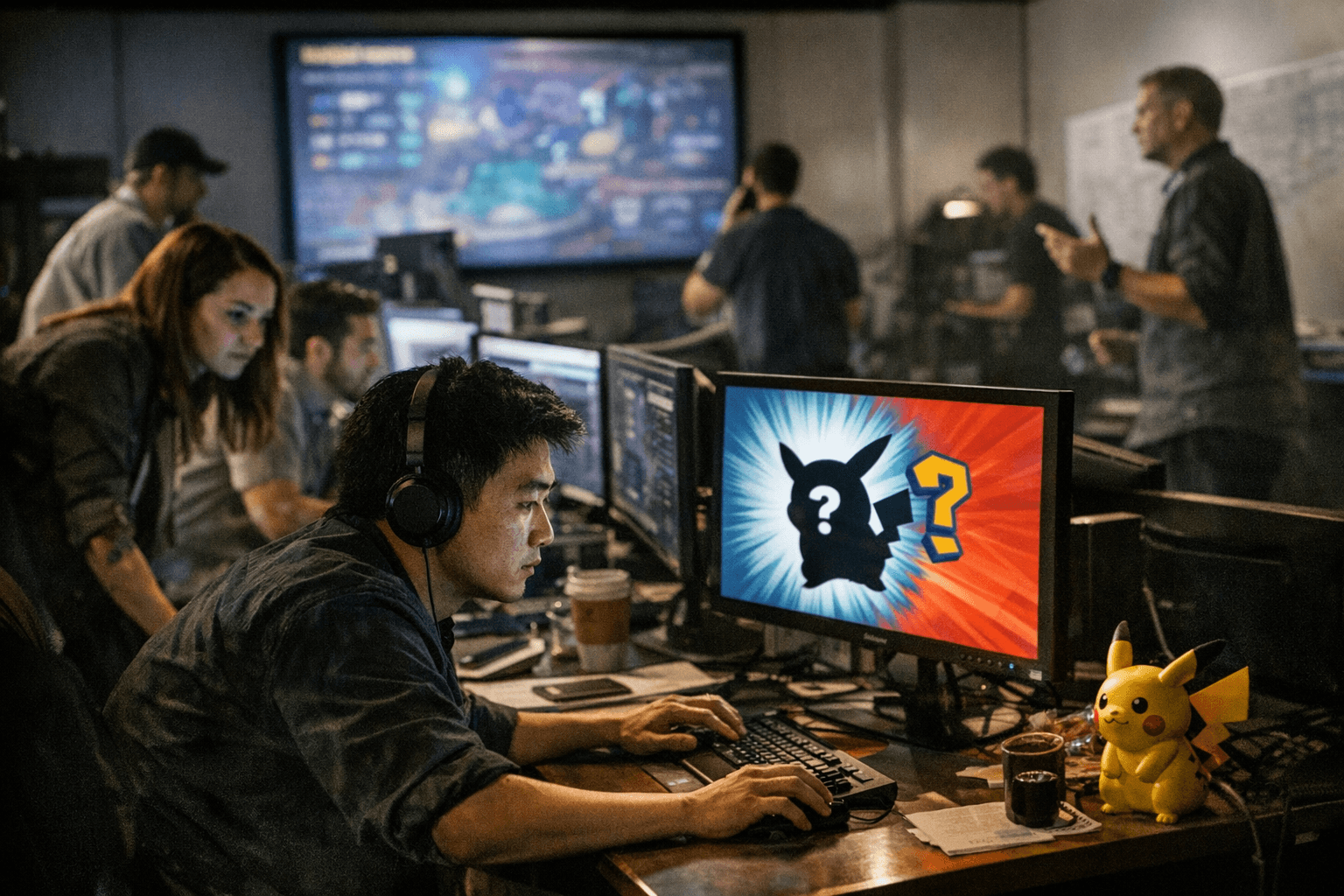
When "Guess Who's Imitating?" Becomes a Full-Team Sprint
At 5am local time on April 1, 2026, Pokémon Pokopia activated the Copycat Challenge: a 24-hour event built around Sudowoodo, the series' canonical faker, in which players interacted with Pokémon doing impressions of other species and earned an Inflatable Sudowoodo decoration for correctly identifying three in a row. Nintendo of America flagged the event on social media the same morning it went live, noting the window would close at 4:59am PT on April 2. Game Informer, covering the broader wave of April 1 gaming gags, specifically called this one out as "actually a real in-game event" to separate it from the day's many fake announcements. That distinction matters more than it might appear: the Copycat Challenge looked like a casual joke, but every team that made it run treated it like a micro-launch.
The Pokopia event is the clearest recent example of a structural pattern across Nintendo's live-service titles. Short-run activations, particularly those tied to a culturally loaded date like April Fools, compress what would normally be distributed over a week's worth of event management into a single 24-hour window. The operational burden does not shrink proportionally; in many respects it intensifies, because every team must be ready simultaneously rather than in sequence.
What a 24-Hour Window Actually Costs Internally
For live-ops and backend engineering, the Copycat Challenge required service-load validation, event-rule configuration, content flags, and telemetry instrumentation all before 5am rollout. A one-day concurrency spike of players checking in at once, especially on a title running on Switch 2 hardware with a global audience, demands capacity verification that no team can skip. Post-event, the 48-to-72-hour incident rotation does not disappear just because the in-game clock has moved on: backend teams must confirm reward issuance completed cleanly, check for edge-case failures in the quiz gating logic, and validate that the event flags deactivated correctly across all regions.
QA and certification face a compressed version of the same pressure. Functional testing for gating logic, UI text fitting, and region-locked behaviors must be signed off before the activation window, and any regression discovered during the sign-off cycle has a hard deadline tied to a calendar date that cannot move. For a franchise where visual polish and text accuracy carry the weight of the Pokémon brand's quality standard, a misaligned UI string or a broken quiz trigger on April 1 would be visible to millions of players simultaneously, not gradually.
The Localization Crunch Hidden Inside a Single Joke Event
The Sudowoodo premise, a Pokémon that fools others into thinking it is a tree, lands cleanly in English. In localized markets it requires careful handling: the humor rests on wordplay and imitation themes that translate differently across Japanese, French, German, Spanish, Italian, and Korean builds, each of which must be copy-frozen, spot-checked, and certified before the global 5am rollout. Because the event window opens in local time rather than a single global timestamp, localization teams face a rolling deadline that begins in Asia-Pacific and ends in the Americas, with no buffer between them.
Last-minute copy issues, whether a string that overflows a text box in German or a localized reward name that does not match what the support team's FAQ says, require an emergency patch workflow that most localization pipelines are not designed to execute in hours rather than days. For Nintendo teams running events like the Copycat Challenge repeatedly across a title's lifecycle, the solution is a compact localization sprint template for one-day events: a standardized sequence of rapid translation, spot-check reconciliation, and a pre-approved patch deployment path that can be triggered without a full review cycle.
Customer Support Absorbs the Spike Last
After the event closes, customer support inherits whatever the prior teams did not catch. For the Copycat Challenge specifically, the failure modes are predictable: players who logged in after the 4:59am close and found the event gone, players whose reward did not register despite completing three correct answers, and players confused about whether the Inflatable Sudowoodo they already owned from earlier content paths counted as a duplicate. Each of those scenarios generates tickets, and because the event is time-limited, the urgency level players attach to their complaints is higher than for permanent content.
Preparing a focused FAQ and a tiered escalation list before the event goes live, rather than drafting responses reactively after tickets begin arriving, is the single highest-leverage customer-care action available. Canned responses calibrated to the specific Copycat Challenge mechanics cut average handling time during the surge period. The escalation path for reward-issuance failures must be clearly defined in advance, because the engineering team that can resolve a missed reward distribution is several layers removed from the front-line agent receiving the complaint.
The HR Dimension Teams Rarely Document
What rarely appears in post-event retrospectives is the scheduling pattern these micro-windows create for front-line staff. A 5am local-time rollout means someone on the live-ops team was confirming go/no-go before most offices opened. A 4:59am close the following morning means the incident rotation extended overnight. For a single event this is manageable; for a team that runs a Copycat Challenge in April, a summer anniversary event, a holiday activation in December, and region-specific promotional windows throughout the year, the cumulative scheduling pressure compounds quickly. People managers should treat compensatory time-off and scheduling buffers as a standard line item in any short-event run-book, not an afterthought requested after burnout surfaces.
Three Playbook Lessons That Scale
The Pokopia Copycat Challenge is useful precisely because it is small enough to examine clearly. Three lessons emerge that apply to any similar activation:
- Build the run-book before the creative brief is final. Pre-event load testing, final copy freeze timelines for localized text, and a designated QA sign-off checklist should exist as a template that teams fill in, not construct from scratch each time a promotion is greenlit.
- Instrument the event for operational costs, not just player engagement. Capturing engineering hours, QA cycles, and customer-support ticket volume alongside player participation metrics enables a genuine cost/benefit analysis when the next one-day activation is proposed.
- Pre-approve the emergency patch workflow for localization. Establishing in advance which text issues qualify for a hotfix versus a post-event correction, and who has authority to deploy it, removes the bottleneck that turns a minor string error into a visible brand problem.
Nintendo's live-service ecosystem runs on the understanding that quality is non-negotiable regardless of how short or playful a promotion appears. The Copycat Challenge delivered on that standard for players, and the teams that made it happen under a 24-hour deadline will be better prepared for the next one because of it. That accumulated cross-team fluency, rehearsed on a Sudowoodo joke, is precisely what makes larger launches run smoothly.
This article was produced by Prism’s automated news system from verified source data, official records, and press releases, then run through automated quality and moderation checks before publishing. The system is built and supervised by the people who set the standards it runs under. Read our full AI policy.
Did this article answer your question?
