Hekate April Fools' Prank Inverts Controls, Triggers Nintendo Account Bans
A prank baked into Switch modders' most-trusted bootloader caused real account bans on April 1, after inverted inputs pushed consoles online without users realizing it.
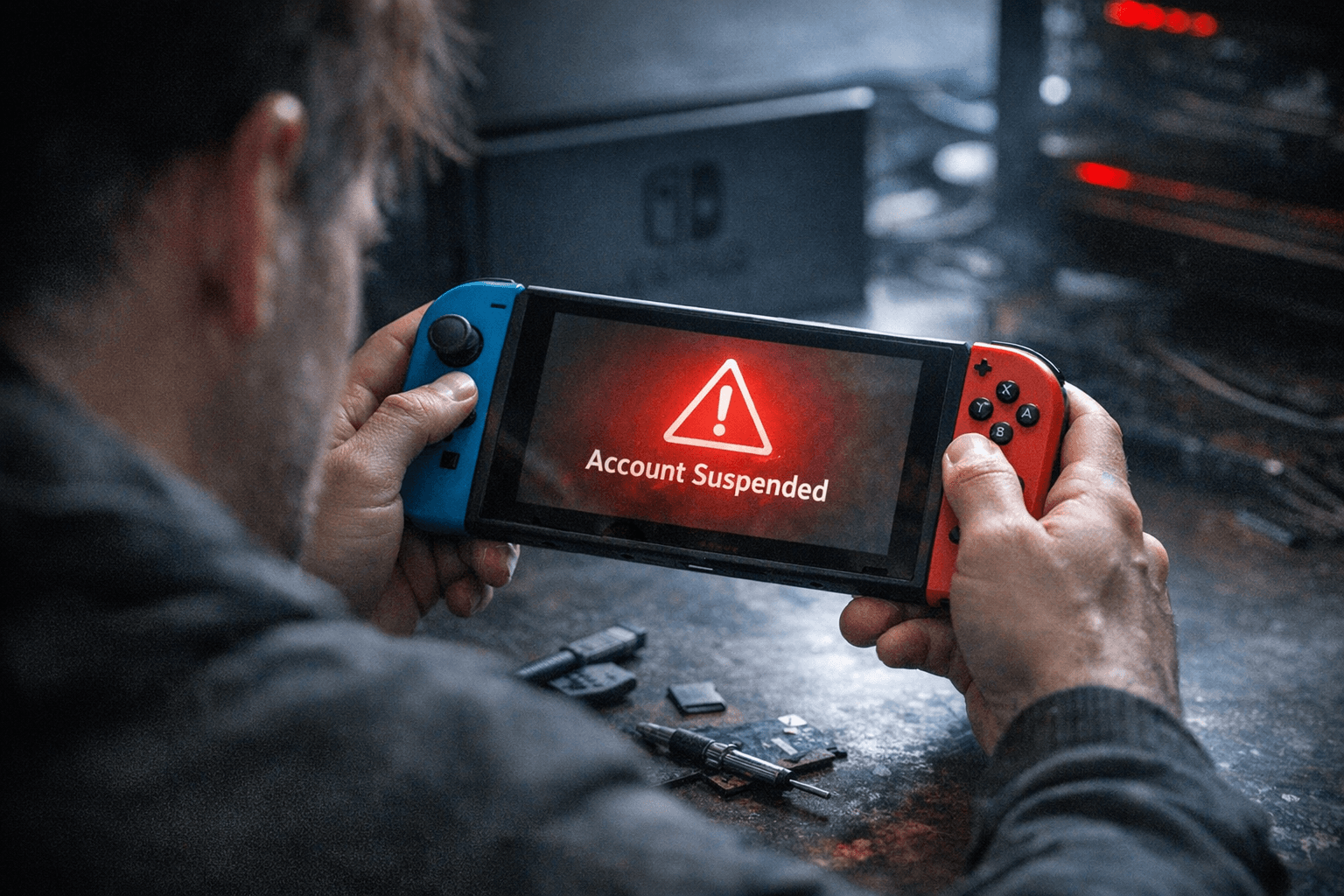
A bootloader prank that inverted every D-pad input inside Hekate cascaded into something Nintendo's security teams had no choice but to treat seriously: real account bans, triggered by real network connections, caused by a joke embedded in software that runs before the Switch's operating system even initializes.
Hekate, the widely used custom bootloader that serves as the entry point for most Switch custom firmware setups, activated its annual April Fools' gag on April 1, 2026, this year swapping normal directional inputs for their mirror opposites. Press up, the cursor moved down. Press left, it moved right. In spirit it tracked with the team's 2025 joke, which replaced the bootloader cursor with a troll-face meme. But the 2026 version landed at the deepest layer of software the modding community interacts with: before the system OS loads, before network services initialize, before a user has any of the guardrails normal firmware provides.
That layer is precisely why this year's gag crossed from community amusement into enforcement territory. A misplaced input inside Hekate can select and boot into system firmware instead of custom firmware, triggering a network handshake or update check that Nintendo's detection systems are designed to flag. Users posting on Reddit described exactly that sequence: inverted inputs caused accidental menu selections, accidental selections caused online connections, and online connections on modded hardware led to permanent bans.
From Nintendo's internal vantage point, the incident maps onto at least four operational pressure points. Legal and enforcement teams will process the resulting ban casework, including appeals from users whose actions were unintentional. Support queues absorb ban-related inquiries that are harder to triage when the root cause is a third-party tool, not deliberate circumvention. Security and platform engineers face a calibration question: does an anomalous device state caused by a prank register as suspicious behavior that should trigger enforcement, and if so, are the detection heuristics appropriately tuned? Communications teams, meanwhile, must hold a line that protects platform integrity without appearing to punish users who were, effectively, pranked into getting banned.
The deeper concern, and the one with longer tails for Nintendo's security posture, is what Hekate's incident reveals about trusted modding infrastructure as an unmanaged attack surface. When a legitimate, well-maintained tool behaves unexpectedly, users cannot immediately distinguish a prank from a compromised build. That uncertainty creates demand for fast fixes circulated in Discord servers and subreddits, precisely the distribution channel a bad actor would exploit. A fake "Hekate patch" pushed on April 1 would have found an unusually receptive audience already primed to expect abnormal behavior from the tool.
Nintendo's security and comms teams will likely track two signals in the weeks ahead: a spike in ban appeals dated April 1, which would clarify whether enforcement volume was proportionate to the underlying conduct, and new tooling circulating in modding communities claiming to patch the inverted-input behavior. That second category historically accelerates the spread of illicit custom firmware by bundling legitimate fixes with features that would never survive review. A prank that ran for hours inside a bootloader menu could leave a longer imprint on the threat landscape than anyone on the Hekate team intended.
Know something we missed? Have a correction or additional information?
Submit a Tip