IGDA crunch standards offer Nintendo a practical management lens
Nintendo’s launch pressure makes IGDA’s crunch limits a useful test: if overtime keeps carrying the plan, quality, bugs, and leadership are already at risk.
A practical test for a quality-first company
Nintendo’s business is built on making hardware and software work together, and that makes IGDA’s crunch standards unusually useful inside the company. When a project has to align engineers, designers, QA, localization, marketing, and management across Kyoto, Japan and regional teams in North America, Europe, and Australia, overtime can start to look normal before anyone calls it a problem. IGDA’s framework cuts through that haze by asking a simple question: is the schedule driving the work, or is the work being forced to carry a broken schedule?
That matters at Nintendo because the company’s own management language points in the opposite direction from heroics. It says it values originality, flexibility, sincerity, and teamwork, and it says it wants an environment where employees can realize their maximum potential. It also says it provides human-rights and compliance training across Japan, North America, Europe, and Australia. Those are not just culture statements. They set a standard that makes chronic overtime a management issue, not a badge of commitment.
What IGDA means by crunch
IGDA defines crunch as overtime used to meet development deadlines, but the definition goes further than long hours alone. The association separates crunch into two separate problems: unsustainable work and management abuse. That distinction is important for Nintendo because it shifts the discussion away from whether a team is “tough enough” and toward whether the plan itself is sound.
The underlying warning is blunt. IGDA cites research showing that productivity falls quickly once overtime begins, and that long-term useful output is maximized around a five-day, 40-hour workweek. The standard it points managers toward is equally clear: teams should aim not to exceed 40 hours, and periods of overwork should not last more than two weeks. For a company that prides itself on quality and on integrating multiple disciplines into a finished product, those are not abstract labor talking points. They are production controls.
Where Nintendo should pressure-test the plan
The best use of IGDA’s standards is as a pre-crunch checklist, before overtime becomes visible and before late nights start being treated as a normal part of the launch calendar. That is especially relevant in a major hardware cycle, including a peak Switch 2 production phase, when the pressure to keep everything aligned can make delays feel more acceptable than they are.
The places to look first are predictable:
- Hardware launches, where manufacturing, supply, and software readiness have to line up at once.
- Software milestones, where content locks and code stability can get squeezed by one more round of changes.
- Marketing beats, where trailer timing and campaign delivery can pull teams into last-minute approvals.
- Localization deadlines, where translation, cultural adaptation, legal review, and implementation all have to land together.
- QA crunch, where unstable builds and compressed test windows can hide defects until they are expensive to fix.
If the same people keep being asked to absorb the overflow at each of those points, the problem is probably not dedication. It is structure. That is exactly where IGDA’s standards become a management lens for Nintendo managers and team leads: if a project repeatedly depends on extended overtime, the schedule is not resilient enough yet.

Why the standard matters to the work itself
For workers, the stakes are bigger than fatigue. Sustainable pacing directly affects judgment, creativity, bug detection, production quality, and leadership quality. In a company like Nintendo, where reputation is tied to polished releases and long franchise legacies, that connection is easy to miss when everyone is focused on the next deadline. But the work product changes when hours stretch too far. Small defects survive longer, review gets shallower, decisions get rushed, and the team’s ability to course-correct narrows.
That is why the practical question is not whether a team can push through a hard week. It is whether the project can still ship well without turning overtime into the operating model. The earlier schedules, approvals, and staffing gaps are pressure-tested, the less likely it is that quality will be sacrificed in the final stretch.
The evidence behind the warning
IGDA’s Developer Satisfaction Survey gives that caution real weight. The association and Western University run the survey as a biannual look at quality of life and career satisfaction in game development. The 2023 edition drew 777 respondents collected between May 17 and October 20, 2023, and respondents expressed discontent about employment, crunch, and proper crediting.
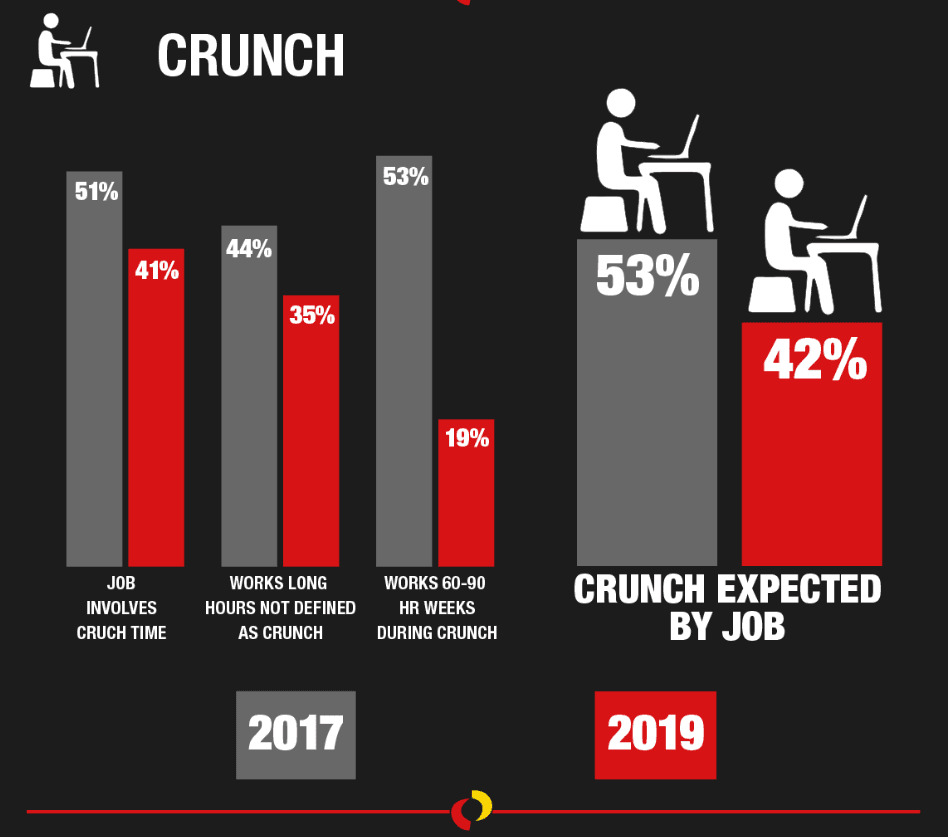
The historical pattern is even harder to ignore. Public reporting on IGDA survey data has said that 76 percent of game developers reported work weeks that periodically exceeded 40 hours. During crunch, 35 percent said they worked 50 to 59 hours, 28 percent worked 60 to 69 hours, and 13 percent worked more than 70 hours. The same reporting said 89 percent did not receive paid overtime. Those numbers explain why IGDA keeps emphasizing thresholds, not slogans. Without a clear line, overtime becomes a habit instead of an exception.
Why leadership has to own the risk
IGDA has been equally direct in its public criticism of mandatory overtime. In its response to CD Projekt Red, the association said mandatory overtime was a failure of leadership and argued that crunch drives departures from companies and from the industry. That is the central management lesson for Nintendo, too. If a project cannot meet its goals within normal hours, the question is not how much more the staff can absorb. The question is what needs to change in planning, scope, sequencing, or staffing.
That is especially important in a company culture that already talks about teamwork, flexibility, and sincerity. Those values only hold up if managers use them to protect the work, not to normalize pressure. Across Kyoto, Japan and regional teams at Nintendo of America, Nintendo of Europe, and Nintendo Australia, the same rule applies: a good launch is one that does not need to be rescued by exhaustion.
Nintendo’s advantage has always been its ability to bring hardware, software, and people into alignment. IGDA’s crunch standards give managers a concrete way to check whether that alignment is holding before the overtime shows up. When the plan is healthy, quality travels on schedule. When it is not, crunch stops being a surprise and starts being a warning.
This article was produced by Prism’s automated news system from verified source data, official records, and press releases, then run through automated quality and moderation checks before publishing. The system is built and supervised by the people who set the standards it runs under. Read our full AI policy.
Did this article answer your question?
