Nintendo expands CSR reporting, reveals 2024 emissions data
Nintendo’s CSR data sheet turns emissions and employee data into a management dashboard, showing how workplace decisions shape what the company reports.

Nintendo’s CSR sheet is a working management tool, not just a public-facing scorecard
Nintendo’s CSR data sheet reads like a compact dashboard for the people who actually run the company. In one place, it pulls together environmental, employee, and governance and compliance numbers, which makes it useful far beyond sustainability teams. For anyone in operations, procurement, facilities, or corporate reporting, the message is clear: the company is measuring the footprint of how it works, not just the results of the games it ships.
That matters inside a business built on precision and reputation. A quality-first culture depends on disciplined internal systems, and this sheet shows that discipline extending into workplace planning, travel, energy use, waste handling, and staffing. The data does not just describe Nintendo’s image. It helps define the internal standards by which the company can be judged.
The 2024 emissions picture is large, and the scope makes the trend harder to read
Nintendo’s latest disclosed figures show 2024 Scope 1 emissions of 2,410.9 tons, Scope 2 emissions of 14,047.9 tons, and Scope 3 emissions of 2,482,803.5 tons. The headline is obvious: the company’s biggest climate impact sits well outside the walls of its offices and production sites, with Scope 3 dwarfing the other categories. Within that total, Category 1 purchased goods and services alone accounted for 2,199,513.8 tons, underscoring how much of Nintendo’s footprint is embedded in its supply chain.
That is the kind of number procurement and operations leaders cannot ignore. It points to supplier selection, contract standards, packaging decisions, logistics planning, and material sourcing as real levers, not abstract ESG talking points. For a company whose products depend on tight coordination across development, manufacturing, and distribution, the emissions table is also a map of where the biggest decisions are likely made.
The reporting shift matters as much as the totals
Nintendo says 2024 data collection was expanded to the Nintendo Group, while 2022 and 2023 figures were collected from a narrower set of entities. That means the year-to-year series is useful, but not perfectly comparable across the full span. The company also says 2022 and 2023 Scope 1 figures were retroactively revised to show amounts before carbon offsets.
For readers inside the company, that nuance is not a footnote. It is the difference between using the sheet as a clean benchmark and using it as a rough directional guide. Managers tracking progress against emissions targets need to know whether a change reflects genuine operational improvement, broader reporting coverage, or a methodology shift. The sheet is transparent about the fact that the reporting boundary changed. That is good practice, but it also limits how much confidence employees should place in simple year-over-year comparisons.
The employee table is where the sheet becomes especially useful for workplace planning
Nintendo’s employee data gives the clearest window into the company’s internal labor picture. The latest table shows 5,630 permanent employees across Japan, the United States, Europe, and Australia. It also tracks turnover, average tenure, paid-leave uptake, childcare-leave usage, and career-development review coverage, which makes the disclosure more than a headcount exercise. It is a real workforce planning tool.
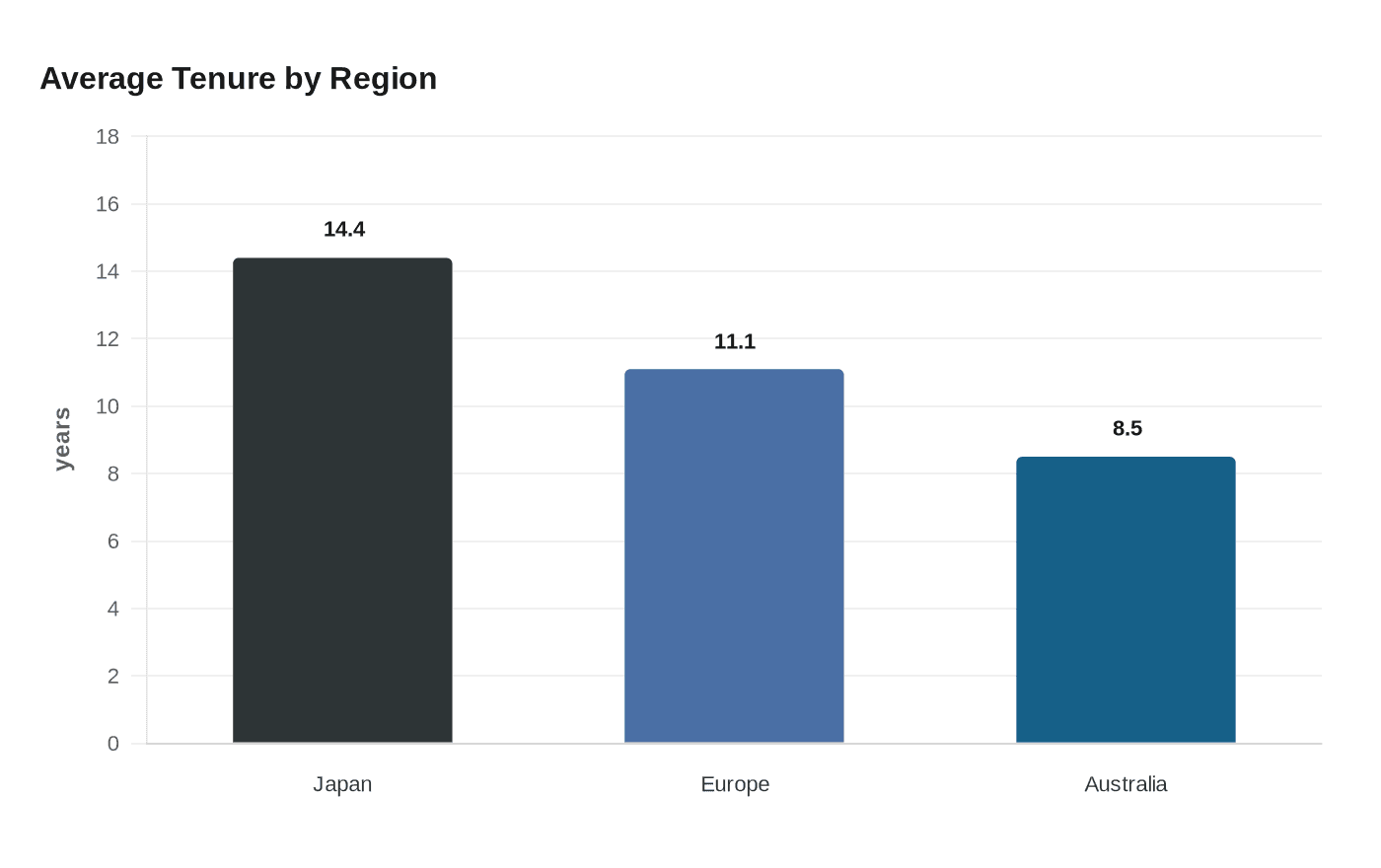
The strongest signal in that table is retention. Nintendo Japan reports an average tenure of 14.4 years, while Nintendo Europe stands at 11.1 years. Nintendo Australia shows the highest turnover rate at 16.7 percent and the shortest average tenure at 8.5 years. That spread tells a story that HR, regional leadership, and business planning teams would all care about: the company’s employment experience is not identical across regions, and local conditions are likely shaping stability, mobility, and continuity differently from office to office.
Paid-leave uptake adds another layer. Nintendo reports a paid-leave acquisition rate of 86.0 percent in Japan, 89.1 percent in the U.S., 87.2 percent in Europe, and 80.9 percent in Australia. For managers, those numbers can help test whether policy is actually being used. For employees, they signal whether leave is just written into the handbook or normalized in day-to-day practice. In a company that relies on long project cycles and cross-functional coordination, that sort of usage data can reveal more than a policy memo ever will.
Who inside Nintendo would actually use this information
This sheet is most useful when different teams treat it as shared infrastructure.
- Operations teams can connect workplace decisions to energy use, commuting, and waste handling.
- Procurement can use the Scope 3 breakdown to pressure suppliers and review purchasing practices.
- Facilities teams can track office footprint and resource use against internal targets.
- HR and regional leadership can read the employee table as a retention and mobility signal, not just a compliance report.
- Corporate reporting teams can use the numbers to keep disclosures consistent and defensible.
- Executive management can use the full picture to compare regional performance and decide where the company’s risks and strengths are concentrated.
That cross-functional use is exactly why the page matters. It shows that corporate accountability is not siloed. A decision about commuting policy, office space, or vendor contracts can end up in the same disclosure architecture as employee tenure or emissions totals.
The company is being more open, but the sheet still leaves some questions unanswered
Nintendo deserves credit for publishing a single-page data sheet that covers environmental, employee, and governance and compliance figures instead of burying them across separate documents. It also says its FY2025 CSR priority areas are Consumers, Supply Chain, Employees, and Environment, and that those priorities are shaped with input from outside experts before being reported to executive management. That suggests the company is using external feedback to set internal priorities rather than making CSR a purely branding exercise.
Even so, the disclosure still stops short of full operational transparency. The sheet is strong on totals, but it does not fully expose the underlying drivers that would let workers or outside observers see exactly which sites, teams, or business decisions are moving the numbers. It gives the map, but not every street name. For a company with Nintendo’s global footprint and reputation for control, that leaves an important gap.
Why this matters for Nintendo’s workplace culture
Nintendo’s strength has always depended on disciplined execution, whether the subject is game quality, franchise stewardship, or product reliability. The CSR data sheet shows that the same logic now reaches into employment practices and environmental management. That is useful for staff because it turns abstract policy into measurable practice, and it gives managers a concrete way to compare offices, track behavior, and spot weak points before they become bigger problems.
The larger takeaway is simple: Nintendo is not only telling the market how it wants to be seen. It is also building a framework that lets the company measure how it actually operates. For employees, that is the part that matters most, because what gets measured inside a company eventually shapes what gets managed.
This article was produced by Prism’s automated news system from verified source data, official records, and press releases, then run through automated quality and moderation checks before publishing. The system is built and supervised by the people who set the standards it runs under. Read our full AI policy.
Did this article answer your question?
