Nintendo raises Japan base pay 10% to secure long-term workforce
Nintendo’s 10% Japan base-pay hike is really a retention play, timed to keep experienced teams in place as Switch 2 ramps and inflation reshapes wages.
Nintendo raised base salaries in Japan by 10% as Shuntaro Furukawa told shareholders the company wanted compensation kept at an appropriate level and the workforce secured for long-term growth. At its 86th annual general meeting of shareholders in Kyoto, held at Kyoto International Exhibition Hall “Miyako Messe,” the company put the decision inside a broader governance package, alongside its FY2026 business report, audited financial statements and other resolutions.
The timing matters because Nintendo’s hardest work now runs through multi-year teams, not one-off releases. Hardware launch support, game production, QA, localization, merchandising, security and the operations that keep a flagship platform healthy after launch all depend on people who know the company’s tools, standards and franchise history. Furukawa’s comments came in response to shareholder questions, including one about unions, a signal that Nintendo is choosing to address pay and retention through company policy and governance rather than through a wider labor-management structure.
The company also entered the meeting with strong numbers behind it. For the fiscal year ended March 31, 2026, Nintendo reported net sales of 2.313 trillion yen, operating profit of 360.1 billion yen and net profit attributable to owners of the parent of 424.0 billion yen. It said sales in its dedicated video game platform business grew significantly because of the launch of Nintendo Switch 2, which posted 19.86 million hardware units and 48.71 million software units in FY2026. That kind of transition rewards continuity: the people who understand launch cadence, certification, localization pipelines and post-launch fixes are the same people a company wants to keep when the next hardware cycle gets busy.

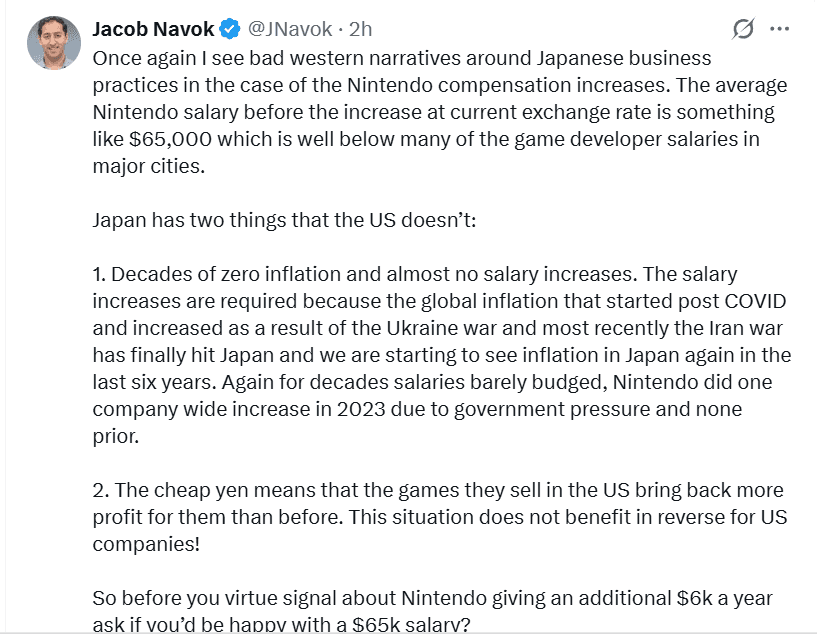
The wage move also lands in a national labor market where Japanese employers have been under pressure to raise pay as inflation persists and annual spring wage negotiations reset expectations. Prime Minister Fumio Kishida pushed companies to lift wages after years of deflation and stagnant pay, and Nintendo’s 10% increase fits that pattern while still serving its own needs. For developers, designers, testers and business teams, the message is less about a headline raise than about whether Nintendo plans to compete for scarce talent by offering stability, not just prestige.
Nintendo’s own governance materials show an Audit and Supervisory Committee, a compliance program and a whistleblowing hotline, reinforcing a model built around long-run control and continuity. The June 26 meeting also approved officer changes effective that day, another sign that the company is pairing compensation decisions with a larger effort to keep its organization steady as Switch 2 scales.
This article was produced by Prism’s automated news system from verified source data, official records, and press releases, then run through automated quality and moderation checks before publishing. The system is built and supervised by the people who set the standards it runs under. Read our full AI policy.
Did this article answer your question?
