Nintendo Switch 2 enters year two with plenty to prove
Nintendo’s fastest hardware launch is now a workforce test: year two will show whether Switch 2 can keep teams aligned around software, services, and supply.
The real year-two test
Nintendo Switch 2 enters its second year with a contradiction baked in: it is already a record-breaker, but it still has to prove it can become a durable platform. The console launched on June 5, 2025, at a U.S. suggested retail price of $449.99, with a Mario Kart World bundle at $499.99, and sold over 3.5 million units worldwide in its first four days, the fastest start Nintendo has ever posted for hardware.

For Nintendo workers, that kind of launch is not a finish line. It is the point where the real company-wide test begins, because year two is when novelty gives way to execution. Hardware teams, software teams, QA, localization, retail, and business planners all have to help turn a hot debut into a platform with staying power.
What the launch did right
Switch 2 arrived with clear product signals that mattered to the people building and supporting it. Joy-Con 2 controllers attach magnetically, can function like a mouse in compatible games, and GameChat adds voice chat, video chat, and screen sharing for up to twelve people. Nintendo also kept backward compatibility in the picture, while warning that some existing Switch titles may not be fully supported.
That mix tells you a lot about the work behind the curtain. The hardware team had to balance novelty with continuity, while QA had to think about compatibility failures, peripheral behavior, and feature edge cases across a massive library of older games. Localization teams also have a bigger job than simply translating menus, because features like GameChat and magnetic Joy-Con behavior have to be explained clearly and consistently in every market Nintendo serves.
The launch design also fits Nintendo’s long-running culture better than a specs-first arms race would. Under Shuntaro Furukawa, the company still wins by creating experiences that feel distinct, not by trying to match Sony and Microsoft feature for feature. That means year two is about protecting a unique identity while keeping enough technical polish to satisfy players who expect premium performance.
The scorecard is still strong, but the stakes are higher
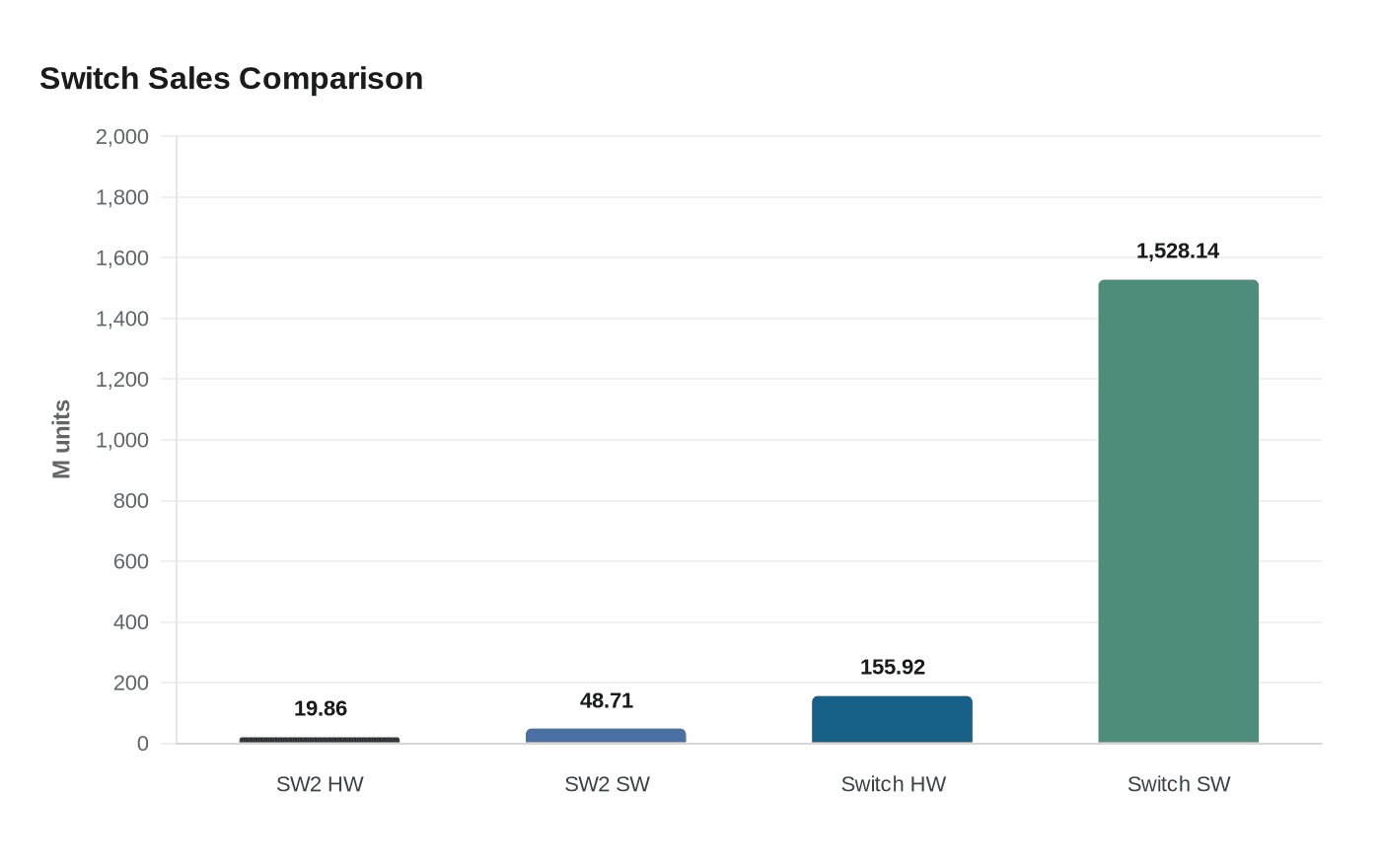
Nintendo’s own numbers show why the company can call the launch a success without pretending the work is done. As of March 31, 2026, Switch 2 had sold 19.86 million hardware units and 48.71 million software units. For context, the original Switch reached 155.92 million hardware units and 1,528.14 million software units over its lifetime, which is a reminder of the scale that the new machine is being measured against.
The financial lift has been immediate. For the first nine months of FY2026, Nintendo reported net sales of 1,905.8 billion yen, up 99.3% year over year, and profit attributable to owners of the parent of 358.8 billion yen, up 51.3%. Operating profit came in at 300.3 billion yen, with hardware sales rising sharply on the strength of Switch 2 and its higher average selling price.
Software matters just as much as the box itself, and Mario Kart World has already become a key proof point. Nintendo said the game sold 14.03 million units by the third quarter of FY2026. For developers and production teams, that kind of attach rate matters because it shows the platform can still generate momentum around a flagship release, not just around the hardware launch window.
Third-party publishers also got a stronger signal than many expected. Ampere Analysis said Switch 2 helped drive third-party full-game sales across Nintendo Switch devices up 76% year over year to $2.3 billion in Q2 through Q4 2025. For business development, partner management, and platform operations teams, that is the kind of result that can change internal priorities fast. It suggests the new system is already improving Nintendo’s value proposition beyond first-party exclusives, which should raise the importance of SDK support, certification flow, storefront performance, and publisher-facing coordination.
Where the pressure has shifted
The launch was widely expected to be supply constrained, and consultant Serkan Toto described demand as sky-high. That kind of early scarcity can be flattering, but it also creates pressure on manufacturing forecasts, regional allocation, retail planning, and customer communication. If hardware is hard to find, the burden shifts to teams that have to explain availability, avoid mismatched expectations, and keep excitement from turning into frustration.
Later, Bloomberg reported that Nintendo cut Switch 2 output by more than 30% amid weaker-than-expected U.S. sales. That is the kind of change that can ripple through supply chain planning, regional marketing, channel management, and sales forecasting. A platform that begins with record-breaking demand can still run into softer pockets by market, and the U.S. appears to have become an important place where Nintendo had to reassess assumptions.
For workers inside Nintendo, that means year two is not just about celebrating a successful launch. It is about reading the market accurately enough to adjust production, tune the software roadmap, and keep the platform visible in a crowded premium console market. The company’s global offices have to stay tightly aligned with Kyoto, because misread demand in one region can affect everything from inventory to campaign timing.
What year two demands from Nintendo teams
The second year of Switch 2 is likely to reward the teams that can move in sync. Hardware engineers have to keep the platform stable. Software teams have to deliver enough compelling releases to keep owners engaged. QA has to keep compatibility problems from undermining trust. Localization has to make every feature feel native, not bolted on. Business teams have to protect the value proposition as the console moves from launch hype to long-term habit.
That is why the anniversary matters as a workplace story, not just a sales milestone. Switch 2 has already proved it can launch fast, move software, and lift third-party business. Now it has to prove it can keep compounding those gains without losing the clarity that made Nintendo different in the first place. Year two is where a hit product becomes an operating model, and everyone inside the company will feel the difference.
This article was produced by Prism’s automated news system from verified source data, official records, and press releases, then run through automated quality and moderation checks before publishing. The system is built and supervised by the people who set the standards it runs under. Read our full AI policy.
Did this article answer your question?
