Nintendo translator role shows localization is key to development workflow
Nintendo’s translator posting shows localization is a production job: it blends interpretation, planning, security, and developer coordination, not just bilingual fluency.
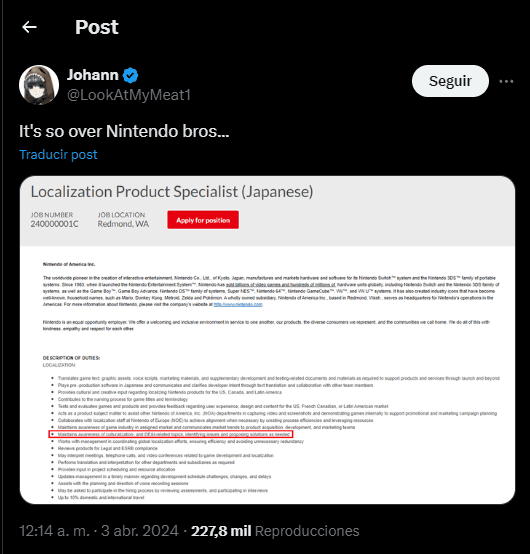
Localization at Nintendo starts with the job description
Nintendo’s translator posting makes one thing plain: the company does not treat localization as a sidecar to development. The role is built around confidential email and document translation, verbal interpretation for meetings and calls, and “congruity judgments” that choose wording that preserves intent, not just literal meaning. That is already a different standard from simple language conversion, and it sits closer to the flow of production than to a standalone writing desk.

The requirements underline that point. Nintendo asks for native-level verbal and written English and Japanese, an excellent understanding of Japanese business culture and etiquette, two to four years of related experience, and two years of translation experience. That profile looks less like an entry-level language task and more like a specialist role expected to navigate both corporate tone and product pressure.
What the translator is actually responsible for
The posting goes well beyond translating sentences. It says the translator may create translation workflow manuals and update them as department needs change, which means the work includes process design, not just output. It also says the person may act as a liaison with Japanese developers, assist with scheduling and planning, and coordinate short- and long-term project management.
That list matters because it reveals how Nintendo expects localization staff to function inside the machine. A translator in this setup is not waiting at the end of the pipeline for finished text. The role is present while work is still moving, shaping handoffs, aligning calendars, and keeping content usable across teams that may be separated by geography, language, and time zone.
The other critical detail is security. The role must follow corporate prototype security policy and procedures, which tells you the job may touch unfinished hardware or software information that cannot leak, drift, or be handled casually. For anyone inside development or publishing, that is the clearest sign that localization at Nintendo is part of operational control, not an isolated language service.
Why this looks more like product operations than language support
This posting shows Nintendo hiring for a hybrid function: interpreter, coordinator, documentation builder, and security-conscious production partner. The translator is expected to preserve meaning, but also to protect the product, keep projects aligned, and help teams move work forward when plans shift. That is the language of operations.
For employees in QA, marketing, publishing, and development, the implication is direct. If a translated line is wrong, late, or culturally off, the problem is not just linguistic. It can affect release readiness, review quality, testing notes, developer communication, and the way a game lands in different regions.
That is why the word “localization” can be misleading if it is read too narrowly. At Nintendo, it appears to include interpretation, workflow management, and cross-functional support. The role is part of how the company protects quality while moving Japanese-origin projects into global markets without losing intent or control.
Nintendo’s broader hiring pattern shows a structured localization machine
The translator posting does not sit alone. Nintendo Careers also lists roles such as Manager, Localization - English Writing, Associate Localization Specialist (Japanese), Sr Technical Localization Specialist, Bilingual Project Manager (Japanese), and Associate Localization Audio Editor (Bilingual Japanese). Together, those roles point to a mature localization organization with distinct functions for writing, technical review, project management, and audio.
That matters because it shows Nintendo is not improvising localization on a title-by-title basis. It is staffing a recurring workflow with specialized roles that can support products and services through launch and beyond. In practical terms, that means localization is built into the company’s production structure, with different people handling different parts of the same multilingual pipeline.
The presence of a bilingual project manager role is especially telling. When a company hires for project management in a language-specific workflow, it signals that coordination itself is a core deliverable. Nintendo is not simply hiring translators to pass text along. It is staffing people who can keep work moving between Japan and overseas teams while deadlines, assets, and approvals are still changing.
Why the role matters across development, QA, marketing, and publishing
Nintendo’s own hiring language frames localization as support for products and services, not just for final text. That means the work can touch game text, voice scripts, marketing materials, and supplementary development and testing-related documents. In a company known for quality standards and franchise continuity, that range is not incidental. It is how meaning survives from the Japanese source material to the final regional release.
For QA, that can mean clearer bug reports, cleaner terminology, and fewer misunderstandings when a feature is being tested under deadline. For marketing and publishing teams, it means campaign language, product descriptions, and launch materials stay consistent with the game itself. For developers, it means less friction when a Japanese team and an overseas team need to agree on terminology, intent, or scheduling.
Nintendo’s localized workflow also reflects its global operating model. The company says it has been creating entertainment experiences in North America for more than 30 years, and its official history notes that the NES launched in North America in 1985 and helped revitalize the U.S. video game industry after the 1983 crash. That legacy explains why language work at Nintendo is not treated as a back-office function. The company has spent decades building a business where Japan and overseas markets have to stay in sync.
The Animal Forest example shows why “translation” is too small a word
Nintendo localization manager Leslie Swann once described the English-language launch of Animal Forest as a huge job because of the amount of text and the Japan-specific cultural references and items. That example captures the real problem localizers solve at Nintendo: they are not just changing words, they are carrying context across cultures without breaking the game’s feel or logic.
That is where congruity judgments come in. A literal translation can preserve the dictionary meaning and still fail the player, the developer, or the brand. Nintendo’s translator role suggests the company wants someone who can decide when a phrase needs adaptation, when a document needs interpretation, and when a process needs tightening so the work remains coherent from Kyoto to North America.
The larger lesson is straightforward. At Nintendo, localization is not a service parked outside development. It is a connective tissue role that protects meaning, safeguards prototypes, supports scheduling, and keeps multiple teams aligned. In a company built on precision and legacy, that makes the translator’s job part of production itself.
This article was produced by Prism’s automated news system from verified source data, official records, and press releases, then run through automated quality and moderation checks before publishing. The system is built and supervised by the people who set the standards it runs under. Read our full AI policy.
Did this article answer your question?
