Nintendo’s producer role goes far beyond schedules, developers say
Nintendo’s producers do more than chase milestones: they shape hardware direction, coordinate teams, and guard quality across studios, reviews, and global launches.
What a Nintendo producer actually owns
A lot of people think producer means schedule keeper. The Producers Guild’s game-credit guidance shows why that is too narrow: video-game producing can include Executive Producer, Senior Producer, Producer, Game Producer, Creative Producer, Technical Producer, Associate Producer, Production Supervisor, and Production Coordinator, and those credits do not always map neatly onto internal management charts or film and TV habits. In that framework, executive producers work at a strategic level across creative, business, financial, and technology partnerships, while still being accountable for keeping projects on schedule, inside budget, and aligned with quality standards.
That mix matters because the job sits where design, engineering, audio, localization, QA, legal, publishing, and outside partners all meet. A producer is the person trying to keep the work shippable without sanding off the reason the team wanted to make the game in the first place. At Nintendo scale, that means the title is less a clerical role than a coordination mandate.
How Nintendo shows the role in practice
Nintendo’s own developer interviews make the broader scope easy to see. On *The Legend of Zelda: Echoes of Wisdom*, Eiji Aonuma said that as producer he played the game from the player’s perspective and continuously provided feedback. Tomomi Sano described her job as managing and coordinating production, suggesting adjustments, and checking the outcome so Grezzo’s work stayed aligned with the Zelda series.
That split is telling. The producer is not just watching a calendar; the role is helping preserve series identity while the team iterates. In a company known for quality-first standards and legacy franchises, that often means pushing back on drift early, before a late-stage fix becomes expensive or visible to players.
Why the role looks even bigger at Nintendo of America
Nintendo of America is based in Redmond, Washington, and it says it works closely with Nintendo Co., Ltd. to bring Nintendo franchises across the Americas through video games, hardware systems, and collaborations that can include feature films and theme parks. That means producer work can touch far more than one release train. A single project may need coordination across regions, business units, and partners that do not share the same day-to-day workflow.
For workers, that changes the skill profile. A strong producer needs enough fluency to read risk in art assets, code stability, review feedback, partner dependencies, and market timing. They also need the people skills to surface problems early without turning every issue into a false emergency. In a global company with Japan HQ and overseas offices, the producer often becomes the translation layer between creative intent and execution realities.
Where the producer stops and other roles begin
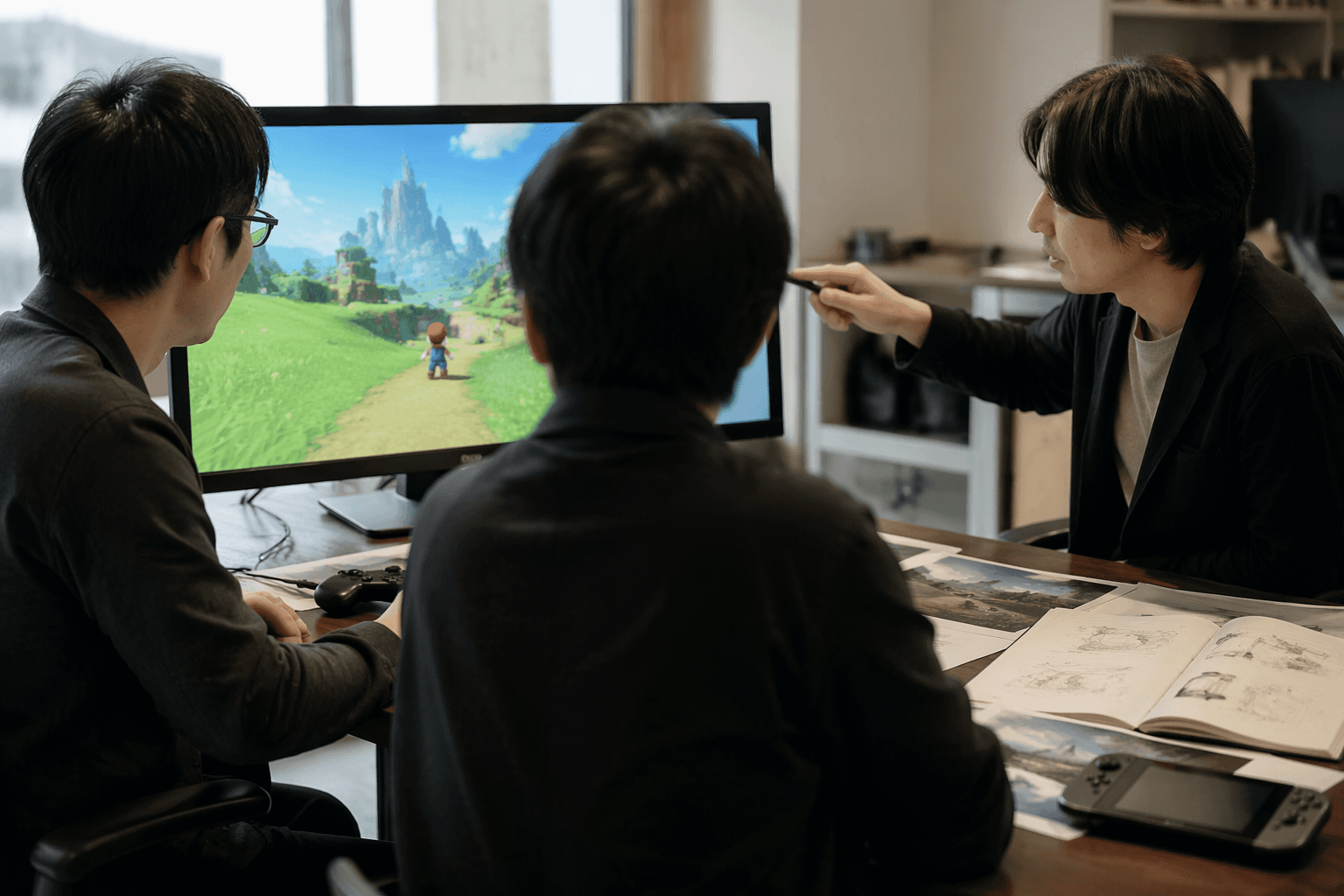
Nintendo’s recent hardware and software interviews show that “producer” can also mean high-level product direction, but not total ownership of every decision. For Switch 2, Kouichi Kawamoto said his role was to set the direction for what kind of system to develop and to consult with hardware development and other teams on the detailed specifications. On *Mario Kart World*, Kosuke Yabuki described long-running stewardship of the series, saying he has been involved since *Mario Kart Wii*, directed *Mario Kart 7* and *Mario Kart 8*, and has produced the series since *Mario Kart 8 Deluxe*. On *Donkey Kong Bananza*, Kenta Motokura said he crafted the game’s concept and set the direction for its overall structure and player controls.
Those examples show a producer who can own product framing, series continuity, and cross-team alignment, not just milestone tracking. The director’s job still leans toward the creative shape of the game, while the producer keeps the work moving through the system that has to support that vision. A project manager may run the task-level machinery, but the Nintendo examples suggest the producer is often the person deciding what must be solved now, what can wait, and what tradeoffs would damage the game.
The review gate that makes the job real
Nintendo’s developer portal adds another layer: before a game can publish on Nintendo platforms, it must be submitted for review, and Nintendo says that review is necessary to ensure the game can be safely played and conforms to Nintendo production standards. That is the point where producer judgment becomes operational. The person in the middle has to know whether an issue is a cosmetic delay, a compliance risk, or a reason to pull in more people immediately.
That is why the best producers are part diplomat, part project lead, and part product sense checker. They are not there to replace the director, the engineer, or the QA lead. They are there to make sure those functions are pulling toward the same release, under the same quality bar, with the least possible waste of time and talent.
What this means for Nintendo teams
At a company where a handheld system, a flagship kart game, and a Zelda collaboration can all hinge on different kinds of producer judgment, the title should be read as a broad leadership role. The people who succeed in it are the ones who can hold a creative standard in one hand and a risk register in the other, then keep talking long enough for a large team to stay aligned.
This article was produced by Prism’s automated news system from verified source data, official records, and press releases, then run through automated quality and moderation checks before publishing. The system is built and supervised by the people who set the standards it runs under. Read our full AI policy.
Know something we missed? Have a correction or additional information?
Submit a Tip