Los Angeles Spends $2.8 Million Giving Free Street Food Carts to Vendors
LA is spending $2.8M to hand out nearly 300 free food carts to street vendors, and brick-and-mortar restaurants say it's a $2.8M argument for two sets of rules.
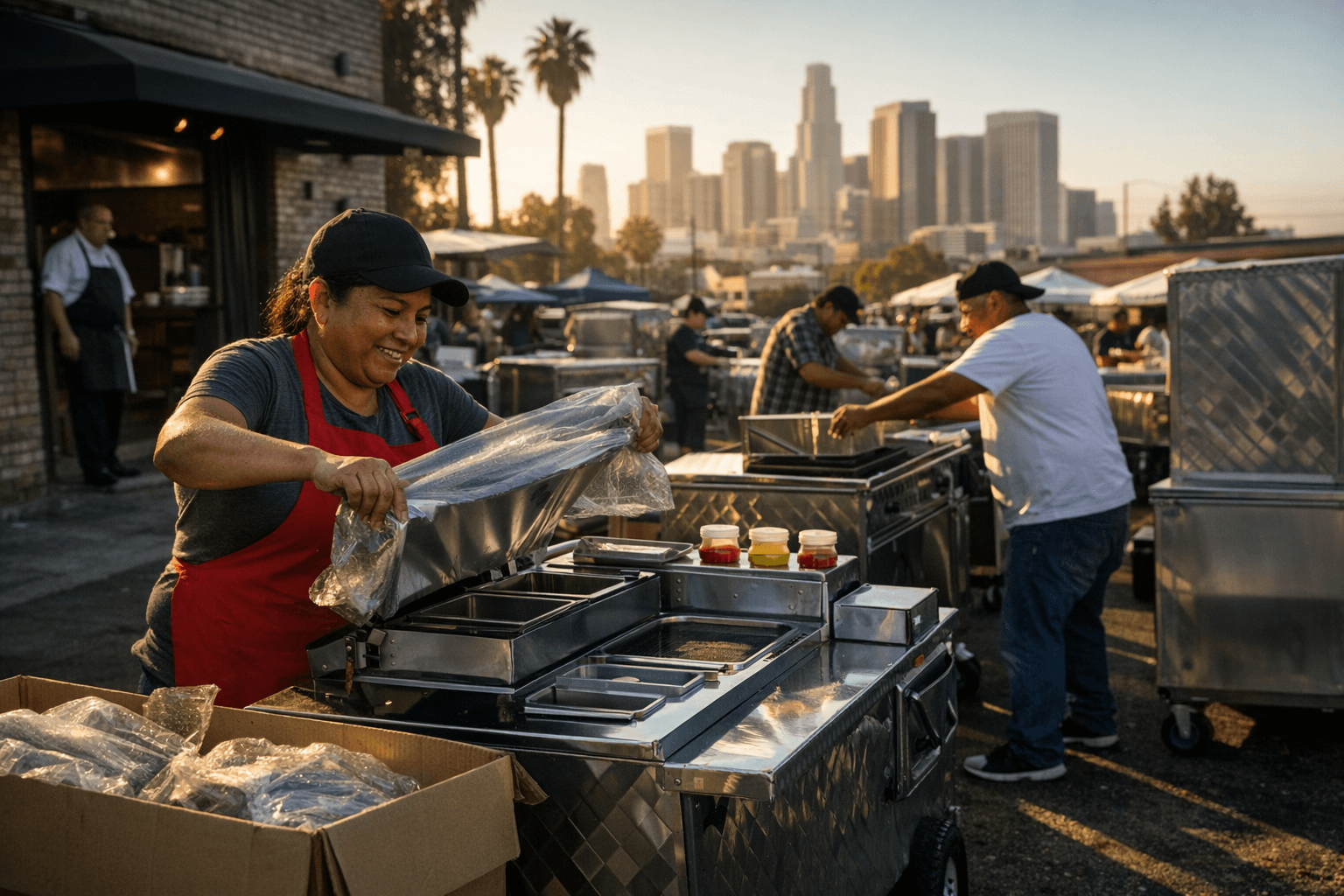
Los Angeles city and county officials are distributing at least 281 health-code-compliant street food carts to sidewalk vendors under a $2.8 million equity initiative designed to pull thousands of informal vendors into the legal economy. For brick-and-mortar restaurant operators, the program reads as one more example of a regulatory system that punishes established businesses while subsidizing the competition.
Andrew Gruel, the SoCal restaurateur who built Slapfish from a single food truck into a chain spanning more than 55 locations across three countries, isn't buying the equity framing. "There's two different sets of rules," Gruel said. "If I were, as a brick-and-mortar business, to do anything outside the regulatory framework of the city — zoning, health standards, wage laws — I'm going to get smashed left and right."
The city and county announced the food cart initiative in January. LA County Supervisor Hilda Solis championed the program, describing it as support for small business growth and economic stability among street vendors who have long operated outside formal permitting structures.
Gruel says he understands the appeal of street vending. He describes himself as an early adopter, running food trucks in Los Angeles in 2010 and 2011 before the city moved to tighten regulations on that industry. "Once the government realized food trucks were popular, they started taxing them like crazy," he said. He eventually pulled his operations from Los Angeles entirely as the regulatory environment tightened.
His critique of the cart program isn't a call for enforcement against vendors. It's a call for consistency. "If you're allowing [food carts] to operate and you're actually encouraging them financially by subsidizing them to operate under the radar, without the regulations, then subsidize brick-and-mortars and decrease their regulations as well," said Gruel, who now serves on the Huntington Beach City Council.
The deeper tension the program surfaces is one the restaurant industry has wrestled with for years in Los Angeles: the cost structure of running a brick-and-mortar operation, where compliance with zoning rules, health inspections, wage laws, and licensing fees is non-negotiable, versus the lighter footprint of informal vending. Gruel argues that subsidizing carts without demanding regulatory parity doesn't legalize the informal economy so much as it codifies a disadvantage for restaurants. "I'm a deregulate guy," he said. "If you're going to give $3 million to food vendors, then give $3 million to brick-and-mortars that are hurt by it."
What the program does not yet answer publicly: who qualifies for the free carts, what the enforcement mechanism looks like for health compliance once carts are distributed, and whether vendors receiving county-supplied equipment will face the same wage and tax obligations as their brick-and-mortar counterparts. Those gaps are precisely what critics like Gruel say make the program feel less like leveling the playing field and more like tilting it.
Know something we missed? Have a correction or additional information?
Submit a Tip