McDonald's Germany Hides Food on Billboards During Ramadan Fasting Hours
McDonald's Germany stripped food from its digital billboards during Ramadan daylight hours, then filled them back at sunset — a 2023 campaign by Scholz & Friends that went viral again this month.
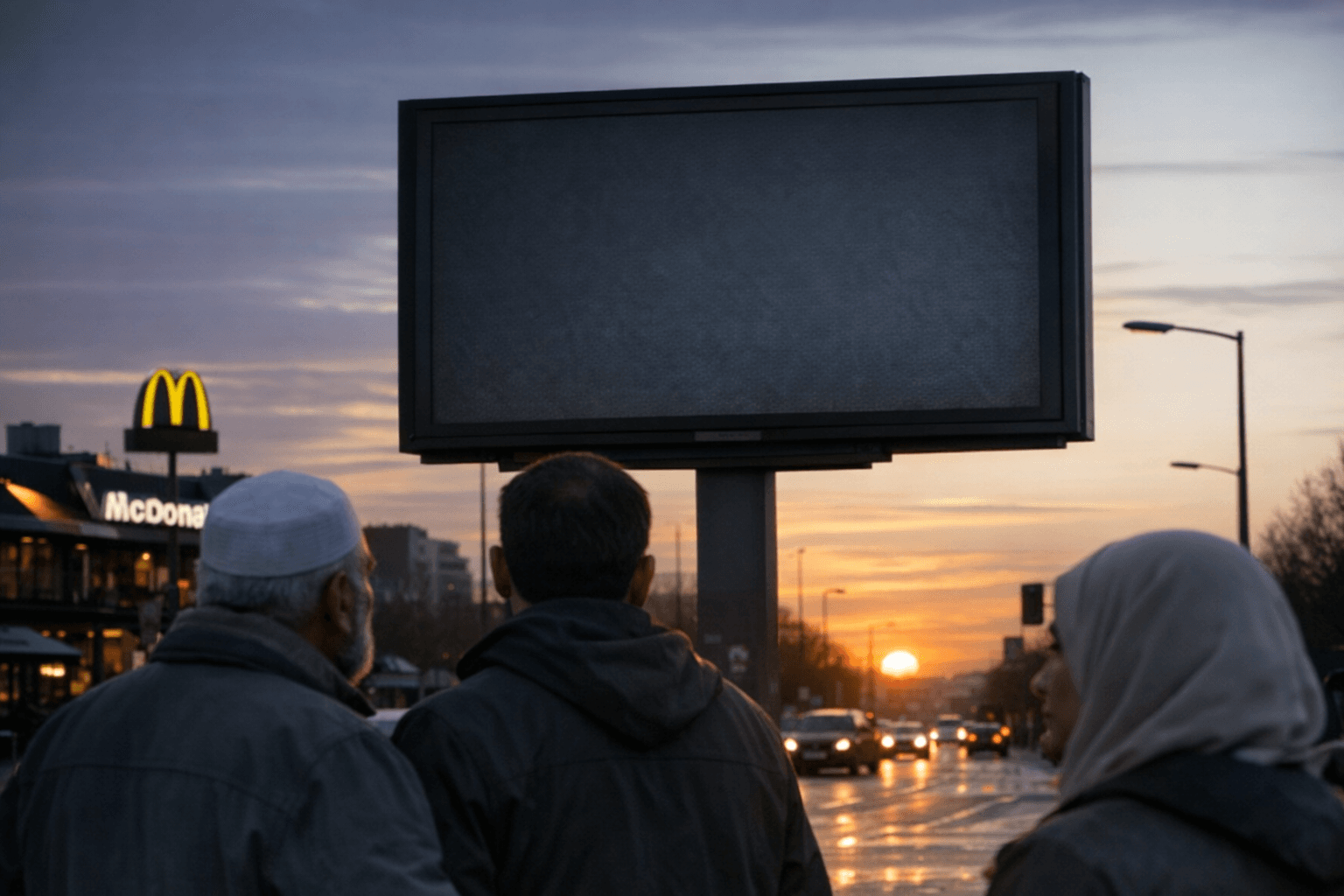
A McDonald's advertising campaign in Germany, in which digital billboards synced with the sun to reveal food only after dark during Ramadan, resurfaced online this month, reigniting a debate that cuts right to the heart of how brands navigate religious culture in a diverse workforce and customer base.
The Digital Out-of-Home posters from 2023 were programmed so that during daylight fasting hours they displayed McDonald's packaging, such as the chain's red-and-yellow fries container and a closed burger box, completely empty. Once the sun set, the same packaging "filled up" in real time, revealing fries and burgers at the exact moment Muslims break their daily fast.
The campaign was created by the German agency Scholz & Friends, whose concept centers on removing McDonald's most recognizable visual element, its food, as a gesture of respect for those observing Ramadan. The billboards carried the greeting "Happy Ramadan" and utilized sun-synced data combined with local prayer times to determine precisely when the transformation occurred.
The mechanics behind the switch were precise. The solution, as Scholz & Friends described it: food is simply removed from the ads until Iftar. The digital OOH campaign is perfectly synchronized with the daily position of the sun, so when the sun rises, the tempting dishes do not appear in the ads. Once the sun set and Iftar began, the visuals transformed automatically, revealing the full range of McDonald's meals and creating a warm, appetizing moment timed to when the audience could finally enjoy food again.
The audience McDonald's was addressing is significant. The initiative used Digital Out of Home technology combined with solar data and local prayer times to adjust the content of the ads in real time, targeting a Muslim population that, at roughly 6.5% of Germany's total, numbers in the millions of potential customers. For the kitchen and service staff inside those same restaurants, many of whom observe Ramadan themselves, the campaign landed as something more than a marketing exercise.
When the original campaign went viral in late February 2026, reaction split sharply. A post from the Threads account Ads With Benefits noting that "McDonald's removed all the food from its own digital billboards" garnered more than 63,000 views. One person remarked, "Germany is a Christian country if I'm not mistaken," while another asked, "What about the majority of people who don't observe Ramadan? This ad campaign makes sense for the Middle East but not the West."
Invidis noted the risk that culturally sensitive campaigns, including what it called Scholz & Friends' award-winning Ramadan concept from 2023, are increasingly misinterpreted through a polarized political lens, and that what was until recently celebrated as considerate, clever and inclusive now carries a different weight in a Europe where cultural debates have become weaponized.
McDonald's Germany moved quickly to clarify the timeline. A spokesperson told Newsweek: "The marketing campaign in question is not a current activation." The company explained at the time that the action did not correspond to a permanent activation, with the motifs shown on a one-off basis in selected locations to mark the beginning of Ramadan. The company also underlined its commitment to diversity and stated that in its German restaurants, employees from more than 160 different nationalities work.
That last detail is worth sitting with. The 160-nationality figure describes, in part, the same line cooks and shift workers who would have been fasting while executing a full service day. The McDonald's campaign demonstrated that cultural relevance does not have to be political; it can simply be thoughtful, empathetic and rooted in an understanding of audience needs. Whether a three-year-old billboard campaign can carry that weight in 2026's political climate is a question the new wave of attention has left wide open.
Know something we missed? Have a correction or additional information?
Submit a Tip